BIO 203 Lecture 17 (Exam 4)
 Call Kai
 Learn
 Practice Test
 Spaced Repetition
 Match
 Flashcards
 Knowt Play
1/25

There's no tags or description
Looks like no tags are added yet.
26 Terms
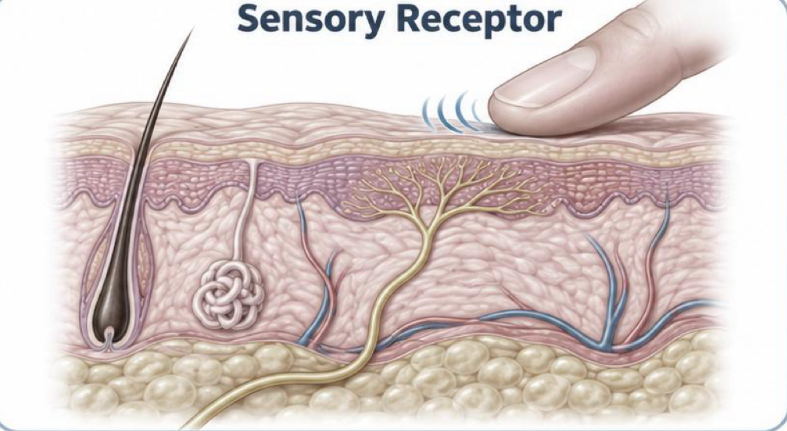
sensory receptor
a specialized cell or nerve ending that detects a stimulus and converts it into an electrical signal

exteroceptors
sensory receptors that detect stimuli from the external environment, such as touch, temperature, light, and sound

sense organ
a structure containing sensory receptors and supporting tissues that help detect specific stimuli, such as the eye or ear

interoceptors
sensory receptors that detect changes within internal organs and tissues, such as stomach stretch and changes in blood pressure
proprioceptors
sensory receptors in muscles, tendons, and joints that provide information about body position and movement

sensory adaptation
a decrease in a sensory receptor’s response over time during a constant stimulus, typically resulting in a decrease in sensory neuron firing rate
rapidly adapting receptors
respond mainly to changes in a stimulus, including its onset and often its removal
slowly adapting receptors
continue signaling during sustained stimulation, although their firing rate may gradually decrease
stronger stimuli
generally produce:
higher firing rates: activated sensory neurons generate more action potentials per second (gentle pressure)
greater recruitment: additional sensory neurons become active (firm pressure)
stimulus transduction
the conversion of stimulus energy into an electrical signal in a sensory receptor
receptor potential
a graded change in membrane potential that can be depolarizing or hyperpolarizing
stimulus transduction that occurs with touch
mechanical energy from pressure → electrical signal, channels open (depolarization)
stimulus transduction that occurs with vision
light energy → electrical signal, channels close (hyperpolarization)
stimulus transduction that occurs with hearing
mechanical energy from sound-induced vibrations → electrical signal, channels opn (depolarization)
thermoreceptors
detect temperature changes (sensing warmth and coolness at the skin)
mechanoreceptors
detect mechanical deformation, including pressure, stretch, and vibration (touch, body position, hearing, balance, blood-pressure sensing, and organ stretch)
nociceptors
detect damaging or potentially damaging mechanical, thermal, or chemical stimuli (a thorn prick or contact with a dangerously hot surface)
photoreceptors
detect light (rods and cones in the retina, which support vision)
chemoreceptors
detect chemical stimuli (smell, taste, and changes in blood O2, CO2, and pH)
why are different receptors specialized to detect specific types of stimuli
to allow precise sensory perception in the skin
free nerve endings in the skin
detect pain (nociceptors), temperature (thermoreceptors), crude touch & are widely distributed in epidermis and dermis
hair receptors (root hair plexus)
light touch (hair movement) & are rapidly adapting
Meissner’s Corpuscles (Tactile Corpuscles)
light touch, flutter, stroking & are rapidly adapting
Ruffini Endings (Bulbous Corpuscles)
sustained skin stretch & are slowly adapting
Pacinian Corpuscles (Lamellar Corpuscles)
high-frequency vibration and rapid changes in pressure & are rapidly adapting
Merkel Discs (Tactile Discs)
steady pressure, texture (fine touch) & are slowly adapting