INTRODUCTIO N TO COGNITIVE PSYCHOLOGY (Part 1)

0.0(0)
Studied by 0 people
call kaiCall Kai
learnLearn
examPractice Test
spaced repetitionSpaced Repetition
heart puzzleMatch
flashcardsFlashcards
GameKnowt Play
Card Sorting

1/13

encourage image

There's no tags or description

Looks like no tags are added yet.

14 Terms

1
New cards

Wilhelm Wundt

(1879) established psychology as a science, focusing on introspection.

<p>(1879) established psychology as a <u><mark data-color="#f6ffc0" style="background-color: rgb(246, 255, 192); color: inherit;">science, focusing on introspection.</mark></u></p>
2
New cards

Behaviorism

(Early 20th Century) Focused on observable behavior, ignoring mental processes.

<p><strong>(Early 20th Century)</strong> Focused on<mark data-color="#eef9c4" style="background-color: rgb(238, 249, 196); color: inherit;"> </mark><u><mark data-color="#eef9c4" style="background-color: rgb(238, 249, 196); color: inherit;">observable behavior, ignoring mental processes.</mark></u></p>
3
New cards

Perception

- How we interpret sensory information (vision, hearing, touch).

<p>- How we <u><mark data-color="#fff9c4" style="background-color: rgb(255, 249, 196); color: inherit;">interpret sensory information</mark></u> <strong>(vision, hearing, touch).</strong></p>
4
New cards

Attention

- How we focus on certain information while ignoring others.

<p>- How we <u><mark data-color="#ffebeb" style="background-color: rgb(255, 235, 235); color: inherit;">focus on certain information while ignoring others.</mark></u></p>
5
New cards

Memory

- How information is encoded, stored, and retrieved (short-term, long-term memory).

<p>- How <u><mark data-color="#ffecda" style="background-color: rgb(255, 236, 218); color: inherit;">information is encoded, stored, and retrieved </mark></u><strong>(short-term, long-term memory).</strong></p>
6
New cards

Language

- How we understand, produce, and use language.

<p>- How we <u><mark data-color="#e2faf8" style="background-color: rgb(226, 250, 248); color: inherit;">understand, produce, and use language.</mark></u></p>
7
New cards

Problem-Solving & Decision-Making

- How we analyze situations and make choices.

<p>- How we <u><mark data-color="#ffe1e8" style="background-color: rgb(255, 225, 232); color: inherit;">analyze situations and make choices.</mark></u></p>
8
New cards

Cognitive Neuroscience

- How brain structures support cognitive functions.

<p>- How <u><mark data-color="#fbecff" style="background-color: rgb(251, 236, 255); color: inherit;">brain structures support cognitive functions.</mark></u></p>
9
New cards

Information Processing Model

- The mind works like a computer, processing information in steps.

<p>- The <u><mark data-color="blue" style="background-color: blue; color: inherit;">mind works like a computer</mark></u>, processing information in steps.</p>
10
New cards

Connectionism (Parallel Distributed Processing)

- The brain processes information through interconnected networks of neurons.

<p>- The brain processes information through<u><mark data-color="#f4ffb8" style="background-color: rgb(244, 255, 184); color: inherit;"> interconnected networks of neurons.</mark></u></p>
11
New cards

Embodied Cognition

- Thinking is influenced by our body and interactions with the environment.
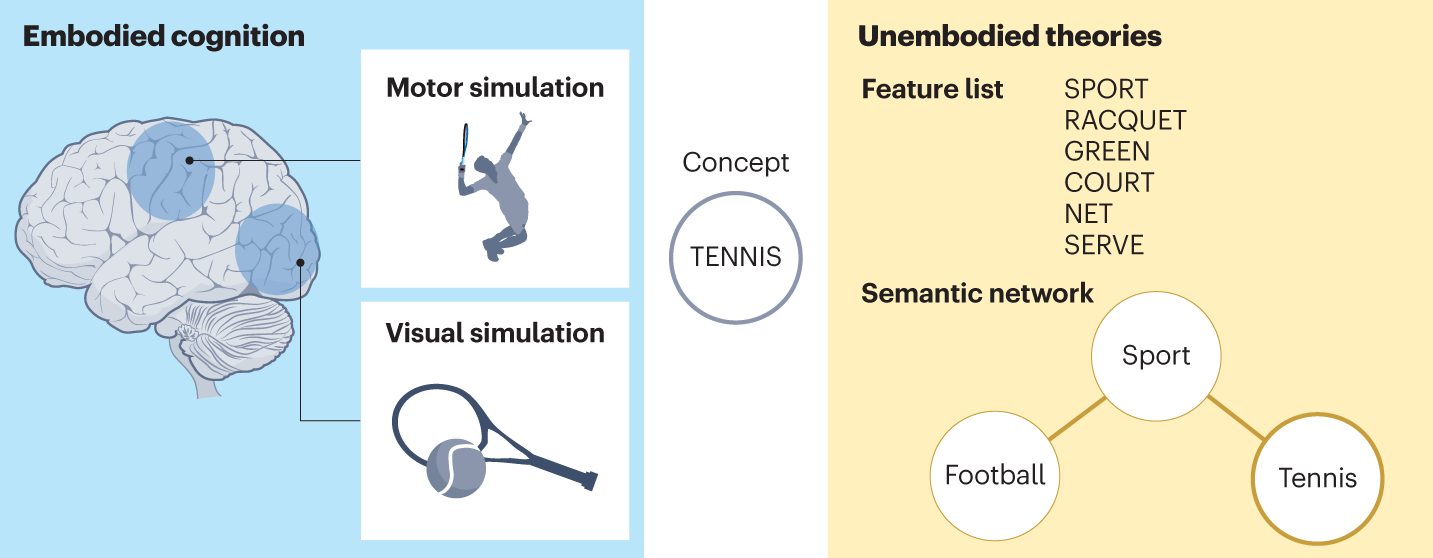
<p>- Thinking is <u><mark data-color="#fffdcb" style="background-color: rgb(255, 253, 203); color: inherit;">influenced by our body and interactions with the environment.</mark></u></p>
12
New cards

Education

Enhancing learning and memory techniques.

<p>Enhancing learning and memory techniques.</p>
13
New cards

Artificial Intelligence

Designing systems that mimic human cognition.

14
New cards

Mental Health

Understanding cognitive disorders like ADHD and Alzheimer's.

<p><u><mark data-color="red" style="background-color: red; color: inherit;">Understanding cognitive disorders</mark></u> like ADHD and Alzheimer's.</p>



