Quasi-Experiments and Small-N Designs
 Call Kai
 Learn
 Practice Test
 Spaced Repetition
 Match
 Flashcards
 Knowt Play
1/45

Earn XP
Description and Tags
Quasi-experiments, case studies and small-N designs (stable and multiple-baseline designs)
46 Terms
What is a quasi/natural experiment?
Nature/society creates groups (PPTs aren’t randomly assigned to conditions)
Start by selecting a quasi-IV + DV → study PPTs who are exposed to each level of the IV
PPTs assigned to IV by external factors (teachers, political regulations, acts of nature, own choices)
RQs around naturally occurring stimuli → draw inferences/conclusions about it
Provides a pseudo-experimental situation → lack experimental control
E.g. Spanish flu/influenza epidemic + the consequences of this on pregnant women
What are the similarities between quasi and correlational studies?
Involve measuring variables (not manipulating them)
Neither use random assignment
Both may use IGD
Vulnerable to similar internal validity threats (e.g. selection effects + lurking variables)
What are the differences between quasi and correlational studies?
Correlational → typically select a broad sample (e.g. a large survey) + measure the relationship between 2 variables within that sample
Quasi → more intentionally select or target specific groups (e.g., states with different laws, people who had surgery vs. those who didn't) to study the effect of a particular "treatment" or event
What is a quasi-independent variable?
Functions like an IV in an experiment BUT isn’t manipulated by the researcher (e.g., a new law, a media event, a policy)
Studies using these variables focus more on potential interventions + causal relationships
Document similarities/differences associated with social identities
What is a participant variable?
Categorical characteristic of a person that is measured, not manipulated (e.g., age, gender, ethnicity, personality type)
Studies using these variables are typically correlational + aim to document differences between groups (e.g., "Do men and women have different rates of organ donation?")
Outline Johnson and Goldstein’s (2003) study. What type of quasi-experiment is this?
Nonequivalent control group posttest-only design
1000s of people die waiting for organ donations → investigated ways to increase number of consented donors in 11 European countries
Framing of organ donation
Opt-in → people must take action (e.g., check a box) to become a donor
Opt-out (presumed consent) → must take action to NOT be one (default options)
Countries with a presumed consent (opt-out) default had consent rates of almost 100%. In contrast, countries requiring an opt-in action had much lower consent rates
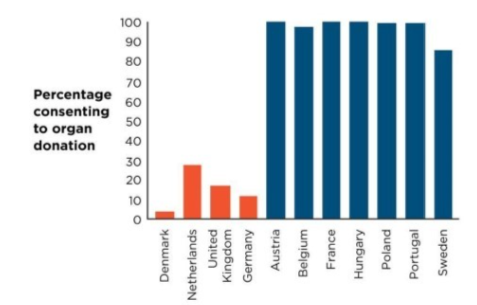
What is a nonequivalent control group posttest-only design?
Nonequivalent control group = PPTs weren’t randomly assigned to live in countries with different laws
Posttest-only = only tested once, after being exposed to their respective default options
Outline Margraft’s et al (2013) study. What type of quasi-experiment is this?
Nonequivalent control group pretest/posttest design
Does cosmetic surgery actually improve body image, self-esteem, and well-being?
Studied ~600 German patients → elected to have plastic surgery
Measured self-esteem, life satisfaction + self-rated attractiveness at:
Before surgery (baseline)
3 months
6 months
1 year after
Compared to 250 PPTs who had registered interest in surgery but decided against it (measured at the same time intervals)
Results
Surgery group's life satisfaction rating increased over the year, while the comparison group's slightly decreased
Surgery group's self-rated attractiveness increased significantly, while the comparison group's decreased
Surgery group's self-esteem score increased over the year, whereas the comparison group's score dropped notably after 3 months + continued to decline

What is a nonequivalent control group pretest/posttest design?
Nonequivalent = PPTs self-selected (into the surgery or comparison groups)
Pretest/posttest = measured both before + after the intervention (surgery)
How did Margrat et al (2013) address selection effects?
Surgery group might be different from the comparison group (e.g., wealthier)
Created matched groups based on age, gender, income, etc. → found similar results
Increased confidence that observed effects were due to the surgery itself (not pre-existing differences)
Outline Alpert’s et al. (2022)study. What type of quasi-experiment is this?
Nonequivalent control group interrupted time-series design
Compared opioid prescription + overdose death rates in triplicate states (more paperwork/regulated) vs nontriplicate states, both before and after OxyContin was introduced in 1996
Test if Purdue Pharma's aggressive marketing of OxyContin played a role
Results
Before 1996 → opioid death rates were similar or higher in triplicate states
After 1996 → deaths climbed dramatically in nontriplicate states where the drug was aggressively marketed, but remained much lower in triplicate states

What is a nonequivalent control group interrupted time-series design?
Nonequivalent control group → states weren’t randomly assigned to be triplicate or nontriplicate.
Interrupted time-series → tracked data over time, with the "interruption" being the introduction + marketing of OxyContin in 1996
Which concepts threatened the internal validity of quasi-experiments?
Selection effects
Observer bias
DMCs
Placebo effects
History threats
Selection-history threats
Attrition threat
Design confounds
Maturation threat
Regression to the mean
Testing threat
Instrumentation threat
What are selection effects?
Threat to IGD
Occurs when the PPTs in one group are systematically different from those in another group before the study begins
What is observer bias?
Occurs when an experimenter's expectations about the study's outcome influence their interpretation of the results
Checkingu for this → ask if the study was blind (person measuring behaviour doesn't know the study's hypothesis) or double-blind (neither the PPTs nor the experimenters know who is in which group)
What are demand characteristics?
PPTs guess the purpose of the study and change their behaviour to align with what they believe the researchers expect
What are placebo effects?
PPTs show improvement because they believe they are receiving an effective treatment (not because of the treatment itself)
Rule this out by including a control group that receives an inert or placebo treatment
What are history threats?
Occurs when an external, historical event happens at the same time as the treatment → unclear whether the outcome was caused by the treatment or the external event
What are selection-history threats?
More specific threat where the historical event affects only one group (the treatment or comparison group) + not the other
What is an attrition threat?
Occurs when PPTs drop out of a study over time
Becomes a threat to internal validity when the dropouts are systematic (a specific type of person is more likely to leave the study)
Can conduct a missing values analysis to check whether PPTs who dropped out were systematically different
What are design confounds?
Occurs when an outside variable accidentally + systematically varies with the levels of the quasi-IV
Would have to test to prove this confound
E.g. show that all presumed consent countries had greater awareness + all opt-in countries did not
What is maturation threat?
Occurs when an observed change could have happened spontaneously over time
Use comparison group to rule this out
What is regression to the mean?
When an extreme outcome, caused by a combination of random factors, becomes less extreme over time
Rule out using pretest scores + question why PPTs were selected (e..g had unsually low self-esteem at the start or just people who visited the clinic)
What is a testing threat?
Type of order effect where PPTs change their behaviour because they have been tested before
Repeated testing could cause scores to improve (practice effect) or decline (fatigue/boredom)
What is an instrumentation threat?
Occurs when the measuring instrument itself changes over time
Eg. if a study uses two different versions of a test, or if human coders change their standards for scoring over the course of the study → could appear that PPTs have changed when they haven’t
How can testing and instrumentation threats be ruled out?
Use comparison group → test the same amount of times
Why do researchers use quasi-experiments despite their vulnerabilities to internal validity threats?
Allow study of important phenomena/events as they naturally occur in the real world
Can take advantage of situations they can’t create/control
Often take place in real-world settings → findings are more likely to generalise to other real-world circumstances/individuals
Enhances external validity (even if some internal validity is sacrificed._
Many RQs would be unethical to study in a true experiment → provide an ethical way to investigate these important questions
How can construct validity (how well the study manipulated/measured its variables) be established in quasi-experiments?
Quasi-IV → ask if the manipulation was successful (e.g., did countries truly have different consent policies?)
DV → how well they were measured (e.g., were the measures of self-esteem reliable and valid?)
How can statistical validity (assessing strength and precision of findings) be established in quasi-experiments?
Effect size → how large were the group differences?
CI → how precise is the estimate of the effect size?
Who was patient HM? What did this case study demonstrate evidence for?
Brain surgery (1953) → removed portions of hippocampus, amygdala + medial temporal lobes on both sides of his brain
Profound anterograde amnesia → can't form new declarative LTM
BUT retained memories from before the surgery + intelligence + personality was intact
Evidence for bio separation of memory types
Couldn't remember new facts or events BUT could remember new motor skills
E.g. learn how to trace a picture by looking in a mirror → no memory of having done it before BUT got quicker at it each time (evidence of learning + memory)
Localisation of function → hippocampus is essential for forming new declarative memories BUT NOT for procedural memory or STWM

What is a small-N design? When is this type of design particularly valuable?
Gathering extensive data from a small number of PPTs (often just 1 or a few) rather than gathering little data from a large group
Useful in clinical + therapeutic settings → determine if a specific treatment works for a specific individual
What are the differences between a small-N and a large-N design?

Other than clinical and therapeutic settings, how can small-N designs be used in real world settings? What is a weakness of this?
Schools, clinics etc to test interventions → importance of internal validity
BUT in a simple "before-and-after" test, it’s hard to prove the treatment caused the change → need specific small-N designs
Which specific small-N design types can be used to determine whether an IV causes a change in a DV?
Stable-baseline designs
Multiple-baseline designs
What is a stable-baseline design?
Involves observing a subject's behaviour for an extended period before introducing a treatment
Record baseline data until the behaviour is consistent (stable) → then intervention introduced
E.g. Ms S (had Alzheimer's) → measured her word recall for several weeks until her performance was consistently low and stable → once the "expanded rehearsal" technique was introduced, her recall improved dramatically
Stable baseline → can confidently attribute the sudden improvement to the new technique rather than random chance or natural recovery

What is a multiple-baseline design?
Staggering the introduction of the intervention across different individuals, times, or situations
More robust method used to rule out coincidental changes
Treatment is applied to Subject A, then later to Subject B + then to Subject C (instead of treating everyone at once)
E.g. helping 3 autistic kids overcome fear of dogs
All three children initially kept a safe distance from a dog.
Therapy (contact desensitization) began for John first, then Sally, then Bob
Each child's fear only decreased after their specific treatment started, not before → confirms that the therapy, not an external event (like seeing a friendly dog elsewhere), caused the behavioural change

How was multiple-baseline designs used across different locations for industrial safety in mining?
Studied accident rates in dangerous strip mine
Introduced token system to reward safety compliance
Introduced at one mine location in 1972 + a different location in 1974)
Injury-related absences decreased only after the token system was implemented at each specific location
Staggered timing ruled out external factors (e.g. new safety laws) + proved the token system caused the reduction in injuries
How did Piaget use a small-N design to develop his cognitive development theory?
Systematically observed his own 3 children -. careful observation + systematic questioning
Found that younger children lack conservation → understanding that quantity remains the same despite changes in shape or appearance
E.g. children believed liquid volume increased when poured into a taller, thinner glass
BUT observer bias → own children + invested in his theory being correct
Apart from stable and multiple-baseline designs, what is another type of small-N design?
Reversal designs = used to test if a behaviour change is reversible, thereby proving the treatment's effectiveness
E.g. Darnell → 18yo autistic who suffered from rumination (regurgitating and re-chewing food) → severe weight loss
Given 3 of his favourite foods during sessions
Based on view that eating + ruminating were incompatible -> f he was eating, he couldn't ruminate
Findings
Baseline: high rates of rumination
Treatment: rumination dropped significantly
Reversal: when favourite foods were withheld, rumination spiked again
Reintroduction: when foods were provided again, rumination dropped

What are the steps involved in conducting reversal designs?
Baseline → measure the problem behaviour without treatment
Treatment → introduce the intervention and measure improvement
Reversal (withdrawal) → remove the treatment to see if the problem behaviour returns
Reintroduction → apply the treatment again to see if the behaviour improves once more
What is a weakness of reversal designs?
Withdrawing an effective treatment (e.g. Darnell's food strategy) can be harmful
For educational interventions (e.g. Ms. S's memory technique), skills once learned usually don’t disappear when the "treatment" stops → ineffective for testing those specific cases
How did Ebbinghaus use a single-N study to develop the forgetting curve?
Was his own PPT
Over several years, he memorized thousands of lists of "nonsense syllables" (e.g., pon, mip) to eliminate the influence of prior knowledge → tested recall at various time intervals
Documented that memory loss follows a predictable pattern
Rapid decline: memory drops dramatically within the first hour and day after learning
Gradual decline: after initial drop, the rate of forgetting slows down significantly, levelling off over days and weeks
Achieved high replicability + experimental precision → established fundamental laws of memory that still hold true today

How is statistical validity attained in small-N studies?
Typically don't use traditional inferential stats (e.g. p-values) → rely on visual analysis of graphs
If the data points in the treatment phase are distinctly different from the baseline phase, the evidence is considered strong
What is a strength of small-N designs?
Experimental control (have generally high internal validity) → can be scientifically rigorous despite small sample sizes
Use control groups (e.g. comparing HM to healthy peers) + carefully designed tasks to isolate specific cog functions
Within-subject designs allow researchers to confidently claim the treatment caused the change, ruling out individual differences
What are the weaknesses of small-N designs? How can they be overcome?
Internal validity
In cases like HM, brain damage is rarely limited to one precise area
E.g. had damage to the hippocampus, surrounding areas + cerebellum (from medication)
Difficult to pinpoint exactly which tissue caused which deficit
External validity/generalisability
Results from unique cases (e.g. surgery patients with epilepsy) may not apply to the general population
BUT
Use triangulation → compare findings from case studies with other methods (e.g. fMRI scans on healthy adults) to confirm theories
Specific populations → researchers often aren't trying to generalise to everyone, but to a specific group (e.g., people with Alzheimer's)
Idiographic value → sometimes, helping just one person (e.g. Darnell) is the primary goal (generalisability is less relevant)
Construct validity
Objective measures (e..g number of words recalled) are easy to measure accurately
BUT subjective measures (e.g. fear behaviours, rumination) need clear operational definitions
Should use multiple observers → interrater reliability