oral health and prevention - unit 3
 Call Kai
 Learn
 Practice Test
 Spaced Repetition
 Match
 Flashcards
 Knowt Play
1/45

Earn XP
Description and Tags
oral physiotherapy
46 Terms
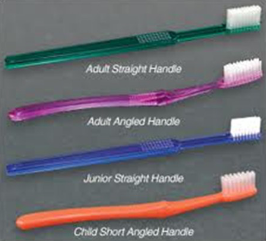
What part of toothbrush designs are considered when determining what design is best for your clients?
Handle length and contour
comfort, access, and age of client
Head size and shape
consider size of mouth, be able to access the last molar
Bristle quality (soft is recommended)
Design of bristles (for various brushing methods)
Manual or electric
client dexterity and their efficiency removing plaque
What is the frequency of brushing based on?
Rate of plaque accumulation
Caries susceptibility
Periodontal involvement
Flossing technique
Diet
Other factors - xerostomia, physical limitations
How many times should an adult with no history of caries brush and floss their teeth per day?
2x per day to maintain their oral health
How many times should a child/adolescent susceptible of caries brush and floss their teeth per day?
3 or 4x a day
Basic principles of sequence for effective removal of plaque include: (3)
Thoroughness
Be systematic, area to area
Time spent and frequency
Brush for 2-3mins minimum
At least twice a day
Technique used
Use technique effectively surface to surface
Use a toothbrush suited to the clients needs
Describe how to care for toothbrushes
Rinse throughly under forceful water to remove particles
Tap handle on sink to remove excess water/debris
Air dry upright
Portable brushes: in clean ventilated container
Replace when bristles splay outward/after 2-3 months/after illness
Length of time a brush lasts depend on toothbrushing technique
Antimicrobial sprays or soaking sanitizers can be used
When recommending toothbrushes to clients what should be considered? (6)
Client dexterity
Oral anatomy
Oral complications present
Tendency of pressure applied
Time spent brushing
Affordability

Describe Bass/Sulcular (manual) brushing technique
• Bristle Angle: Aimed toward the gums at a 45° angle.
• Motion: Small, firm vibratory wiggles directly inside the gumline gap.
• Main Use: Deep cleaning below the gumline and maintaining healthy gums.

Describe Stillman (manual) brushing technique
• Bristle Angle: Aimed toward the gums at a 45° angle, resting half on the tooth and half on the gum.
• Motion: Short, back-and-forth vibrating strokes to the occlusal direction, going down the tooth.
• Main Use: Gum stimulation and managing receding gums.
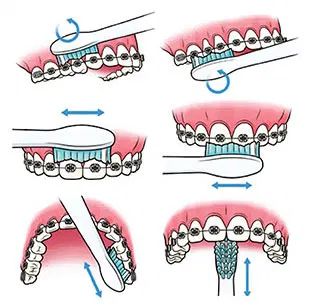
Describe Charters (manual) brushing technique
• Bristle Angle: Aimed away from the gums at a 45° angle, pointing toward the chewing surfaces.
• Motion: Short, vibrating back-and-forth wiggles.
• Main Use: Braces, fixed dental bridges, or cleaning healing surgical sites.
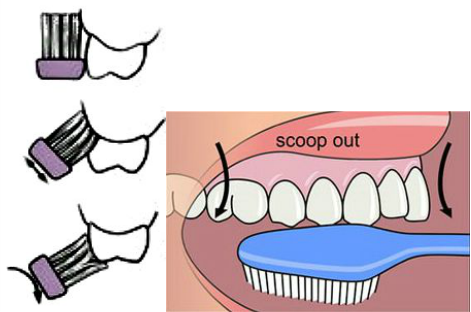
Describe Rolling Stroke (manual) brushing technique
• Bristle Angle: Pointed toward the gums to start.
• Motion: Swept vertically away from the gums toward the chewing edges.
• Main Use: Sweeping away loose plaque, typically paired right after using the Bass or Stillman methods.

Describe Fones (manual) brushing technique
• How to do it: Move bristles in a circular motion on all surfaces.
• Position: Place bristles straight against teeth and gums.
• Best for: Young children with baby teeth. (Not recommended otherwise).

Describe Horizontal Scrub (manual) brushing technique
• How to do it: Move bristles back and forth in short, horizontal strokes.
• Best for: Chewing surfaces only (occlusal surfaces).
• Warning: Do not use on other tooth surfaces. It can cause gum damage (recession) and wear down teeth (abrasion).

Describe Oscillating-Rotations with Microvibrations (electric) brushing technique
• Action: Uses a linear magnetic drive to make the brush head rotate back-and-forth while micro-vibrating.
• Example: Oral-B iO

Describe Oscillating-Rotations (electric) brushing technique
• Action: The entire brush head swivels in one direction, then reverses to the other.
• Examples: Oral-B Genius/Pro/Vitality, Conair Opticlean

Describe Circular (electric) brushing technique
• Action: The entire brush head continuously spins in a single direction.
• Example: Zila Rotadent Procare

Describe Sonic (electric) brushing technique
• Action: Bristles vibrate rapidly side-to-side or up-and-down at high speeds. This creates sound waves that push fluid between teeth.
• Examples: Philips Sonicare, Waterpik Sensonic, Colgate 360°

Why is tongue cleaning important?
Removes plaque accumulations.
If not removed, stains and odor will remain which contributes to halitosis
Makes papilla longer
Encourages more plaque to remain
Some studies indicate that powered toothbrushing is superior. True or False?
True
How to properly use a powered toothbrush (3)
Half bristles on gingival, half on tooth surface
Hold the head over each tooth for at least 5sec, overlapping each tooth
Scrub occlusal surfaces after facial and lingual surfaces
What kind of clients seem to benefit more from using a powered brush than a manual brush? (5)
Physical or mental limitations
Clients with gum or periodontal disease
Clients with dental implants
Orthodontic clients
Parents brushing their children’s teeth
Powerbrushes are recommended for all clients!
What is the primary function of fluoride in dentifrice?
Reduces the risk of caries for everyone.
What is the standard concentration of fluoride in typical toothpaste?
1000 ppm
What toothpaste consideration applies to children under the age of three?
Non-fluoridated toothpastes must be considered
What is the most common and effective fluoride ingredient?
Sodium fluoride
What active ingredient is found in Crest ProHealth & Gum Detoxify, and what is its age restriction?
0.454% Stannous Fluoride
(do not use on children under 12)
What is the function of abrasives in toothpaste?
Reduces/removes stains and calculus build-up
True or False: "Whitening" claims are therapeutic and regulated by Health Canada.
False. It is a cosmetic claim and not regulated by Health Canada.
Which ingredient has lower abrasiveness and is found in Arm & Hammer Enamel Care toothpaste?
Sodium bicarbonate (baking soda).
Which formulation is less abrasive and better for exposed cementum: gels or pastes?
Gels are generally less abrasive than pastes.
Why is the regular use of whitening toothpastes a concern?
They are highly abrasive and often contain peroxide.
What is the function of desensitizing in dentifrice?
Aids in reducing sensitivity
Why does tooth sensitivity usually occur?
Often due to exposed cementum
What are the 4 active desensitizing ingredients mentioned?
• Potassium nitrate
• Strontium chloride
• Stannous fluoride
• Arginine
How long must desensitizing toothpaste be used to see initial vs. full results?
At least 2 weeks for noticeable results
Up to 12 weeks for signs of relief.
What are the two major limitations/rules of desensitizing toothpaste?
1. Not recommended for children under 12.
2. Only effective while actively using the product.
What is the primary function of anti-bacterial dental agents?
Reduces the number of microorganisms
Which two active ingredients are commonly used in anti-bacterial dental products?
• Zinc (e.g., Colgate Total)
• Stannous Fluoride (e.g., Crest Gum Detoxify)
What is the primary function of tartar control agents?
Reduces the buildup of supragingival calculus.
Which two active ingredients are used for tartar control?
• Soluble Pyrophosphates (e.g., Crest Whitening)
• Sodium Hexametaphosphate (e.g., Crest ProHealth)
not recommended for clients under the age of 12
Which type of floss is best for tight contacts and interproximal restorations?
Waxed floss (helps it slip through easily)


What is the main advantage and main disadvantage of unwaxed floss?
• Advantage: More absorbent because fibers splay out.
• Disadvantage: Tends to shred passing through tight contacts.

What is dental tape and when is it indicated?
A broad, flat floss used when regular floss shreds, or where there is recession and bone loss.

What is Superfloss and what are its primary indications?
Floss with a stiff plastic thread end and thick nylon yarn.
Used under fixed bridges, through furcations, and under implant abutments.
Know the difference between the thee embrasure types:
type 1: dental floss
type 2: proxy brush, end tuft, interdental brushes
type 3: proxy brush, end tuft, wooden edge, rubber tip
