Ecology
 Call Kai
 Learn
 Practice Test
 Spaced Repetition
 Match
 Flashcards
 Knowt Play
1/49

There's no tags or description
Looks like no tags are added yet.
50 Terms
Define ‘Organism’
Any individual living thing
Define ‘Species”
A group of organisms that genuinely have the same look, and possess the ability to reproduce and have fertile offspring.
Define a ‘cell”
The unit of life; Is the building block for all living things (organisms)
Define ‘Organic Material’
Made of chemicals, (that are carbon based), that come from living or formerly living things. (e.g. fats, proteins, etc.)
Define ‘Inorganic Materials’
Simple chemicals that don't come from living matter. (e.g. O2, CO2)
Explain what an ecosystem is
Is a community of living and nonliving things.
- Interacts with each other and environment
-Geographic areas are generally small.
-Biotic and abiotic interaction.
Biotic factors are..
Is any living component. (e.g. animals, plants/algae, organic remains, etc.)
An abiotic factor is..
Is any non-living or chemical part of the environment. (e.g. temperature, sunlight, rainfall, pH, wind, etc.)
A habitat is…
Is the environment where an Organism lives and grows. (e.g. desert)
A population is…
Are the total set/members of one species living in a particular area at a given time.
A community is…
Are all the populations of different species living in a particular area of a given time (biotic).
List the level of complexity
Individual. Population. Community. Ecosystem.
What is a producer?
Is an Organism which makes their own food via photosynthesis, instead of eating other animals. (e.g. all plants + algae)
AUTOTROPHS
What is a consumer?
Is an Organism that can't make their own food and must eat other living things for energy.
-Primary consumers, (first order), eats plants.
HETEROTROPHS
What is a decomposer?
Is an Organism which breaks down dead plants, animals and their waste materials, into simpler substances to return nutrients back to the soil. (e.g. fungi, bacteria, etc.)
-turns organic material, inorganic
-Recycles wastes to be used for materials by producers
HETEROTROPHS
What is earth’s 4 systems?
Biosphere (life), Atmosphere (gases, clouds, air..), Lithosphere / Geosphere (land), and Hydrosphere (water)
-Within these systems different nutrients are cycled through, (e.g. carbon, nitrogen, phosphorus, water, etc..)
What is the Carbon cycle?
Is Earth's process for reusing carbon atoms; moves them through 4 systems.
- CO2 is absorbed by plants via photosynthesis.
-CO2 is used to make glucose. Animals then eat plants, and then will get this glucose
-CO2 released back into air via respiration
How does CO2 move around the biosphere?
Almost all organic materials contain carbon; Is needed to build DNA, proteins, sugars and fats.
Moves through four ways.
PHOTOSYNTHESIS: Absorbs CO2, converts sunlight into glucose (plants)
FOOD WEBS: Animals eat each other or plants, which passes CO2 compounds
RESPIRATION: Organisms release CO2 back to the atmosphere or water
DECOMPOSITION: Breaks down stuff; returns CO2 to the soil and air
Explain photosynthesis
Is when plants take in CO2 and H2O and react in the presence of light (solar energy) to produce glucose and oxygen.
Plants use a green pigment, chlorophyll, which is located in the chloroplasts of the plant cells, to capture sunlight. It is then converted into chemical energy, in the chemical bonds of glucose; oxygen is a byproduct.
What is the equation for photosynthesis?
refer to photo

Diagram of carbon cycle
refer to photo
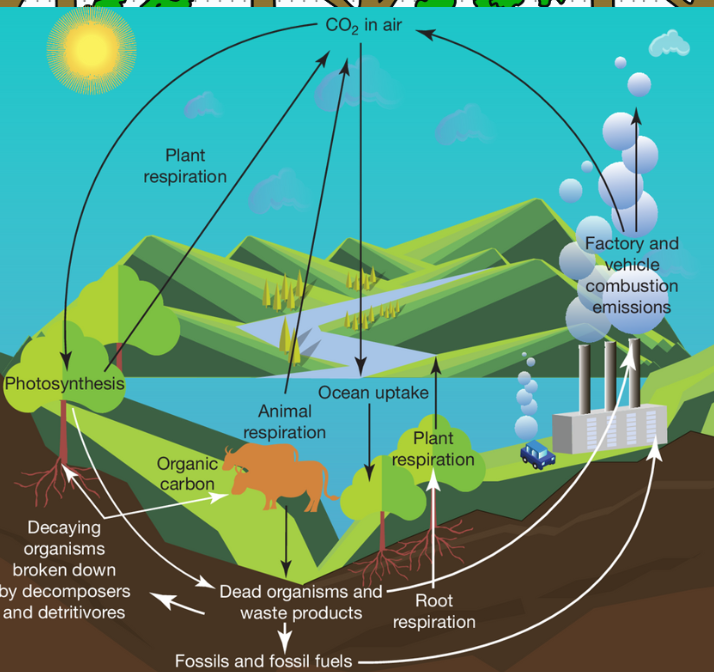
What is cellular respiration?
Is the metabolic reaction that converts nutrients (glucose) into energy (ATP).
If there is no O2 gas, organisms undergo anaerobic respiration (fermentation).
Are photosynthesis and cellular respiration linked? justify your answer
Cellular respiration and photosynthesis are linked. Both have water and carbon circulating constantly, and photosynthesis produces glucose and oxygen (needed in cellular respiration), while cellular respiration produces CO2 and water (needed in photosynthesis).
What is the equation for cellular respiration?
refer to photo

Explain the energy pathway
Refer to worded or diagram version:
Plants absorb light energy from the sun and convert it to the chemical energy of glucose in chloroplasts.
All organisms break down the glucose to produce energy (ATP) which can then be used in cellular processes.
The inputs of photosynthesis are carbon dioxide and water; the outputs are glucose and oxygen.
The inputs of cellular respiration are glucose and oxygen; the outputs are carbon dioxide.

How does carbon get into the hydrosphere?
Includes all water on Earth, (underground, ice, or in the atmosphere). When CO2 and H2O interact, it forms carbonic acid. Carbonic acid is dissolved in water.
How does carbon get into the biosphere?
Carbonic acid can be used by marine organisms to build shells. Too much acid causes ocean acidification. Carbon enters the biosphere primarily through photosynthesis carried out by plants.
What is ocean acidification?
Is the decrease in pH of the Earth's oceans. Carbonic acid releases hydrogen ions, which increases acidity. Effects: dissolving shells of wildlife, disrupted food chains, etc.
How does ocean acidification affect coral bleaching?
Ocean acidification DOES NOT cause coral bleaching, (which is when heat stress causes corals to expel the colorful algae on them.) Instead, it dissolves coral skeletons, making it harder to repair themselves where they become likely to die. Bleached corals aren't dead but more of risk of starvation and disease.
How does carbon get into the lithosphere?
Carbon gets into the soil through decomposition of a dead Organism. These can be compressed into limestone, marble, diamond, etc.
Over millions of years, these deposits can turn into fossil fuels such as oil, gas, coal, etc. Burning fossil fuels releases carbon back into the atmosphere as CO2.
What is combustion?
Combustion is the process of burning carbon-based materials in the presence of oxygen to release CO2, water vapor, and heat.
When fossil fuel is combusted, it quickly reacts with O2 to produce heat. By burning fossil fuels, humans have contributed to an increase of CO2 in the atmosphere.
Since 2000s: CO2 increased by 12%
since 1800s: CO2 increased by 70%
What is the formula for combustion?
refer to image

How have humans impacted the CO2 emissions?
Humans have disturbed the balance of the carbon cycle through activities like burning fossil fuels, deforestation, increased use of plastics, and plastic waste.
How has deforestation impacted the carbon cycle?
Deforestation creates less trees, meaning it's harder for CO2 to be absorbed by trees via photosynthesis, allowing for an increased count of carbon in the atmosphere.
How has mining released CO2?
Some mining activities produce lots of CO2, such as destroying rocks with carbon gaps and machines that use fossil fuels.
How has plastic use and waste effected the carbon emissions?
Plastics are produced from crude oil, a type of fossil fuel, when burned, releases CO2 back into the atmosphere. Use machines that run on fossil fuels.
Has been dumped into oceans, destroying populations of small animals and plants. Plastic can break down into nano plastics dispersed by wind and can end up in bodies.
How does carbon get into the atmosphere?
Can get into the atmosphere naturally via wildfires, cellular respiration, decomposition, etc.
How does carbon leave the hydrosphere?
Leaves hydrosphere when water is warm; it holds less dissolved gas.
Scientist’s data
Scientists have created methods to access the number of different species in an area, size of local population, health of a population, and presence of introduced disease(s). Determines if a species is stable or under threat.
What is ‘species abundance’?
Refers to the number of individuals of a particular species in an area.
It's not probable to count all organisms, so scientists use techniques to form an estimate. 2 common techniques are:
-Quadrats (plants)
-Capture-mark-recapture (animals)
What is a quadrat?
Is a shape (typically a square) with a known error used to sample plants. All individuals in the quadrat are counted, or the percentage of coverage is estimated.
Useful to estimate large areas.
20% of the total area should be sampled for accuracy.
Quadrats can be divided into smaller grids for easy area estimations.
Tips for sampling?
Is a shape (typically a square) with a known error used to sample plants. All individuals in the quadrat are counted, or the percentage of coverage is estimated.
Useful to estimate large areas.
20% of the total area should be sampled for accuracy.
Quadrats can be divided into smaller grids for easy area estimations.
opt for one of the grids in photo

What is Capture-Mark-Recapture?
Used to get an estimate of population size of a mobile species (animals). Uses a sample of the species that has been captured, tagged (marked) and then released. Sometimes later another sample can be captured from the same population.
What is the formula for Capture-Mark-Recapture?
Refer to photo

What is the greenhouse effect?
The process where the gases in the Earth's atmosphere absorb and trap heat from the sun, acting as a warm blanket.
-This keeps Earth's surface temperature warm to keep the planet livable.
-The most common greenhouse gases are water vapor, CO2, and methane.
What is the enhanced greenhouse effect?
Is the warming/excess heat being trapped in the atmosphere due to the increased concentration of CO2 and methane being produced by human activities.
Examples of human activities that produce CO2
-burning fossil fuels
-machines using fuel
-mining
Examples of human activities that produce CH4 (Methane)
-Agricultural (during cattle and sheep’s digestions)
-Fossil fuel extractions
-Decomposition in landfills
-Wastewater treatments
What is the evidence of global warming?
-Rising global temp.
-Higher ocean temperature (creates heat stress and more coral bleaching events)
-Longer Bush fire seasons and more intense fires
-Land ice melting and shrinking glaciers
-Intensified rainfall in some regions
-Lack of rain and drought in other regions.
What are the impact of global warming?
Infrastructure costs have risen due to lack of resources and bushfires.
Agricultural less suitable land for farming. Higher costs, less food and water.
Health. diseases from tropical regions have been found in colder areas. Air pollution can lead to respiratory issues.
Cultural, floods and fires have created the loss of many cultural sites. The dry areas are hard to visit due to high heat.
Droughts are happening more frequently and longer around the world. Bush fire seasons are longer and more intense due to the hot, dry climate