BIO1 MIDTERM: TOPIC 1 Microscope (Parts and Functions)
 Call Kai
 Learn
Learn Practice Test
 Spaced Repetition
 Match
Match Flashcards
 Knowt Play
1/26

There's no tags or description
Looks like no tags are added yet.
Name | Mastery | Learn | Test | Matching | Spaced | Call with Kai | Chat |
|---|
No analytics yet
Send a link to your students to track their progress
27 Terms
Microscope
An instrument that produces magnified images of tiny structures.

Eyepiece (Ocular Lens)
The top lens closest to the viewer's eye used to look at the specimen, commonly in 10X or 15X magnification.

Eyepiece Tube
The holder that carries the eyepiece directly above the objective lens.

Diopter Adjustment
A control knob on binocular microscopes used to adjust focus on one eyepiece to compensate for vision differences between eyes.

Nosepiece (Revolving Turret)
A movable circular structure holding the objective lenses that rotates to change magnification.

Objective Lenses
The lenses closest to the specimen (typically 4X, 10X, 40X, and 100X) that provide primary magnification.

Coarse Adjustment Knob
(1) A large knob used for rapid stage movement to focus images under low power magnification.

Fine Adjustment Knob
(2) A smaller knob used to sharpen and fine-tune image focus, especially under high power magnification.

Stage
The platform where the specimen slide is placed and held in position by stage clips.
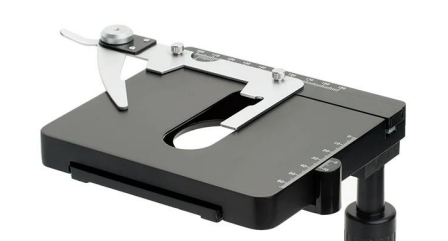
Stage Control Knobs
Mechanical knobs used to move the stage left, right, forward, and backwards.

Aperture
The opening in the stage through which light passes to reach the specimen.

Illuminator
The light source (such as a lamp or mirror) that provides illumination for the sample.

Condenser
Lenses located beneath the stage that gather and concentrate light from the illuminator onto the specimen.

Diaphragm (Iris)
An adjustable mechanism under the stage that controls the intensity and size of the light beam reaching the specimen.

Condenser Focus Knob
A knob that moves the condenser vertically to control the focal concentration of light.

Abbe Condenser
A specialized condenser in high-quality microscopes allowing magnification beyond 400X.

Rack Stop
A safety stop mechanism that prevents the stage from rising too high and damaging the objective lens or slide.

Light Switch
An electrical switch used to turn the illuminator on and off.

Brightness Adjustment
A control mechanism regulating the voltage to adjust light intensity.

Scanning Objective
Observing larger specimens, getting a general sample overview, and locating areas of interest for higher magnification.

Low Power Objective (LPO)
An objective lens providing a wider field of view.

High Power Objective (HPO)
An objective lens providing greater magnification and finer detail over a smaller area.

Oil Immersion
Examining microscopic structures and observing details at the cellular level. A drop of oil to be placed on the specimen for optimal performance.
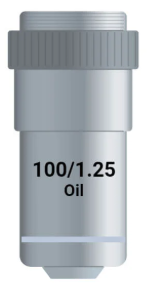
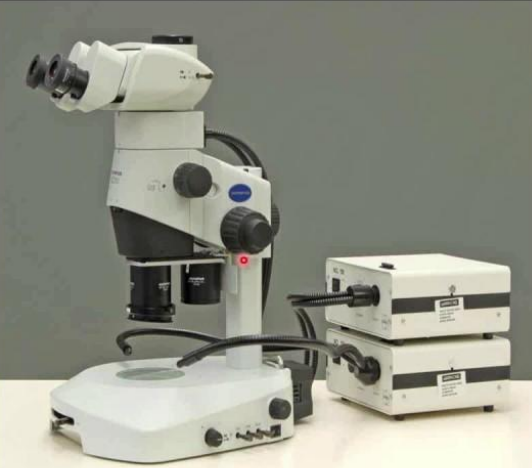
Stereo Microscope (Dissecting Microscope)
A microscope using two optical paths to produce a 3D image of solid specimens at lower magnification.
FoV
How much of the speciman we can see through a microscope.
Field Number
Diameter of the image area that can be observed through an eyepiece.
On the eyepiece beside the magnification
Where is the Field Number inscribed?