Midterm 1 Syllabus Readings PLSC 1413
 Call Kai
 Learn
Learn Practice Test
 Spaced Repetition
 Match
Match Flashcards
 Knowt Play
1/15

There's no tags or description
Looks like no tags are added yet.
Name | Mastery | Learn | Test | Matching | Spaced | Call with Kai | Chat |
|---|
No analytics yet
Send a link to your students to track their progress
16 Terms
Shelby Grossman
In informal markets in Lagos, Nigeria, some market leaders provide public goods (utilities, conflict resolution, and negotiation with local governments) to vendors in market associations, but can also be others are predatory and exploit vendors.
Argument: Threats from the state, (market renovations, police interference) give incentives to for market vendors to cooperate and for market leaders want support to organize a response thus incentivizing better governance
Significance: a mixed government equilibrium can occur where the state exists in parallel with structures that actually provide public goods
Charles Tilly
States could be viewed as extortion or protection rackets.
The state trades security for revenue.
The difference is that the seller of security represents a key threat to the buyer’s continued security.
Legitimacy matters: state vs. cartel
“bellicist” argument: war makes the state and the state makes war
mechanism: high population density → conflict over land → war (survival by conquering and investing in war machine, impetus to build-up institutions to fund the state) → state formation
state making = the elimination of internal rivals and the development of the capacity to extract resources
The modern state did not rise intentionally, but as a by-product of leaders’ attempts to survive and control territory. Needed resources to fund war, convince people in territory to fund war by making concessions (often protection) and restraint of predation,
By regulating their predatory instincts, rulers could increase their net extractive capacity: “Mercantile (merchants and trade, pre-industrial) capitalism and state making reinforced each other”
states developed different levels of capacity depending on how they obtained the resources needed for warfare.
“If outside states guarantee a country’s boundaries, then there is no forging of mutual constrains between rules and ruled.”
Jeffery Herbst
State failure because population density was low and land was abundant in Africa, so no conflict over land or impetus to build-up institutions to fund the state
(European colonial powers had no incentive to invest in the state. They focused on commercial exploitation and outright plunder of the mineral and natural wealth.
Following independence, the international system enforced the colonial boundaries.
applies case colonialism to Tilly’s argument to explain African state capacity)
James Robinson
the bellicist theory is the wrong framework to analyze post-colonial countries
disagrees with Tilly and Herbst population component
the opposite is true: Prior to 1415 areas with higher population density had more
developed states
a reversal of fortunes took place due to colonial powers + European pre-colonial expansion
European expansion shaped pre-colonial institutions
• Political and social institutions in Africa were formed and transformed as a consequence of the Atlantic slave trade (almost 200 years before formal colonization took place in Africa)
• States did not form to provide public goods, but to predate on their own people.
ALSO
dutch east india company: Instead of building stronger states, external commercial exploitation could weaken local economies and reduce rulers’ ability to raise revenue.
Miguel Angel Centeno
In Latin America, the relative absence large-scale inter-state of wars explains the fragility of the state
because internal conflicts outweighed external threats → no impetus to build state capacity
thought-of as “leviathan” strongman states but actually weak capacity
also went into debt to finance the state → less pressure to build own strong fiscal system (state-building when global financial system already exists, thus govt doesn’t have to make concessions to capitol owners)
affirms Tilly’s bellicist argument
Robert Dahl
proposed a procedural view of democracy with 2 dimensions:
Contestation captures the extent to which citizens are free to organize themselves into competing blocs in order to press for the policies and outcomes they desire.
Inclusion has to do with who gets to participate in the organize themselves into competing blocs in order to press for democratic process.
polyarchy = political regime with high levels of both contestation and inclusion (says no country is a perfect polyarchy)
Georgina Waylen
Orthodox definitions of democracy consider political citizenship, and not social and economic inequality. “Only if women were denied the vote, and perhaps not even then, would gender relations become relevant”
Then definitions of democracy sideline inequalities
not solely top-down or bottom-up transition typology, role of women is more apparent in the early stages of social movements (even if appears elite-led)
Anne Meng
Anne Meng argues that authoritarian regimes are more stable when executive constraints create credible power-sharing, because elites with real influence have incentives to support the regime, while formal rules like term limits alone cannot reliably constrain an autocrat.
Meng argues that authoritarian regimes are more stable when institutions create credible power-sharing, because formal rules like term limits cannot constrain autocrats unless elites have real power to hold them accountable.
executive constraints are rules and institutions that limit an autocrat’s power, such as term limits, succession procedures, and power-sharing arrangements that give elites real influence over the leader.
Why: Credible power-sharing makes a regime more stable because elites have a real stake in the government and are less likely to try to overthrow the autocrat.
Stable means: The regime is likely to survive over time without a coup, leadership crisis, or collapse.
focuses on one attribute: executive constrains (executive term limits and formal succession procedures). Her data does not show a decline
an autocrat CANNOT credibly promise to respect the term limits specified in the country's constitution.
proposed to classify non-democracies according to how institutionalized they are
Anne Meng argues that giving the opposition positions of value in the cabinet would be a more credible way to share power and tie the autocrat’s hands.
Kapstein and Converse
Kapstein and Converse argue that young democracies face greater political and economic instability because young democracies often face poverty, inequality, commodity dependence, and social fragmentation combined with weak institutions, making it harder for leaders to make credible promises to the electorate, often encouraging clientelism and political business cycles.
Clientelism: Politicians provide individual benefits (such as jobs or money) in exchange for political support or votes.
Political business cycles: Politicians manipulate the economy, often by increasing spending before elections, to improve their chances of reelection.
younger democracies are different. Their initial conditions are challenging:
• Poverty,
• Inequality,
• Economic dependence on small range of commodities,
• High levels of social fragmentation.
Leaders of young democracies may have difficulty making credible promises to their electorate; it takes times to develop democratic institutions, often face weak institutions. Efforts to build trust may lead to clientelism and political business cycles.
The political and economic performance of young democracies is more volatile. (dependent on circumstance, international system)
Barbara Geddes
proposed classifying non-democracies according to who rules (typologies - IRL usually mixed)
• military (ruled by a military junta),
• party-based (rules by a single authoritarian party),
• personalist (ruled by a charismatic figure).
Party regimes last longer because a ruling party can enforce agreements among authoritarian leaders and elites, while in other regimes leaders have no reliable way to guarantee that elites will honor their bargains or that leaders themselves will keep their promises.
Personalist regimes: One leader concentrates power and weakens independent institutions, making the regime heavily dependent on that leader and making succession more difficult.
Military regimes: Officers share power and care about protecting the military as an institution, so they may give up governing if politics threatens the military’s unity or reputation. (LEAST LIKELY TO ENDURE)
Nancy Bermeo
Bermeo argues that since the Cold War, democratic backsliding has shifted from overt coups and election fraud toward gradual, seemingly legal tactics like executive aggrandizement and electoral manipulation. Democratic backsliding is often legitimated by the very institutions democracy promoters prioritize.
Democratic backsliding (meaning the state-led debilitation or elimination of the political institutions sustaining an existing democracy) has changed dramatically since the Cold War. Open-ended coups d’état, executive coups, and blatant election-day vote fraud are declining while promissory coups, executive aggrandizement and strategic electoral manipulation and harassment are increasing. Contemporary forms of backsliding are especially vexing because they are legitimated by the very institutions democracy promoters prioritize but, overall, backsliding today reflects democracy’s advance and not its retreat. The current mix of backsliding is more easily reversible than the past mix and successor dictatorships are shorter-lived and less authoritarian.”
Nancy Bermeo argues that modern democratic backsliding is usually gradual and strategic, with leaders weakening democratic institutions through seemingly legal changes that attract less criticism than overt coups. These changes can appear justified when old institutions are corrupt, and although democracies still break down, the resulting authoritarian regimes tend to be less authoritarian and shorter-lived than in the past.
“Democratic backsliding is the state-led debilitation or elimination of any of the political institutions that sustain an existing democracy.”
The current forms of backsliding are slower, appear legal: “strategic” in that international (and often domestic) observers are less likely to catch or criticize it
Sometimes reforms “cut through the old order with ‘a democratizing edge” → old institutions corrupt/undemocratic, so present democratic backsliding may appear justified
Changing voters’ preferences is a difficult and long-term project.
There has been a marked decrease in the length of time that a country with a toppled democracy stays autocratic. Moreover, the dictatorships that follow failed democracies today are, on average, less authoritarian than their predecessors
Steven Levitsky and Daniel Zibllatt
litmus test to identify would-be autocrats before they come to power
rejection of democratic rules
denial of the legitimacy of political opponents
tolerance or encouragement of violence
readiness to curtail civil liberties of opponents, including media
democracies depend on robust unwritten norms for checks and balances
institutions can become political weapons wielded by those who control them
current backsliding worse with polarization (because political parties and civil society must actively resist leaders who try to undermine democracy)
Monica Nalepa
Nalepa argues that authoritarian regimes may agree to an amnesty-for-elections pact, but once the opposition wins, it can renege and pursue transitional justice. Regimes can reduce this commitment problem by infiltrating the opposition with collaborators, making post-transition punishment less likely. The old regime can reduce this commitment problem by placing its collaborators within the opposition, giving the opposition an incentive to prevent the new government from punishing former regime officials.
Timur Kuran
relies on “compliment” logic: citizens public preferences for regime change are conditional on their beliefs concerning other citizens’ support for the regime
as individuals reveal their preferences, the regime sometimes tips from autocracy to democracy almost overnight:
in a revolutionary cascade, more and more people fulfill individuals’ evolutionary thresholds needed to participate
bottom-up transition
Our inability to observe private preferences and revolutionary thresholds conceals potential revolutionary cascades and makes revolutions impossible to predict: “predictability of unpredictability”
Adam Przeworski and Fernando Limongi
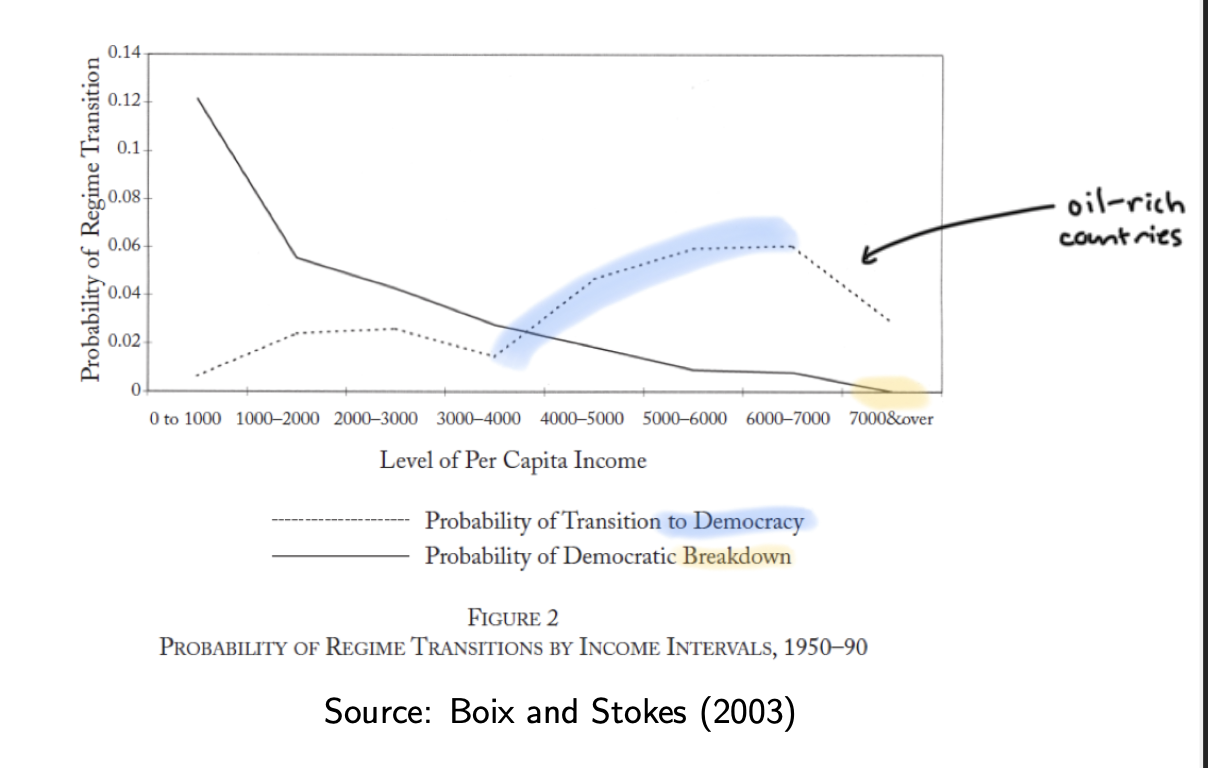
Przeworski and Limongi argue that democracy does not necessarily produce faster economic growth than authoritarianism, and that democracy can emerge independently of economic development. However, economic development helps democracy survive: in their data, no democracy collapsed when per-capita income exceeded $6,055.
(argues that democracy is established independently from economic development
BUT, democracy is more likely to survive (and emerge) as countries develop and become richer
no democracy has ever fell in a country with a per capita income higher that $6,055)
Adam Przeworski
Minimalist view of democracy: Rulers are elected and turnover in power is peaceful.