[CV] Lecture 4: Camera Calibration
 Call Kai
 Learn
Learn Practice Test
 Spaced Repetition
 Match
Match Flashcards
 Knowt Play
1/268

There's no tags or description
Looks like no tags are added yet.
Name | Mastery | Learn | Test | Matching | Spaced | Call with Kai | Chat |
|---|
No analytics yet
Send a link to your students to track their progress
269 Terms
Q1. What does camera calibration try to determine?
A: The camera parameters that describe how a 3D world point becomes a 2D image pixel.
Q2. What are the two main groups of camera parameters?
A:
Intrinsic parameters: K
Extrinsic parameters: R,T
Q3. What are intrinsic camera parameters?
A: Parameters describing properties of the camera itself, including its lens and sensor.
Q4. What intrinsic parameters are contained in K?
A:
Focal length
Principal point
Skew
Q5. What are extrinsic camera parameters?
A: Parameters describing the camera’s rotation and position with respect to the world.
Q6. What do R and T represent?
A:
R: rotation
T: translation/position
Q7. What is the goal of camera calibration in terms of K,R,T?
A: Recover K,R,T for a camera so we can reason precisely about the 3D world from its images.
Q8. Why must camera calibration be done before multi-view geometry?
A: Multi-view geometry assumes the camera’s intrinsic and extrinsic parameters are already known.
Q9. What can structure from multiple views be used to compute?
A: The 3D coordinates of a point seen in two or more images.
Q10. What else can be recovered from point correspondences between multiple images?
A: The cameras’ relative pose.
Q11. What does calibration provide for multi-view geometry?
A: The required numerical values of the camera’s intrinsic and extrinsic parameters.

Q12. What is the basic idea behind most camera calibration methods?
A: Show the camera an object whose 3D geometry is already known, then observe where its known features appear in the image.
Q13. What is a commonly used calibration target?
A: A planar checkerboard.

Q14. How is a checkerboard normally used for calibration?
A: It is photographed from several different positions and orientations.

Q15. Why is a checkerboard useful for camera calibration?
A: Its real-world corner positions are known in 3D, while the same corners can be detected in the image in 2D.
Q16. What type of data does a calibration checkerboard provide?
A: Many 3D→2D point correspondences.
Q17. What can be solved from enough 3D→2D correspondences?
A: K,R,T.
Q18. What is the formal definition of camera calibration?
A: Determining:
Intrinsic parameters K
Lens distortion
Extrinsic parameters R,T
Q19. Is lens distortion initially included in the calibration derivation in these slides?
A: No. Lens distortion is temporarily neglected and introduced later.
Q20. What is the perspective projection equation used for calibration?
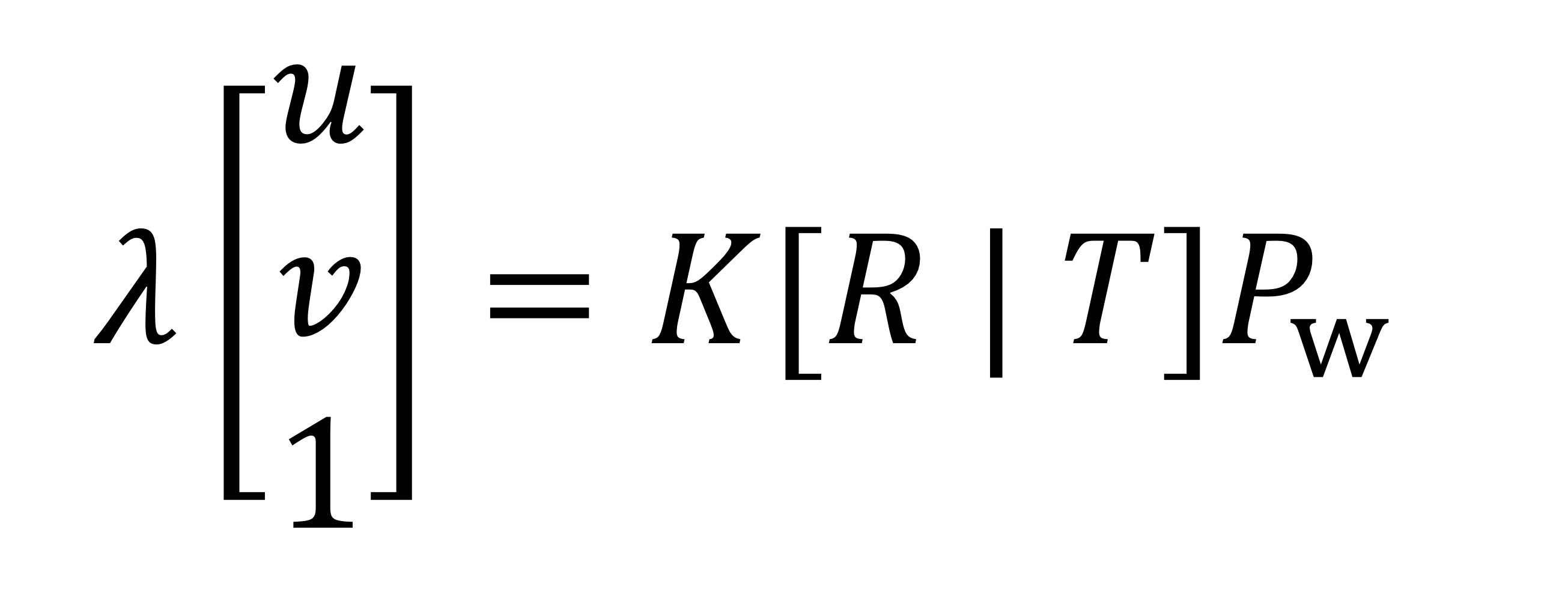
Q21. What does (u,v) represent in the projection equation?
A: The 2D image coordinates of the projected point.
Q22. What does \lambda represent in the projection equation?
A: An unknown scale factor associated with homogeneous coordinates.
Q23. How is a 3D world point P_w written in homogeneous coordinates?

Q24. What are the two major calibration methods introduced in the lecture?
A:
Tsai’s method
Zhang’s method
Q25. What type of calibration object does Tsai’s method use?
A: A 3D calibration object containing known non-coplanar 3D points.
Q26. What type of target does Zhang’s method use?
A: Multiple views of a planar grid, such as a checkerboard.
Q27. Which calibration method is commonly used in MATLAB and OpenCV today?
A: Zhang’s method
Q28. When was Tsai’s camera calibration method proposed?
1987
Q29. How many control points does Tsai’s method require?
A: At least n >= 6 control points.
Q30. What information must be known for each control point in Tsai’s method?
A:
Its 3D world coordinates
Its 2D image coordinates

Q31. How are the 2D coordinates of control points obtained?
A: Through image processing, such as corner detection.

Q32. How are the 3D coordinates of control points known?
A: Because the calibration object is deliberately built with known dimensions and known control-point positions.

Q33. Are the calibration points in Tsai’s method generally coplanar?
A: No. They should be non-coplanar.
Q34. What does DLT stand for?
Direct Linear Transform
Q35. What is the main idea of DLT?
A: Rewrite the perspective projection equation as a homogeneous linear system, allowing calibration to be solved using standard linear algebra instead of iterative optimization.
Q36. What matrix does DLT introduce?
A:
M=K[R|T]
where M is a 3×4 projection matrix.
Q37. Why can K[R|T] be replaced by a single matrix M?
A: Once the camera is calibrated, every entry in K[R|T] is simply a fixed number, so they can be represented by one unknown matrix without losing information.
Q38. What is the simplified DLT projection equation?

Q39. What is the size of the matrix M?
A:
3 × 4
so it contains 12 entries.
Q40. How many independent linear equations does one 3D→2D correspondence provide?
A: 2 independent equations.
Q41. Why are there only 2 independent equations per correspondence?
A: Because the unknown scale factor lambda is eliminated.
Q42. What linear system is produced by stacking all DLT point correspondences?

Q43. What is the size of Q when there are n correspondences?
A:
Q: 2n x 12
Q44. What information is contained in Q?
A: The known 2D and 3D coordinates of the point correspondences.
Q46. What rank must Q have to obtain a unique DLT solution up to scale?
A: rank(Q)=11
Q50. For n\geq6, what does DLT minimize?
A: The sum of squared residuals.
Q51. Why is a unit-norm constraint placed on M?
A: To prevent the trivial solution
M=0
from satisfying QM=0.
Q52. What numerical method is used to solve the DLT system?
A: Singular Value Decomposition (SVD).
Q53. Which solution is selected when solving DLT using SVD?
A: The eigenvector of
Q^TQ
corresponding to its smallest eigenvalue.
Q54. What MATLAB commands were shown for solving DLT?
A:
Q46. What rank must Q have to obtain a unique DLT solution up to scale?
A: rank(Q)=11
Q47. Why does Q need rank 11 instead of 12?
A: M can only be recovered up to an overall scale.
Q47. Why does Q need rank 11 instead of 12?
A: M can only be recovered up to an overall scale.
Q49. What is recommended: a minimal or over-determined DLT solution?
A: An over-determined solution using more than the minimum number of points.
Q50. For n >= 6, what does DLT minimize?
A: The sum of squared residuals.
Q51. Why is a unit-norm constraint placed on M?
A: To prevent the trivial solution
M=0
from satisfying QM=0.
Q52. What numerical method is used to solve the DLT system?
A: Singular Value Decomposition (SVD).
Q53. Which solution is selected when solving DLT using SVD?
A: The eigenvector of
Q^TQ
corresponding to its smallest eigenvalue.

Q54. What MATLAB commands were shown for solving DLT?

Q55. What is a degenerate configuration in DLT?
A: An arrangement of points that does not provide enough independent information to recover a unique M.
Q56. What is the first classic degenerate configuration for DLT?
A: Points lying:
on a plane, and/or
along a single line through the center of projection
Q57. Why can poorly distributed 3D points cause DLT failure?
A: The system loses rank and therefore does not contain enough information for a unique solution.
Q58. What is the second classic DLT degenerate configuration?
A: The camera and points lying on a twisted cubic.

Q59. What is a twisted cubic?
A: A smooth 3D curve of degree 3.

Q60. Why does a twisted cubic cause degeneracy?
A: The points satisfy a polynomial relation that limits the rank of the system.
Q61. Once M is found, what relationship is used to recover camera parameters?

Q63. What condition must a proper rotation matrix R satisfy?
A: Because doing so does not guarantee that the recovered R is a valid rotation matrix
Q63. What condition must a proper rotation matrix R satisfy?

Q64. What type of factorization is used in the slides to recover K,R,T from M?
A: QR factorization.
Q65. What important structural property does K have?
A: K is upper triangular.

Q66. How many calibration points are recommended for Tsai’s method?
A: Much more than 6 — ideally more than 20.
Q67. What geometric property should Tsai’s calibration points have?
A: They should be non-coplanar.
Q67. What geometric property should Tsai’s calibration points have?
A: They should be non-coplanar.
Q69. What do u_0,v_0 represent?
A: The principal point coordinates in pixels.
Q70. What does K_{12} represent?
A: The skew parameter.
Q71. What approximate parameter values were shown in the Tsai calibration example?

Q72. How accurately can image corners typically be detected?
A: With sub-pixel accuracy, typically better than 0.1 pixels.
Q73. For square, unskewed pixels, what intrinsic constraints would we like to enforce?

Q74. When can constraints such as alpha_u = alpha_v and K_{12} = 0 be enforced?
A: During the non-linear refinement stage.

Q75. What is reprojection error?
A: The Euclidean distance, measured in pixels, between the observed image point and where the corresponding 3D point is projected using the estimated camera parameters.
Q76. What is the equation for reprojection error?

Q76. What is the equation for reprojection error?
A: The observed 2D image point.


Q78. What does \pi(P_i^W,K,R,T) represent?
A: The predicted/reprojected location of the corresponding 3D world point in the image.
Q79. What does reprojection error measure?
Calibration accuracy
Q80. What is the ideal reprojection error?
A:
0 for every point.
Q81. What are the three major sources of reprojection error mentioned in the slides?
A:
Lens distortion
Errors in corner detection
Sensitivity/noise in the linear least-squares DLT solution

Q82. Why does lens distortion cause reprojection error in basic DLT?
A: Because the basic linear projection model ignores lens distortion completely.
Q83. Why does corner detection cause reprojection error?
A: Observed 2D feature locations are never perfectly exact.
Q84. Why is the DLT least-squares solution sensitive to noise?
A: It minimizes an algebraic error, rather than the true geometric reprojection error.
Q85. Why perform non-linear refinement after DLT?.
A: To improve the initial K,R,T estimates by directly minimizing the true reprojection error
Q86. What additional camera effect is included during non-linear refinement?
A: Lens distortion.
Q87. How is lens distortion initially set before non-linear refinement?
A: It is initialized to zero.
Q88. What objective is minimized in non-linear calibration refinement?

Q89. What kind of optimization problem is non-linear calibration refinement?
A: A non-linear least-squares problem.
Q89. What kind of optimization problem is non-linear calibration refinement?
A: A non-linear least-squares problem.
Q91. Why is Levenberg–Marquardt preferred over Gauss–Newton according to the slide?
A: It is more robust against local minima.
Q92. What should happen to the observed and reprojected points after successful refinement?
A: They should line up almost exactly.

Q93. What does the remaining visible gap between observed and projected points represent?
A: The reprojection error.

Q94. What is the main practical disadvantage of Tsai’s calibration method?
A: It requires a calibration target containing non-coplanar 3D points, which is inconvenient to build and handle outside a laboratory.
Q95. What does Zhang’s method use instead of a 3D calibration object?
A: Multiple images of a single planar calibration grid, such as a checkerboard.

Q95. What does Zhang’s method use instead of a 3D calibration object?
A: Multiple images of a single planar calibration grid, such as a checkerboard.
Q97. When was Zhang’s method developed?
2000
Q98. Who developed Zhang’s camera calibration method?
A: Zhengyou Zhang at Microsoft Research.
Q99. What is the status of Zhang’s method today?
.
A: It is the de-facto standard for camera calibration and is used by tools such as MATLAB and OpenCV
Q100. Does Zhang’s method use completely different mathematics from Tsai’s method?
A: No. It follows essentially the same DLT logic.