D105 - Intermediate Accounting III OA #2
 Call Kai
 Learn
 Practice Test
 Spaced Repetition
 Match
 Flashcards
 Knowt Play
1/109

There's no tags or description
Looks like no tags are added yet.
Name | Mastery | Learn | Test | Matching | Spaced | Call with Kai | Chat |
|---|
No analytics yet
Send a link to your students to track their progress
110 Terms
LESSEES - Advantages of Leasing
100% financing at fixed rates
Protection against obsolescence
Passes the risk of residual value to the lessor
Flexibility
May contain less restrictive provisions
Less costly financing
Tax benefits from the lessor go back to the lessee as lower rental payments
LESSOR - Advantages of Leasing
Profitable interest margin
Can stimulate sales
Tax benefits
Enhances returns for all parties involved
High residual value to the lessor
Residual values can sometimes provide large profits
Captive Leasing Companies
They are subsidiaries whose primary business is to perform leasing operations for the parent company
They have a point-of-sale advantage in finding leasing customers
Capitalization of Leases
This approach requires only the long-term right to use the property to capitalize. This property-rights approach capitalizes all long-term leases
The only exception is for leases that are less than a year, as they do not have to be capitalized
Finance (Lessee) / Sales-Type (Lessor) Leases
Lessees recognize interest expense on the lease liability over the life of the lease
A lessee reports both interest expense and amortization of the right-of-use asset on the income statement
When the lessee takes ownership or consumes a substantial portion of the underlying asset over the lease term
Operating Lease
Lessee amortizes the right-of-use asset such that the total reported lease expense is the same from period to period
It “plugs” in an amount that increases the Lease Expense so that it remains equal
Lessee reports interest on the lease liability as part of Lease Expense
Only a single lease expense (which is interest on the liability and amortization of the right-of-use asset) is recognized on the income statement
When lessee obtains the right to use the underlying asset but not ownership of the asset itself
Ex.: a lease where the lessee can use one floor of an office building, but not the building itself
Lease Classification Tests
For a lease to be a finance lease, it must be non-cancellable and meet at least one of the five tests. Otherwise, the lease is an operating lease
Transfer of Ownership
Purchase Option Test
Lease Term Test
Present Value Test
Alternative Use Test
Transfer of Ownership
If the lease transfers ownership of assets to the lessee, it is a finance lease
Purchase Option Test
Allows the lessee to purchase the property for a price that’s significantly lower than the underlying asset’s expected fair value at the date the option becomes exercisable (bargain purchase option)
Met if it is reasonably certain the lessee will exercise the option
Lease Term Test (75%)
If the lease term is 75% or greater of the economic life of the leased asset, the lease meets the lease term, and finance lease treatment is appropriate
Bargain renewal option: allows the lessee to renew the lease for a rental that’s lower than expected fair rental at the time the option becomes exercisable
The difference between the renewal rental and the expected fair rental must be great enough to make exercise of the option to renew reasonably certain. Thus, companies should include in the lease term any bargain renewal options
Present Value Test (90%)
If the present value of the lease payments equals or exceeds 90% of the fair value of the asset, then it is a finance lease
To apply the present value test, a lessee must determine the amount of lease payments and the appropriate discount rate
Includes the full amount of the guaranteed residual value
Alternative Use Test
If, at the end of the lease term, the lessor does not have an alternative use for the asset, the lessee classifies the lease as a finance lease
The assumption is that the lessee uses all the benefits from the leased asset and therefore the lessee essentially purchased the asset
Lease Payments
Fixed Payments: payments specified in the lease agreement and fixed over the lease term
Included in the calculation of the present value of the lease liability
Variable payments: based on index or a rate
Lessee should include them in the value of the lease liability at the level of the index rate at the commencement date
Any difference in the payments due to changes in the index or rate is expensed in the period incurred but not included in the calculation of the present value of the lease liability
Amounts guaranteed by a lessee under a residual value guarantee
The lessee includes the full amount of the guaranteed residual value at the end of the lease term in the present value test
The lessee doesn’t consider unguaranteed residual value as part of the present value test
Residual Value
Expected value of leased asset at the end of the lease term
Can be guaranteed or unguaranteed
Guaranteed Residual Value
The lessee has an obligation to return the leased asset at the end of the lease term and guarantee the residual value will be a certain amount
Unguaranteed Residual Value
The lessee does not have any obligation to the lessor at the end of the lease, except to return the leased asset to the lessor
Discount Rate
To determine whether the present value of the payments equals or exceeds 90% of the fair value of the leased asset, a lessee should compute the present value of the lease payments using the implicit interest rate
Implicit Interest Rate
Discount rate that, at the commencement of the lease, causes the aggregate present value of the lease payments and unguaranteed residual value to be equal to the fair value of the leased asset
If it is unknown, the lessee uses the incremental borrowing rate
Incremental Borrowing Rate
Rate of interest the lessee would have to pay on a similar lease or the rate that, at the 0commencement of the lease, the lessee would incur to borrow over a similar term the funds necessary to purchase the asset
Measurement of Lease Liability
Include only the expected residual value probable of being owed by the lessee under the guaranteed residual value
If it is probable that the expected residual value will be greater than the guaranteed residual value, then…
The guaranteed residual value is NOT included in the measurement of the lease liability
Amount Capitalized as Right-of-Use Asset
Amount Capitalized as Right-of-Use Asset = (Annual Payment) x (Present Value of Annual Rental Rate [Implicit Rate])
FINANCE LESSEE Journal Entry - Record Lease

FINANCE LESSEE Journal Entry - Lease Payment

Each lease payment consists of two elements:
A reduction of the lease liability
A financing cost (interest expense)
Total Financing Cost (Interest Expense)
Total Financing Cost (Interest Expense) = (Present Value of Lease Payments) - (Actual Cash Disbursed)
FINANCE LESSEE Journal Entry - Record Interest Expense

FINANCE LESSEE Journal Entry - Amortization of the Right-of-Use Asset

FINANCE LESSEE Journal Entry - Purchasing Equipment at End of Lease

Lease Classification Tests - Lessor
They are identical to the tests used by the lessee
Although not part of the tests, the lessor must also determine whether the collectability of payments from the lessee is probable
If payments are NOT probable, the lessor does not record a receivable. Instead, receipt of any lease payments is recorded as a deposit liability
Sales-Type Lease (Lessor) - Lease Receivable
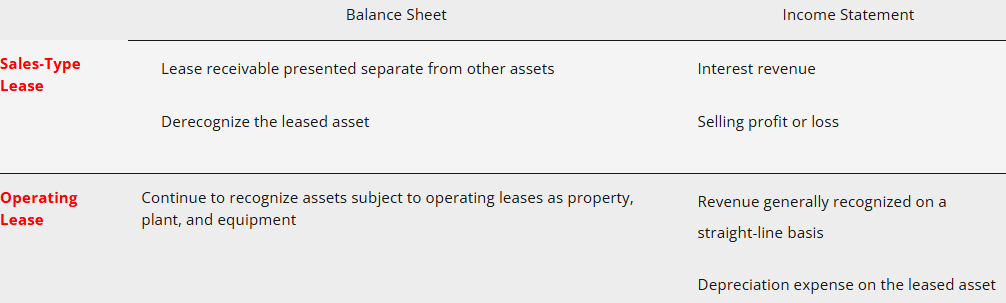
Under a sales-type lease, the lessor generally records a lease receivable and eliminates the leased asset
Lease Receivable = (Present Value of Rental Payments) + (Present Value of Guaranteed AND Unguaranteed Residual Values)
Lessor Profit and Revenue Recognition
Any selling profit on the transfer of the leased asset is recognized by recording sales revenue and related CoGS at the commencement of the lease
The lessor recognizes revenue interest on the lease receivable over the life of the lease using the effective-interest method
Amount to be Recovered by Lessor
Amount to be Recovered by Lessor = (Fair value of the leased equipment) - (Present value of the residual value)
FINANCE LESSOR Journal Entry - Lease Receivable/CoGS/Sales Revenue

FINANCE LESSOR Journal Entry - Record Receipt of First Payment

FINANCE LESSOR Journal Entry - Interest Revenue on Lease Receivable

FINANCE LESSOR Journal Entry - Final Lease Payment, but the asset is not returned until a year later

FINANCE LESSOR Journal Entry - Asset is Returned

OPERATING LESSEE Journal Entry - Record Lease

OPERATING LESSEE Journal Entry - Record First Payment

Lease Expense Schedule
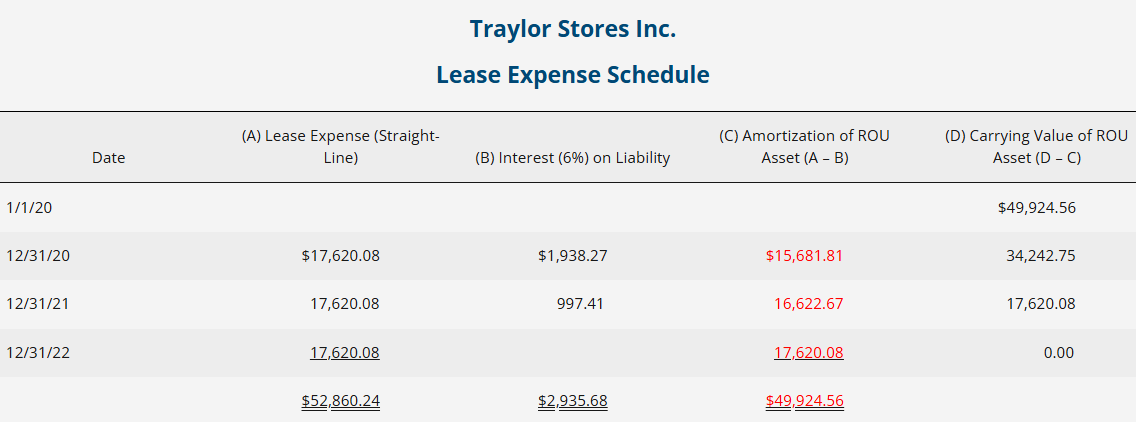
OPERATING LESSEE Journal Entry - Record Lease Expense

OPERATING LESSOR Journal Entry - Record Lease Payment

OPERATING LESSOR Journal Entry - Record Recognition of Revenue

OPERATING LESSOR Journal Entry - Record Depreciation Expense on Lease Equipment

Lease arrangements that cause unique accounting problems
Residual Values
Bargain Purchase Options
Short-term Leases
Presentation, Disclosure, and Analysis
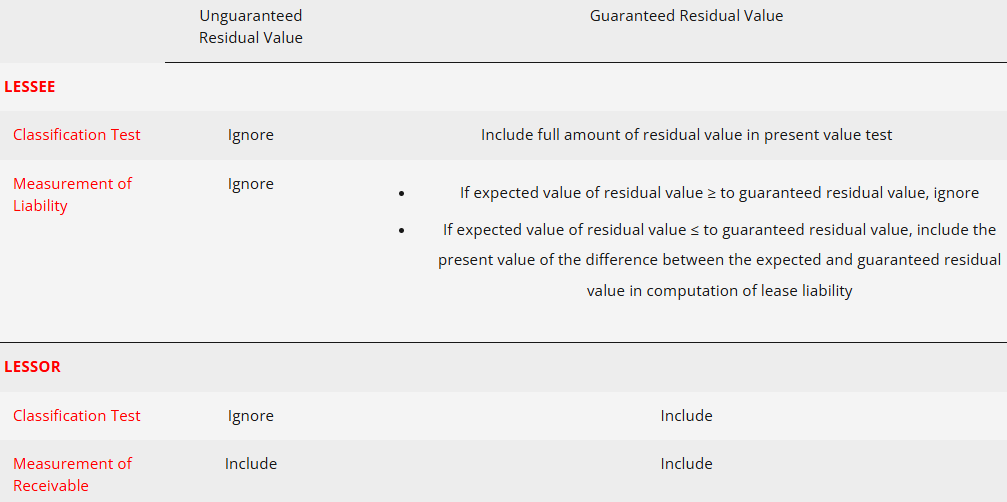
LESSEE - Guaranteed Residual Value
If it is PROBABLE that the expected residual value is GREATER than or EQUAL to the guaranteed residual value, do NOT include the guaranteed residual value in the computation of lease liability
If it is PROBABLE that the expected residual value is LESS than the guaranteed residual value, the difference between the expected and guaranteed residual values should be INCLUDED in the computation of the lease liability
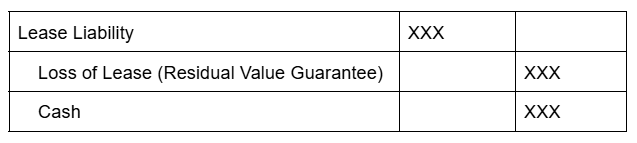
If the fair value of the underlying asset is LESS than the expected residual value, the company will record a loss
LESSEE RESIDUAL VALUE GUARANTEE Journal Entry - Recording a Loss
LESSEE - Unguaranteed Residual Value
Lessee does NOT include the unguaranteed residual value in the computation of the lease liability, whether it is a finance lease or on an operating lease
LESSOR - Guaranteed Residual Value
The calculation used to measure the amount to be recovered by the lessor from rental payments is the SAME whether the residual value is guaranteed or unguaranteed
Lessor accounts for the guaranteed residual value as part of Sales Revenue
Gross Profit = (Sales Price of the Asset) - (CoGS)
LESSOR - Unguaranteed Residual Value
Lessor recognizes sales revenue and CoGS only for the portion of the asset for which recovery is assured
To account for this uncertainty, both sales revenue and CoGS are reduced by the present value of the unguaranteed residual value
Gross Profit = (Sales Price of the Asset) - (CoGS)
Sales Price of the Asset = (Sales Price) - (Present Value of Expected Residual Value)
CoGS = (Cost to the Dealer) - (Present Value of Expected Residual Value)
It is the same gross profit regardless of whether it is guaranteed or unguaranteed, but the sales revenue and CoGS are reported at different amounts under an unguaranteed residual value situation
Summary of Treatment of Residual Values
Additional lease adjustments that affect the measurement of lease assets and liabilities
Executory costs
Lease prepayment and incentives
Initial direct costs
Executory Costs
Normal expenses associated with owning a leased asset, such as property insurance and property taxes
Gross lease: payments to the lessor are fixed as part of the rental payments in the contract
Included in measurement of lease liability
Net lease: lessee makes variable payments to a third party or to the lessor directly for the executory costs
Not included in measurement of lease liability
Expensed as incurred
Lease Repayment and Incentives
Companies adjust the right-of-use asset for any lease prepayments, lease incentives, and initial direct costs made PRIOR to or AT the commencement date
Prepayments made by LESSEE INCREASE the right-of-use asset
Incentive payments made by LESSOR REDUCE the right-of-use asset
Initial direct costs incurred by LESSEE INCREASE the right-of-use asset
Right-of-Use (ROU) Asset
It is the value recorded on a lessee’s balance sheet representing the contractual right to use a leased asset over the lease term, measured initially from the present value of future lease payments plus adjustments
Right-of-Use (ROU) Asset = (Initial measurement of lease liability) + (Prepaid Lease Payments) + (Initial Direct Costs) - (Lease Incentives Received)
Initial Direct Costs
They are incremental costs of a lease that would not have been incurred had the lease not been executed
Costs directly or indirectly attributable to negotiating and arranging the lease (like legal costs, salaries, marketing, depreciation) are NOT considered initial direct costs
Included in the cost of the right-of-use asset but are NOT recovered as part of the lease liability
Lessor Accounting for Initial Direct Costs
Operating lease: the lessor defers the initial direct costs and amortizes them as expenses over the term of the lease
Sales-type lease: the lessor expenses initial direct costs at lease commencement (in the period in which it recognizes the profit on the sale)
An exception is when there is no selling profit or loss on the transaction.
If there is no selling profit or loss, the initial direct costs are deferred and recognized over the lease term
Internal direct costs should not be included in initial direct costs
Internal costs are costs that would have been incurred regardless of whether a lease was executed and they are expensed as incurred
Bargain Purchase Option
Allows the lessee to purchase the leased property for a future price that is substantially lower than the asset’s expected future fair value
If a bargain purchase option exists, the lessee must increase the present value at the lease payments by the present value of the option price
It uses the economic life of the underlying asset
Short-Term Leases
A lease that, at the commencement date, has a lease term of 12 months or less
Lessees may elect to expense the lease payments as incurred
A one-year lease with a renewal option that the lessee is reasonably certain to exercise is NOT a short-term lease
LESSEE Presentation in Financial Statements

LESSOR Presentation in Financial Statements
Qualitative Lease Disclosures for BOTH Lessor and Lessee
Nature of its leases, including a general description of those leases
How variable lease payments are determined
Existence and terms and conditions for options to extend or terminate the lease and for residual value guarantees
Information about significant assumptions and judgements (discount rates)
Lessee Quantitative Disclosures
Total Lease Cost
Finance lease cost, segregated between the amortization of the right-of-use assets and interest on the lease liabilities
Operating and short-term lease costs
Weighted-average remaining lease term and weighted-average discount rate (segregated between finance and operating leases)
Maturity analysis of finance and operating lease liabilities, on an annual basis for a minimum of each of the next 5 years, and the sum of the undiscounted cash flows for all years thereafter
Lessor Quantitative Disclosures
Lease-related income, including profit and loss recognized at lease commencement for sales-type and direct financing leases, and interest income
Income from variable lease payments not included in the lease receivable
The components of the net investment in sales-type and direct financing leases, including the carrying amount of the lease receivable, the unguaranteed residual asset, and any deferred profit on direct financing leases
A maturity analysis for operating lease payments and a separate maturity analysis for the lease receivable (sales-type and direct financing lease)
Management approaches for risk associated with residual value of leased assets (like buyback agreements or third-party insurance)
What is the cost of an asset under a finance lease?
The amount to be recorded as the cost of an asset under a finance lease is equal to the present value of the lease payments
1 / 1
In computing amortization of a leased asset where there is no bargain purchase option, what should the lessee subtract?
In computing amortization of a leased asset where there is no bargain purchase option, the lessee should subtract no residual value and amortize over the term of the lease.
In an operating lease, what does the lessee record?
In an operating lease, the lessee records the lease expense.
In a finance lease, what does the lessee record?
In a finance lease, the lessee records both amortization and interest expense.
For a lessee with a finance lease containing a bargain purchase option, what is the lease asset depreciated over?
A lessee with a finance lease containing a bargain purchase option should depreciate the leased asset over the asset's remaining economic life
Book Value of Leased Asset
The selling price of the equipment is used when determining the book value of a leased asset
Does the lessor recognize a lease receivable under an operating lease?
Under an operating lease, the lessor does not recognize a lease receivable because the asset never left the books
Prospective Reporting
Prospective reporting is reporting in future periods
Companies report changes in accounting estimates prospectively, so they do not adjust previously reported results
Journal Entry - Recording Depreciation

Depreciation Charge Formula
Depreciation Charge = (Book Value of Asset) / (Remaining Service Life)
3 Types of Accounting Changes
Change in accounting principle
Change in accounting estimate
Change in reporting entity
Change in Accounting Principle
A change from one GAAP to another one
Ex.: changing an inventory valuation method from LIFO to average-cost
Change in Accounting Estimate
A change that occurs as a result of new information or additional experience
Ex.: changing its estimate of the useful lives of depreciable assets
Change in Reporting Entity
A change from reporting as one type of entity to another type of entity
Ex.: a company might change the subsidiaries for which it prepares consolidated financial statements
Errors in Financial Statements
Results from mathematical mistakes, mistakes in applying accounting principles, or oversight or misuse of facts that existed when preparing the financial statements
Retrospective Approach
The company goes back and adjusts prior years’ statements on a basis consistent with the newly adopted principle
Retrospective Accounting Change Approach
When a company changes an accounting principle, it should report the change using retrospective application
It adjusts its financial statements for each period presented on the same basis as the new accounting principle
It adjusts the carrying amounts of assets and liabilities as of the beginning of the first year presented
By doing so, these accounts reflect the cumulative effect on periods prior to those presented
The company also makes an offsetting adjustment to the opening balance of retained earnings or other appropriate component of stockholders’ equity or net assets as of the beginning of the first year presented
How do you report changes in accounting principles?
Report changes retrospectively
The application of a different accounting principle to recast previously issued financial statements — as if the new principle had always been used
Reporting a Change in Principle
Other than using the retrospective approach, one must also include the following information in the financial statements:
Nature of the change
Why the company made the change
The years affected
Data on important differences between the amount reported under the old principle and the new one
Retained Earnings Adjustment for Change in Principle
One of the disclosure requirements is to show the cumulative effect of the change on retained earnings as of the beginning of the earliest period presented
Direct Effects of Changes
Companies should retrospectively apply the direct effects of a change in accounting principle
Ex.:
An adjustment to an inventory balance as a result of a change in inventory valuation method
Deferred income tax and the effects of impairment adjustments are also considered direct effects
Indirect Effects of Changes
Any change to current or future cash flows of a company that results from making a change in accounting principle that is applied retrospectively
Indirect effects do NOT change prior period amounts
It is expensed in the current period
It includes in the financial statements a description of the indirect effects
Ex.:
Change in profit-sharing or royalty payment that’s based on a reported amount such as revenue or net income
Impracticability
Retrospective application is considered impracticable if a company cannot determine the prior period effects
Companies should NOT use retrospective application if one of the following conditions exists:
The company cannot determine the effects of the retrospective application
Retrospective application requires assumptions about management’s intent in a prior period
Retrospective application requires significant estimates for a prior period, and the company cannot objectively verify the necessary information to develop these estimates
If any of the above conditions exist, it is deemed impracticable to apply the retrospective approach
If it is impracticable to apply the retrospective approach, the company then …
prospectively applies the new accounting principle as of the earliest date it is practicable to do so
Changes in Accounting Estimates
Changes in accounting estimates are reported prospectively
Companies account for the effects of all changes in estimates in:
The period of change if the change affects that period only
The period of change and future periods if the change affects both
It prohibits retrospective treatment
The following items require estimates:
Uncollectible receivables
Inventory obsolescence
Useful lives and salvage values of assets
Periods benefited by deferred costs
Liabilities for warranty costs and income taxes
Recoverable mineral reserves
Change in depreciation methods
If it is impossible to determine whether a change in principle or a change in estimate has occurred, the rule is:
to consider the change as a change in estimate. This is often referred to do as a change in estimate effected by a change in accounting principle
What is the general rule for issues in differentiating between a change in estimate and a correction of an error?
The general rule is that companies should consider careful estimates that later prove to be incorrect as changes in estimate
For a change in estimate that affects several periods, companies should disclose..
the effect on income from continuing operations and related earnings per share amounts of the current period
When a company has a change in estimate effected by a change in accounting principle, it must indicate why…
the new method is preferable
Changes in Reporting Entity
Changes that result in different reporting entities have to adjust the financial statements of all prior periods presented (retrospectively)
The revised statements show the financial information for the new reporting entity for all periods
Retrospective Approach vs Prospective Approach
Retrospective Approach:
Changes in Accounting Principle
Changes in Reporting Entity
Prospective Approach:
Changes in Accounting Estimates