Glycogen Metabolism (lecture 22: final exam)
 Call Kai
 Learn
 Practice Test
 Spaced Repetition
 Match
 Flashcards
 Knowt Play
1/21

There's no tags or description
Looks like no tags are added yet.
22 Terms
Glycogen is found in:
-liver
-muscle
-adipocytes
-RBCs
-WBCs
Glycation
-Non-enzymatic bonding of sugar molecule to a protein, lipid, or nucleic acid
Glycogen
Glycogen is a branched homopolysaccharide of glucose
Glucose monomers form α(1→4) linked main chains
–Branch-points with α(1→6) linkages linkage occurs every 8-12 residues
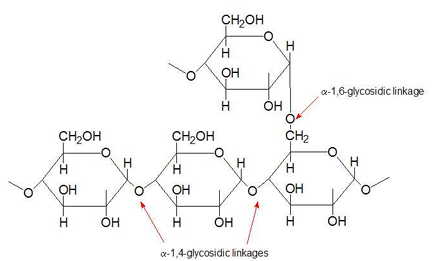
Nonreducing Ends
-site of almost all glycogen metabolism

Glycogen Breakdown (Glycogenolysis)
Requires three enzymes
Glycogen phosphorylase
Glycogen Debranching enzyme
phosphoglucomutase
Glycogen Phosphorylase
Removes glucose residues from the non-reducing ends of glycogen via attack by inorganic phosphate, producing glucose-1-phosphate
Glycogen Phosphorylase Mechanism
Enzyme uses general acid catalysis.
Glycosidic oxygen is protonated.
Bond breaks.
Carbocation intermediate forms.
Phosphate attacks carbocation.
6. Glucose-1-phosphate produced.
Glycogen Debranching Enzyme
Transfers three of glucose residues to the non-reducing end of a nearby branch, then removes the final residue as free glucose.
-Because Glycogen phosphorylase cannot digest branch points
Glycogen Debranching Enzyme Mechanism
Step 1
Debranching enzyme moves:
3 glucose residues
From:
Branch
To:
Nearby linear chain
Step 2
Remaining α(1→6)-linked glucose removed.
Product:
Free glucose
Phosphoglucomutase
Converts glucose-1-phosphate to glucose-6-phosphate
Phosphoglucomutase Mechanism
Enzyme is phosphorylated.
Gives phosphate to glucose.
Creates glucose-1,6-bisphosphate intermediate.
Removes original phosphate.
Produces glucose-6-phosphate.
Enzyme regenerated.
Fate of Glucose-6-Phosphate in Muscle
Muscle cannot perform gluconeogenesis so:
G6P enters glycolysis and turns into ATP; used for muscle contractions
Fate if Glucose-6-Phosphate in liver and kidney
G6P can be dephosphorylated by glucose-6 phosphatase to produce glucose, which is then exported to the blood stream
Kidney and Gluconeogenesis
-contributes 40% of gluconeogenesis
-blood lactate to glucose
Activating Sugars
Cells activate glucose by attaching:
UDP (Uridine Diphosphate)
Product:
UDP-glucose
-UDP-glucose is the activated form used for glycogen synthesis
UDP-Glucose Pyrophosphorylase
-Produces UDP-glucose and:
converts glucose 1-phosphate and UTP to UDP-glucose and PPi
Glycogen synthase will UDP-glucose to add glucose to the nonreducing ends of glycogen chains
UDP-Glucose Pyrophosphorylase Mechanism
1. Glucose-1-phosphate attacks UTP.
2. Pyrophosphate (PPi) released.
UDP-glucose formed.
Glycogen synthase
-uses UDP-glucose to add glucose to the nonreducing ends of glycogen chains
Glycogen Synthase Mechanism
UDP-glucose binds enzyme.
Nonreducing end attacks anomeric carbon.
UDP leaves.
New α(1→4) bond formed.
Glycogen chain lengthens.
Glycogen branching enzyme
Forms α(1→6) branches by transferring 6 or 7 glucose residues from the nonreducing end of the glycogen chain to a C-6 hydroxyl group of an interior residue
Glycogenin (Primer Protein) Mechanism
Glycogenin attaches glucose to Tyr residues.
Uses UDP-glucose.
Adds approximately 7–8 glucose residues.
Creates primer.
Glycogen synthase takes over.
Glycogen particle grows.
Glycogen Regulation
Glycogen Synthase
-regulates glycogenesis
-active when dephosphorylated
-inactive when phosphorylated
-When active, it builds glycogen by adding glucose residues.
Glycogen Phosphorylase
-regulates glycogenolysis
-active when phosphorylated
-inactive when