11/5 thursday incidence, prevalence, sensitivity, specificity, positive predictive value, negative predictive value
 Call Kai
 Learn
 Practice Test
 Spaced Repetition
 Match
 Flashcards
 Knowt Play
1/45

Earn XP
Description and Tags
vm 709 csu
46 Terms
what is a diagnostic?
a diagnostic test is any device or process designed to detect or quantify a sign, substance, tissue change, or body response in an animal
examples of diagnostics for virology:
virus isolation (VI)
hemagglutination inhibition (HI)
fluorescent antibody (FA)
PCR
agar gel immunodiffusion (AGID)
enzyme linked immusorbent assay (ELISA)
serum neutralization (SN)
infection does NOT equal…
…dz
what is the cut off point in dz dx between healthy vs dz animals?
course of infection consists of 2 stages, _ and _
prepathogenesis & pathogenesis
pathogenesis includes:
multiplication
tissue and physiologic changes
signs/symptoms
illness
disability
defect
chronic state → death
prevalence is
the proportion of a population that has a particular condition at a given point in time
“how common” something is - if 10 of 100 people have a condition, prevalence = 10%
what does prevalence help us understand?
the burden of a condition in a population and can inform healthcare planning, resource allocation, and research
incidence is
the number (or proportion of new cases of a conditioner that occur in a population over a specific period of time)
very dynamic → worry about the incidence RATE
fatalities NOT COUNTED
ex: if 5/10 sick, and 2 die, then 3/8 = incidence rate %. if 2 more get sick, then 5 total are sick, and incidence rate = 5/8%
incidence helps us understand…
…the risk of developing a condition and the speed at which it is occurring in a population over time
isues in animal disease diagnosis:
sensitivity vs specificity
presence of false +s / -s
some experts claim there is not perfect diagnostic test

test categories for a veterinarian
screening tests (for clinically healthy animals)
confirmatory/diagnostic tests (for clinically disease animals)
sometimes use both at a time, consider cost!
screening test characteristics
cheap
detects numerous possible cases of disease, less specific for IDing real cases
fast, reasonably accurate
not meant to supply complete info abt patho
need follow up w confirmatory/diagnostic test
confirmatory/diagnostic test characteristics
tests for clin dzd animals
to confirm diagnosis or classify dz status among animals suspected to have dz
a rabies test is (how specific)?
highly specific (basically no false positives)
qualities of a test are
precision and (reproducibility, reliability, repeatability)
validity (accuracy)
goals in using diagnostics:
establish dx in symptomatic Patients
provide prognosis
guide treatment/control strats
monitor treatment effects
what can cause variation in results?
variation w/in ani subjects
variation in reading of test results by same reader (measuring tool)
variation betw those reading test results
data layout for test evaluation
true disease status (+ or -) along horizontal
diagnostic test (+ or -) along vertical

validity is expressed in what four dimensions?
sensitivity
specificity
PPV
NPV
the “gold standard” for diagnostic tests is
a diagnostic test or benchmark that is best, available under reasonable conditions
the criterion standard
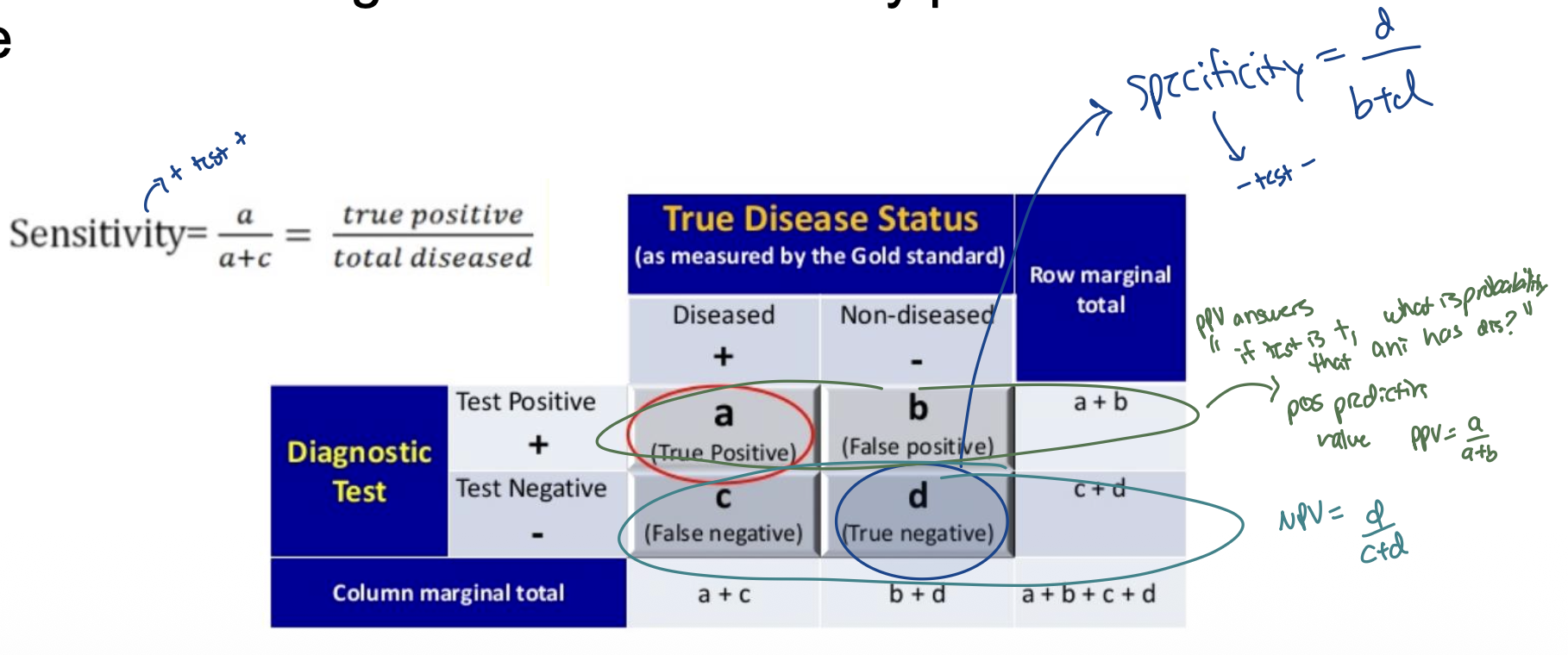
sensitivity of a test is
the probability of the test to generate positive results among animals that actually possess the disease
(true positive) / (true pos + false neg)
a / (a+c)
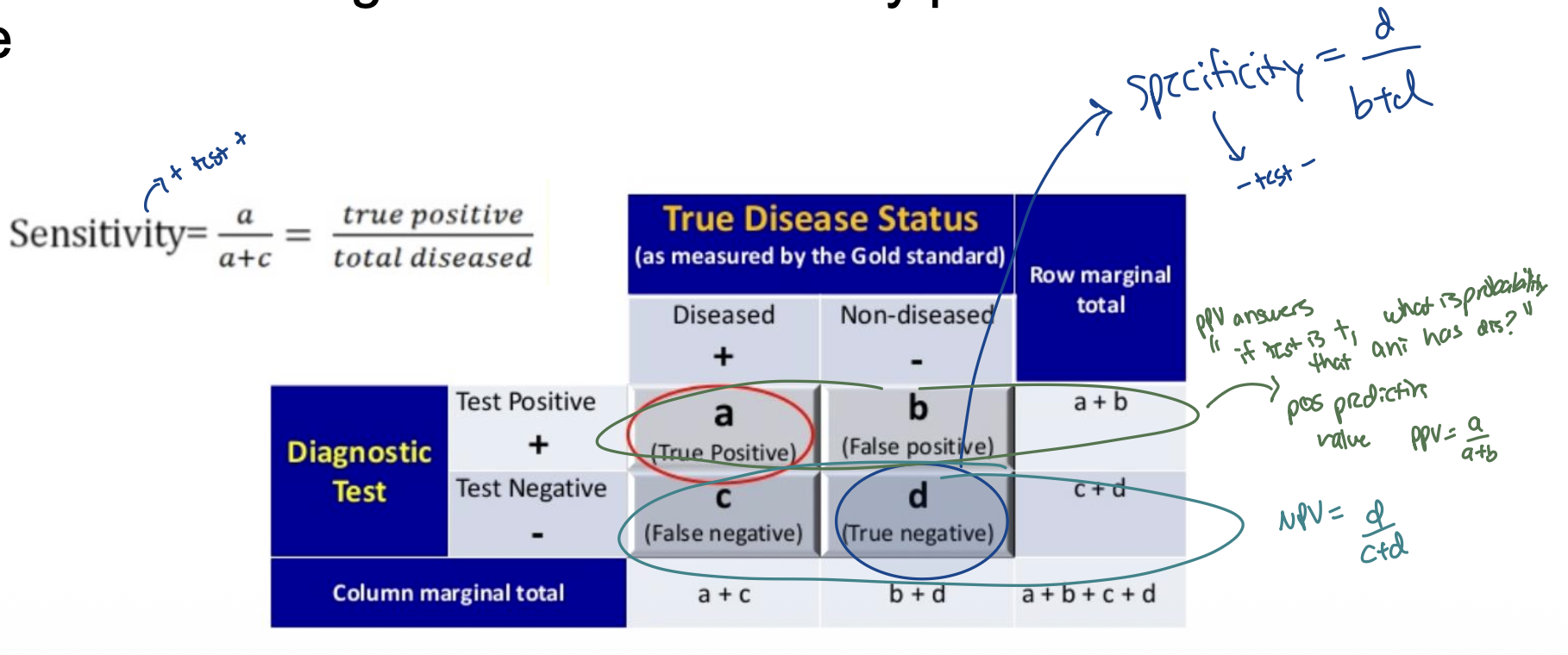
specificity of a test is
the probability of a test to generate negative results among animals that are genuinely free of the disease
true negative / (false pos + true neg)
d / (b+d)
true positive means
positive result in diseased animal
actual infection
false negative means
negative result in diseased animal
natural or induced tolerance
improper timing
improper test
non-specific inhibitors
toxic substances
antibiotic induced
immunoglobulin suppression
incomplete or blocking antibody
insensitive tests
false positive means
positive result in non-diseased animal
group cross rxn
non-specific inhibitors
non-specific agglutinins
true negative means
negative results in an animal with no disease
absence of infection
what happens when you increase the sensitivity of the test (too far)?
end up getting false positives
when should you select a test with high sensitivity?
when missing a dzd ani would be costly or dangerous (ex: foot and mouth)
when screening for a dz or patho in imported animal
demonstration of absence of a dz in a dz-free zone
what happens when you increase the specificity of the test?
increased false negatives
when to select a test with high specificity?
when confirming a diagnosis
when inc false positives would cause physical, emotional, or financial damages
ex: don’t want to say “dog has osteosarcoma” and then “oops nvm he doesn’t” → want a specific test for this
positive predictive value answers the question
“if the test result if positive, what is the prob that the ani actually has the dz?”
horizontal row: a / (a+b) = PPV
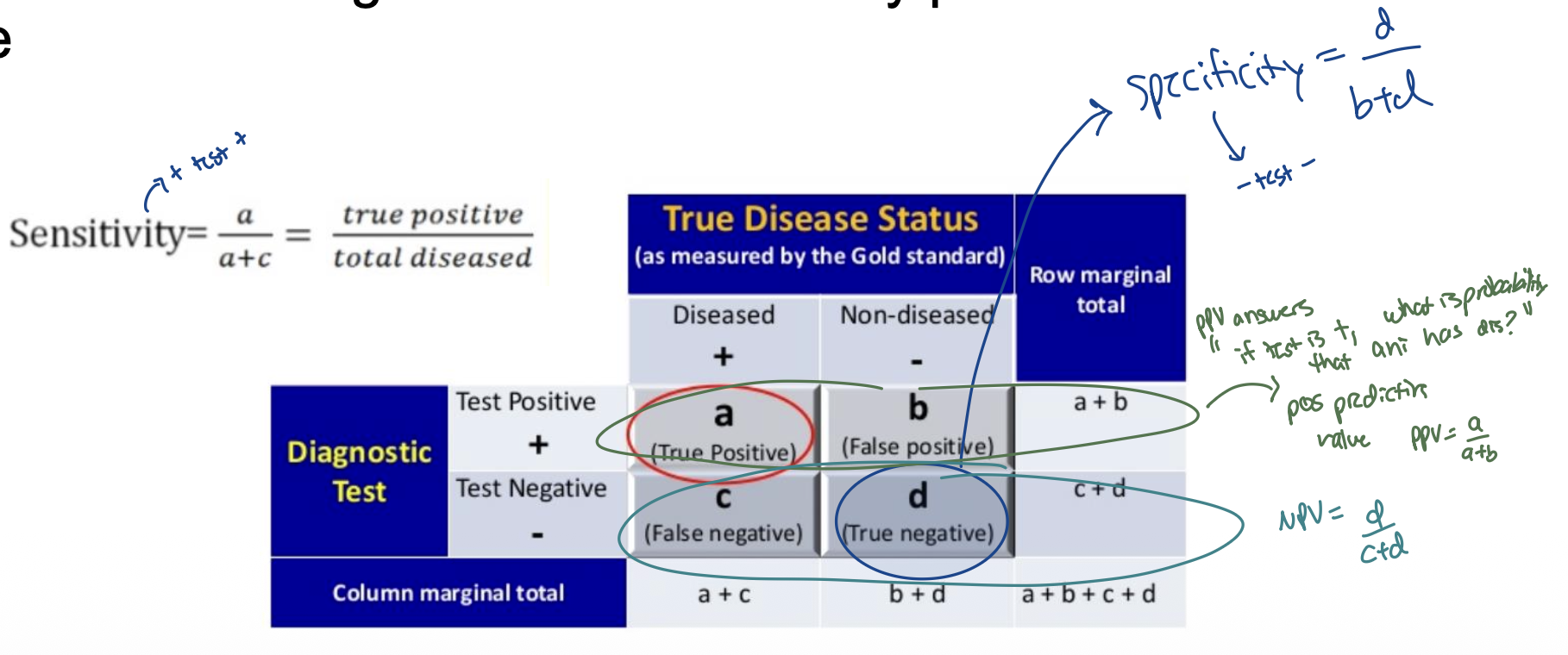
negative predictive value answers the question
“if the test result if negative, what is the probability that the animal does NOT have the dz?”
horizontal row: d / (c+d) = NPV
if you use a test in a population where the dz is more prevalent,
the PPV is increased, and the NPV is decreased
basically, more likely that a positive result = actually dzd ani
predictive value is dictated by…
…the population, NOT the test
when dz is rare, false + make up a larger share of the + tests
nidality of dz is
tendency for a dz to remain localized w/in specific ecological “nest”
“certain zoonotic dz persist in specific natural landscapes, bc pathos, vectors, and ani reservoirs all live together in that ecosystem”
factors impacting ecology of parasitic infectious dz
role in ecosystems/food webs
host specificity
habitate preference/niche/anatomic location
parasite communities and competition
adaptations
ecology is
the study of relationships betw orgs and their enviros
factors regulating #s and distributions
sometimes enviro is another org…
a host is a…
…rich, nutrient-dense environment
most animals have body fluids containing, prots/AAs, carbs, NA precursors, etc
parasites exploit their living enviro
why do adaptations come about in parasites?
so the lifestage can better survive abiotic conditions existing between hosts
does hosts adapt?
hosts adapt (move, and defend themselves)
ex: immune rxns
a nidus is
a specific ecological niche, hab, or geographic focus
nidus is derived from Latin word for
“nest” or “breeding place”
refers to where microbes are located and multiply
a parasite’s ecological niche provides resources from…
…the body of the host OR
…the abiotic conditions encountered by the transmission stages (like eggs, cysts, oocysts, spores, or juveniles)
one medicine
human med + vet med
collab
common physiological and pathological foundations
zoonoses are a focus
one health
humans + anis + plants + ecosystems/environment
key facts of one health
hum/ani/eco all interlinked
links demand COLLABORATION, comm, coord
OH optimizes health of all involved
> 60% of emerging infectious dzs reported globally come from anis
human activities and stressed ecosystems have created new opportunities for dz spread
stressors include: animal trade, ag, livestock farming, urbanization, extractive industries, climate change, hab fragmentation, and encroachment into wild areas
encounter and compatibility filters