chem c22a electrochem 1
 Call Kai
 Learn
 Practice Test
 Spaced Repetition
 Match
 Flashcards
 Knowt Play
1/32

There's no tags or description
Looks like no tags are added yet.
33 Terms
Define oxidation and reduction in terms of oxidation state and electrons.
Oxidation: increase in oxidation state; loss of electrons; occurs at anode
Reduction: decrease in oxidation state; gain of electrons; occurs at cathodeMnemonic: AN OX, RED CAT
What is a reducing agent vs an oxidising agent?
Reducing agent: reduces another substance; is itself oxidised; electron donor
Oxidising agent: oxidises another substance; is itself reduced; electron acceptor
What is a disproportionation reaction?
A redox reaction where the same elementin a substance is simultaneously oxidised and reduced. e.g. 2H++2NO2−→H2O+NO+NO2\text{2H}^+ + \text{2NO}_2^- \rightarrow \text{H}_2\text{O} + \text{NO} + \text{NO}_2 2H++2NO2−→H2O+NO+NO2 (N in NO₂⁻ at +3 → +4 in NO₂ [oxidised] and +2 in NO [reduced])
State the rules for assigning oxidation numbers.
Element in elemental state = 0 (e.g. Ca, I₂, S₈)
Monoatomic ion = its charge (e.g. Cl⁻ = −1)
Neutral compound: sum of O.N. = 0
Polyatomic ion: sum of O.N. = charge on ion
More electronegative atom gets negative O.N. in covalent bonds
Key values:
Group 1 = +1 always; Group 2 = +2always; Al = +3 always
H = +1 (−1 in metal hydrides e.g. NaH)
O = −2 (−1 in peroxides H₂O₂; +2 in OF₂)
F = always −1
Halogens (Cl, Br, I) = usually −1, except with more electronegative atoms
What is a strong electrolyte, weak electrolyte, and non-electrolyte?
Strong: fully ionised in solution (e.g. NaOH, HCl, HNO₃, all ionic compounds)
Weak: partially ionised (e.g. H₂O, NH₃(aq), most organic acids)
Non-electrolyte: does not ionise at all (e.g. hydrocarbons, alcohols, sugars, halogenoalkanes)
Why can't the absolute electrode potential of a half-cell be measured directly?
Any measurement requires two electrodes — connecting a second electrode introduces its own potential. So only the potential difference between two half-cells can be measured. One is assigned as a reference (the S.H.E.).
What are the standard conditions for measuring electrode potentials?
Temperature: 298 K (25°C)
Pressure of any gas: 1 bar
Concentration of all ions: 1 mol dm⁻³
Describe the Standard Hydrogen Electrode (S.H.E.)
Platinum electrode coated with finely divided Pt (to increase surface area for rapid equilibrium)
Immersed in solution where [H⁺] = 1 mol dm⁻³
H₂(g) at 1 bar bubbled over the electrode
Temperature 298 K
Half-equation: 2H+(aq)+2e−⇌H2(g)2\text{H}^+(\text{aq}) + 2e^- \rightleftharpoons \text{H}_2(\text{g}) 2H+(aq)+2e−⇌H2(g), E∘=0.00 VE^\circ = 0.00\text{ V} E∘=0.00 V
Pt is used because it is inert
Define standard electrode (redox) potential.
The e.m.f. measured at 298 K between a given half-cell and the standard hydrogen electrode, with all ion concentrations at 1 mol dm⁻³ and gas pressures at 1 bar. By convention, always written as a reductionhalf-reaction.
What do more positive and more negative E° values indicate?
More positive E°: equilibrium lies to the right → more likely to be reduced → stronger oxidising agent
More negative E°: equilibrium lies to the left → more likely to be oxidised → stronger reducing agent
What happens to E° when you reverse a half-equation or multiply its coefficients?
Reverse: sign of E° changes (e.g. +0.34 V → −0.34 V)
Multiply coefficients: E° value stays the same (E° is an intensive property like density — energy and charge increase proportionately)
What are the three common types of half-cell systems and how are they set up?
Metal/metal ion (e.g. Cu²⁺/Cu): metal rod in metal ion solution
Gas/ion (e.g. Cl₂/Cl⁻, F₂/F⁻): Pt electrode with gas bubbled over it, in ion solution
Ion/ion (e.g. Fe³⁺/Fe²⁺): Pt electrode in solution containing both ions → Pt used as inert electrode when no metal is present
What labels must you include when drawing an electrode potential measurement setup?
Each half-cell: identity of electrode, identity + concentration of electrolyte, gas jar + pressure (if gas), temperatureConnecting: voltmeter on external wire, direction of electron flow, salt bridge
How does the reactivity series of metals relate to E° values?
From Ag → Li:
Reactivity increases
E° becomes more negative
Metals lose electrons more readily → stronger reducing agents
Form positive ions more readily
In the redox series ordered by decreasing E°, where are the strongest oxidising and reducing agents?
Top of left-hand side (most positive E°): strongest oxidising agents (e.g. F₂)
Bottom of right-hand side (most negative E°): strongest reducing agents (e.g. Li)
What is an electrochemical (voltaic) cell?
A cell that converts chemical energy from a spontaneous redox reaction into electrical energy via electron flow through an external circuit.
Define standard cell potential, E°cell
The potential difference between two half-cells under standard conditions. Calculated as:
Ecell = Ecathode - Eanode
where both E° values are given as reduction potentials from the Data Booklet.
In the Daniell cell (Zn/Cu), identify the anode, cathode, electron flow, and calculate E°cell.

What are the two roles of the salt bridge?
Maintains electrical neutrality: cations (e.g. K⁺) migrate to cathode half-cell, anions (e.g. NO₃⁻) migrate to anode half-cell to balance charge buildup
Completes the circuit by allowing ion flow without mixing the two electrolyte solutions
Which half-cell is the anode and which is the cathode in a voltaic cell?
Cathode: half-cell with more positive E°→ reduction occurs → (+) terminal
Anode: half-cell with less positive (more negative) E° → oxidation occurs → (−) terminal
How do you predict whether a redox reaction is spontaneous using E°cell?
Identify which species is oxidised and which is reduced
Write both half-equations and their E° values
Assign cathode and anode
Calculate: Ecell∘=Ecathode∘−Eanode∘E^\circ_{\text{cell}} = E^\circ_{\text{cathode}} - E^\circ_{\text{anode}} Ecell∘=Ecathode∘−Eanode∘
E°cell > 0: spontaneous ✅ | E°cell < 0: non-spontaneous ❌ | E°cell = 0: equilibrium
For the Zn/Cu system, which combinations of species react spontaneously?
Using E°(Zn²⁺/Zn) = −0.76 V and E°(Cu²⁺/Cu) = +0.34 V:
Cu²⁺ + Zn → spontaneous (E°cell = +1.10 V) ✅
Cu + Zn²⁺ → non-spontaneous (E°cell = −1.10 V) ❌
Cu²⁺ + Zn²⁺ → no redox (same species can't transfer electrons to each other) ❌
Cu + Zn → no redox ❌
State the relationship between ΔG° and E°cell, and explain what each sign combination means.


Why does multiplying the half-equation by a coefficient not change E° but doeschange ΔG°?
E° is an intensive property (ratio of energy to charge — both scale proportionately). But ΔG° = −nFE°, and n scales with the coefficient, so ΔG° changes while E° remains the same.
How does changing the concentration of ions affect electrode potential (qualitatively)?
Using Le Chatelier's principle on the half-equation (written as reduction):
Increase [oxidised species]: equilibrium shifts right → E increases(E > E°)
Decrease [oxidised species]: equilibrium shifts left → E decreases (E < E°)
Increase [reduced species]: equilibrium shifts left → E decreases
e.g. For Fe³⁺(aq) + e⁻ ⇌ Fe²⁺(aq), E° = +0.77 V: ↑[Fe³⁺] → E > +0.77 V; ↑[Fe²⁺] → E < +0.77 V
What are the 3 limitations of using E°cell to predict reaction spontaneity?
Kinetic factor ignored: E°cell measures thermodynamic feasibility only — a reaction may have a high activation energy and be kinetically too slow (e.g. H₂(g) + Cu²⁺(aq): E°cell = +0.34 V but no observable reaction)
Non-standard conditions: E° only valid at standard conditions; actual E may differ, changing predictions (e.g. Cu²⁺ + V³⁺ where E°cell = 0 V but reaction proceeds if concentrations are varied)
Side reactions: precipitation or other side reactions can shift equilibrium and make a seemingly non-spontaneous reaction actually occur (e.g. Cu²⁺ + I⁻: E°cell = −0.39 V but CuI precipitates, drastically lowering [Cu⁺] so actual E becomes > 0)
How does a fuel cell differ from an ordinary battery?
Fuel cells use continuously supplied fuel (e.g. H₂) and oxidant (O₂) — they never go flat
Ordinary batteries stop when electrode materials are used up
Fuel cells convert chemical energy to electrical energy directly (no combustion)
Write the half-equations and overall equation for the H₂/O₂ fuel cell in alkaline (KOH) electrolyte.

Write the half-equations for the H₂/O₂ fuel cell in acidic (H₂SO₄) electrolyte.
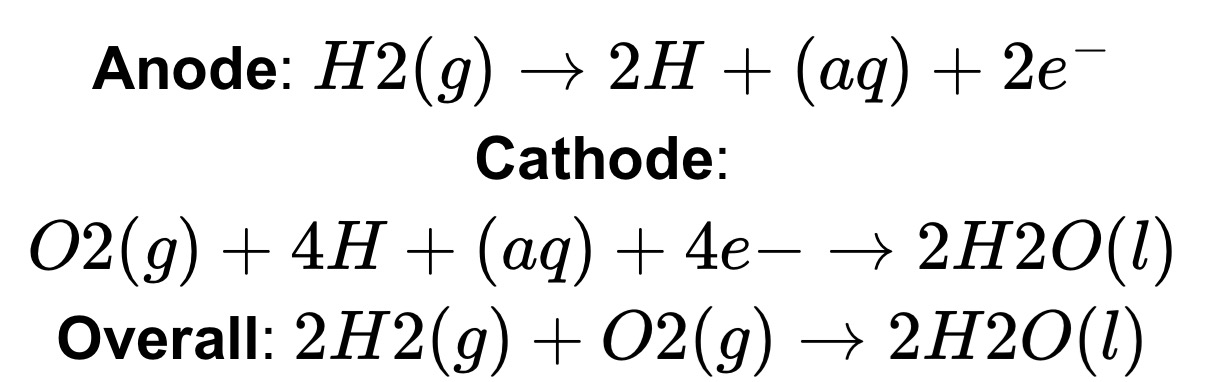
What are the advantages and disadvantages of H₂/O₂ fuel cells?
✅ Advantages:
High energy efficiency (~75% vs ~40% for power stations)
Minimum weight and volume for maximum power (great for space flights)
Does not go dead — reactants continuously supplied
Non-polluting product (water, which was used for drinking in US space lab)
❌ Disadvantages:
Expensive — Pt catalyst required
Most fuels need high temperature to react
H₂ is potentially explosive
What are the criteria for batteries suitable for electric vehicles, and what is an example of an improved battery?
Criteria: high energy density (light yet carries lots of energy), long life, good durability, quick recharging
Example: Lithium-ion battery — about half the mass of a Ni-Cd battery for similar energy output; avoids toxicity of cadmium
What are the advantages and disadvantages of electric cars?
✅ Zero polluting exhaust emissions, quiet, easier mechanical maintenance
❌ Limited range (~120 km) and speed (~80 km/h), batteries are heavy/bulky/expensive, slow recharging (>3 hours)