BIOL1951 #5 - Genetic Technology (1)

0.0(0)
Studied by 0 people
call kaiCall Kai
learnLearn
examPractice Test
spaced repetitionSpaced Repetition
heart puzzleMatch
flashcardsFlashcards
GameKnowt Play
Card Sorting

1/15

encourage image

There's no tags or description

Looks like no tags are added yet.

Last updated 12:59 AM on 10/20/26
Name
Mastery
Learn
Test
Matching
Spaced
Call with Kai
Chat

No analytics yet

Send a link to your students to track their progress

16 Terms

1
New cards

Recombinant DNA

Artificial DNA strand created by joining combining two or more gene sequences

2
New cards

Polymerase Chain Reaction (PCR)

In vitro form of DNA Replication using heat-stable Taq Polymerase

3
New cards

PCR in vitro vs. DNA Replication in cell

  1. Denaturization w/ temperature ➡ Helicase

  2. DNA Primer ➡ RNA Primer

  3. Taq Polymerase ➡ DNA Polymerase


4
New cards

Oligonucleotide Primer

Short, single-stranded DNA sequences that bind to template DNA to start replication

5
New cards

Gel Electrophoresis

  • Technique used to separate mixtures of nucleic acids/proteins based on their size and electrical charge

    • Smaller molecules travel faster and farther down the gel


6
New cards

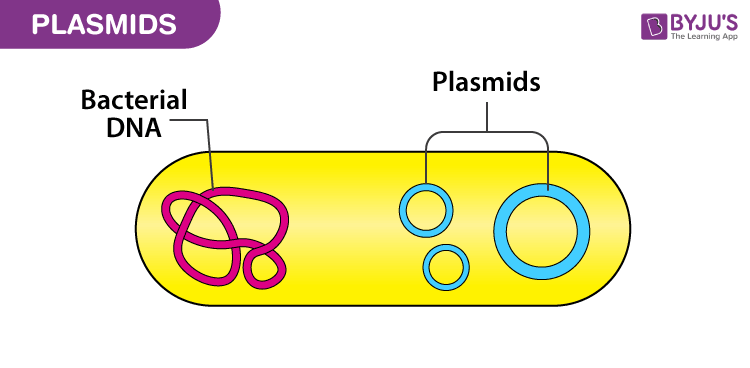
Vector

  • A DNA molecule into which “foreign” DNA is inserted

    • Ex. plasmids, cosmids, etc.


<ul><li><p>A DNA molecule into which “foreign” DNA is inserted </p><ul><li><p>Ex. plasmids, cosmids, etc.</p></li></ul></li></ul><p></p>
7
New cards

Types of Vectors

  1. Cloning Vectors

  2. Expression Vectors

  3. Integration Vectors


8
New cards

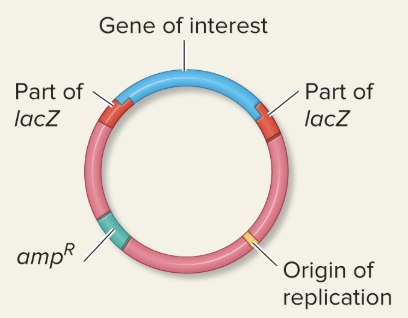
Key Features of Expression Plasmids

  • Origin of Replication (ori)

  • Selectable Marker (amp)

  • Multiple Cloning Site (MCS)


<ul><li><p>Origin of Replication (ori)</p></li><li><p>Selectable Marker (amp)</p></li><li><p>Multiple Cloning Site (MCS)</p></li></ul><p></p>
9
New cards

Origin of Replication (ori)

Binding site of DNA Polymerase

<p>Binding site of DNA Polymerase</p>
10
New cards

Selectable Marker (amp)

Ensures the plasmid is successfully implemented ➡ Resistance to amplicillin

<p>Ensures the plasmid is successfully implemented <span data-name="arrow_right" data-type="emoji">➡</span> Resistance to amplicillin</p>
11
New cards

Multiple Cloning Site (MCS)

Provides a precise insertion site for the foreign gene of interest

<p>Provides a precise insertion site for the foreign gene of interest </p>
12
New cards

Restriction Enzyme

  • Proteins that cut DNA at specific sequences (restriction site)

    • Almost always palindromic


<ul><li><p>Proteins that cut DNA at specific sequences (restriction site)</p><ul><li><p>Almost always palindromic</p></li></ul></li></ul><p></p>
13
New cards

Types of Restriction Enzymes

  1. Some restriction enzymes make staggered cuts ➡ Produce single-stranded ends

  2. Some restriction enzymes make non-staggered cuts ➡ Produce double-stranded  "blunt" ends

  • More difficult to form bonds with


<ol type="1"><li><p><span style="font-family: &quot;Times New Roman&quot;;">Some restriction enzymes make staggered cuts </span><span data-name="arrow_right" data-type="emoji">➡</span><span style="font-family: &quot;Times New Roman&quot;;"> Produce single-stranded ends</span></p></li><li><p><span style="font-family: &quot;Times New Roman&quot;;">Some restriction enzymes make non-staggered cuts </span><span data-name="arrow_right" data-type="emoji">➡</span><span style="font-family: &quot;Times New Roman&quot;;"> Produce double-stranded&nbsp; "blunt" ends</span></p></li></ol><ul><li><p><span style="font-family: &quot;Times New Roman&quot;;">More difficult to form bonds with</span></p></li></ul><p></p>
14
New cards

Restriction Site

Specific DNA sequence, usually 4-8 nucleotides long, recognized and cleaved by restriction enzymes

<p>Specific DNA sequence, usually 4-8 nucleotides long, recognized and cleaved by restriction enzymes</p>
15
New cards

Palindome

Nucleic acid sequence that reading from 5’ to 3’ on one strand matches the 5’ to 3’ sequence on the complementary strand

<p>Nucleic acid sequence that reading from 5’ to 3’ on one strand matches the 5’ to 3’ sequence on the complementary strand </p>
16
New cards

Plasmid Vector Process

  1. Vector is cut by the Restriction Enzyme at the MCS

  2. Gene of interest hydrogen-bonds to the sticky-ends of the MCS

  3. DNA Ligase catalyzes covalent bonds


<ol><li><p>Vector is cut by the Restriction Enzyme at the MCS</p></li><li><p>Gene of interest hydrogen-bonds to the sticky-ends of the MCS</p></li><li><p>DNA Ligase catalyzes covalent bonds</p></li></ol><p></p>