10.6 Electronegativity and Bond Polarity
 Call Kai
 Learn
Learn Practice Test
 Spaced Repetition
 Match
Match Flashcards
 Knowt Play
1/26

There's no tags or description
Looks like no tags are added yet.
Name | Mastery | Learn | Test | Matching | Spaced | Call with Kai | Chat |
|---|
No analytics yet
Send a link to your students to track their progress
27 Terms
polar covalent bond
a covalent bond between two atoms with significantly different electronegativities, resulting in an uneven distribution of electron density
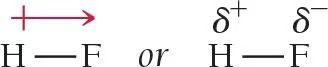
positive, negative
When representing polar covalent bonds with arrows, the positive sign on the tail shows the direction of partial _________ charge while the arrow shows the direction of partial _________ charge.

are not
Delta plus or minus signs of partially positive or negative charge ____ (are/are not) representative of an ionic bond.

electronegativity
an atom’s ability to attract electrons to itself in a covalent bond, resulting in polar and ionic bonds
bond energy
the energy required to break a bond
polar
The bond energy of a heteronuclear diatomic molecule is not necessarily the average of its homonuclear counterparts’ bond energies due to _____ (pure/polar) covalent bonding.
increases
Electronegativity generally _________ (increases/decreases) across a period in the periodic table.
decreases
Electronegativity generally _________ (increases/decreases) down a column in the periodic table.
Fluorine
________ is the most electronegative element.
Francium
_________ is the least electronegative element (electropositive).
noble gas
_______________ (alkali metal/alkaline earth metal/halogen/noble gas) atoms are not assigned electronegativity values.
inversely, less
In general, electronegativity is _________ (directly/inversely) related to atomic size; the larger the atom, the ____ (more/less) ability it has to attract electrons to itself in a chemical bond.
electronegativity difference
∆EN, value determining the degree of polarity in a chemical bond

directly
Electronegativity difference and bond polarity are _________ (directly/inversely) related.
purely, nonpolar
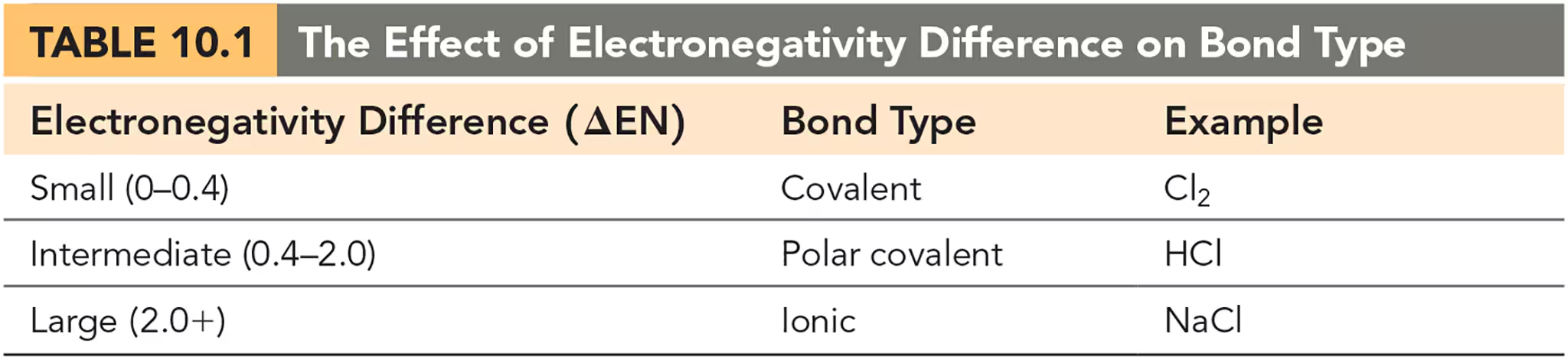
If two atoms with identical electronegativities form a covalent bond, they share the electrons equally, and the bond is ______ covalent or _______.

ionic
If there is a large electronegativity difference between two atoms in a bond (e.g. metal and nonmetal), the electron of the metal is almost completely transferred to the nonmetal, and the bond is _____ (ionic/covalent).

polar
If there is an intermediate electronegativity difference between the two atoms, such as between two different nonmetals, then the bond is _____ covalent.
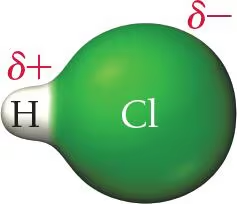
dipole moment (μ)
measure of the separation of positive and negative charge in a molecule, quantified polarity of a bond
μ=qr
equation for magnitude of dipole moment created by separating two particles of equal but opposite charges of magnitude q by a distance r
debye (D)
unit commonly used for reporting dipole moments
1D=3.34×10⁻³⁰C*m
debye to Coulombs*meters conversion
smaller, more
The smaller the magnitude of charge separation, the _______ (larger/smaller) the dipole moment, the _____ (more/less) covalent the bond.
percent ionic character
the ratio of a bond’s actual dipole moment to the dipole moment it would have if the electron were transferred completely from one atom to the other, multiplied by 100%
(measured dipole moment of bond)/(dipole moment if electron were completely transferred) * 100%
% ionic character = measured dipole moment of bond/dipole moment if electrons were completely transferred * 100%
percent ionic character equation

100
A bond in which an electron is completely transferred from one atom to another would have ___% ionic character, but no bond is 100% ionic.

increases
Percent ionic character generally _________ (increases/decreases) as the electronegativity difference increases.
50
In general, bonds with greater than __% ionic character are referred to as ionic bonds.