Virulence vs. Transmission Trade-off
 Call Kai
 Learn
 Practice Test
 Spaced Repetition
 Match
 Flashcards
 Knowt Play
1/12

There's no tags or description
Looks like no tags are added yet.
13 Terms
R_0 Fitness
R_0 = The expected number of secondary cases produced by a single infected individual in a completely susceptible population
Fitness of a pathogen can be measured by R_0
R_0 = S*beta*L
R_0 Considering Virulence
L (length of infectious period) is inversely related to:
Rate of recovery of the infection v
The host’s pathogen- induced mortality rate (i.e., virulence) alpha the host’s natural mortality rate mu
R_0 = (Beta*N)/(mu+alpha+v)
R_0 would be maximized if alpha is minimized, or as alpha → 0
Natural selection favors lower alpha (ideally alpha = 0)
Fits the hypothesis that virulence for emergent new pathogens will decrease over time
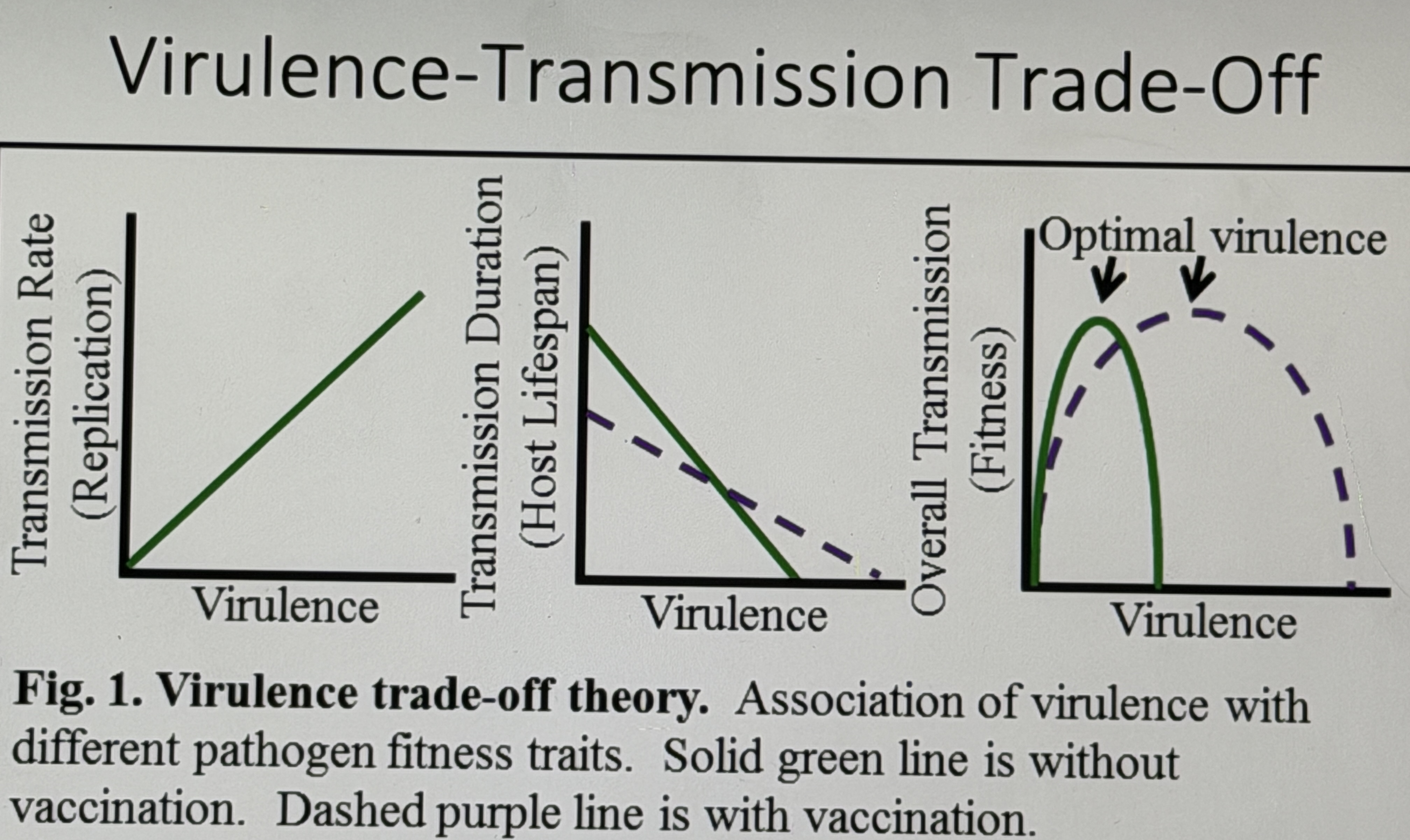
Virulence-Transmission Trade-Off
The harm that a pathogen inflicts on its host through a decrease in host fitness is an unavoidable cost to the pathogen for using the host resources for replication
The cost increases mortality rates, which translates into a shorter infection period in the population
Overall transmission should be the greatest at intermediate levels of virulence, which balances the costs of within-host replication and benefits of infectious period length
R_0 and Virulence-Transmission Trade-Off
Recovery and transmission rates are functions of virulence
Host may recover more quickly from less virulent strains
Decreasing alpha (virulence) may not necessarily increase R_0 because v_alpha will increase as well
R_0 = ((Beta_alpha)*N)/(mu+alpha+v_alpha)
Virulent strains could be better at transmission (beta) because there is more in-host replication (higher “viral load”)
Positive relationship between within-host replication rate and transmission (beta)
Positive relationship between within-host replication rate and host resources used
Virulence is positively coupled with transmission probability (I.e., when one increase/decreases, the other is doing the same)
Virulence-Transmission Summary
It all parameters were independent, benign parasites would evolve
Natural selection would favor highly transmissible, incurable commendable or even mutualists
On the other hand, if transmission and virulence were positively coupled, some level of virulence will be favored
In other words, if higher virulence were linked to increased rate of transmission, there would be a trade-off between this benefit versus the cost of reducing the time that an infected individual could transmit its pathogen
Case Study: Myxoma Virus
Pox virus introduced into Australia to control European rabbit populations
Vectored by mosquitos and fleas, skin lesions
Initially the virus was extremely virulent (e.g., 90%+ mortality)
Subsequently, there was a sharp drop in virulence (~50% mortality)
Virulence of Myxoma Virus
High survival = Low virulence
Australian field strains injected into lab rabbits dropped to intermediate levels
Wild strains 30/42 never as virulent as artificially lab strains
Transmission & Mortality in Myxoma
Positive coupling: notably focused between transmission and virus-induced mortality
Trade off between virulence and transmission:
highly virulent forms killed too quickly, low virulent forms were too attenuated (mild) had fewer lesions and lower viral load → each extreme reduced the chance of being picked up by vector
intermediate virulence:
“Happy medium” was selected for, rather than more benign forms
Expected “Intermediate Virulence”
Changes in rates of infectious transmission will select for parasite strains or species with different levels of virulence
Assumed parasite virulence is constrained solely by the need to keep the host alive long enough to facilitate transmission to next host
Vector Borne vs Direct Transmission
Vectored diseases should have a higher optimal virulence than directly transmitted ones
Immobilizing the host does not prevent, and may even enhance, transmission
Evidence that insect-vectored diseases are more virulent (e.g., higher mortality rates)
More Hypothetical Predictions
Diseases that spread by “cultural vectors” should also tend to high virulence
Cultural vectors are any mixture of behavior and environmental conditions that allow immobilized hosts to transmit infections
For example, diarrheal pathogens can be passed through drinking water systems (an immobilized victim can still infect lots of people if contaminated materials get into drinking water)
Case Study: Broad Street Epidemic
Cholera was thought to be caused by miasma (bad air)
Discovered could be spread by water in London (1853)
In one week, 600+ people near Broad Street died of Cholera
Mapping locations of cholera cases, John Snow determined the source was a single water pump
When the pump was closed, the epidemic ceased
Discovery likely led to the “birth of epidemiology”