Ball screens
 Call Kai
 Learn
Learn Practice Test
 Spaced Repetition
 Match
Match Flashcards
 Knowt Play
1/71

There's no tags or description
Looks like no tags are added yet.
Name | Mastery | Learn | Test | Matching | Spaced | Call with Kai | Chat |
|---|
No analytics yet
Send a link to your students to track their progress
72 Terms
Core basketball concept advantage
Understanding basketball concepts gives players an advantage in any offensive system. The goal is not to master every action immediately, but to understand the basic ideas and recognize them during games.
Two-person actions
Actions involving two teammates that create quick advantages. They are important because they can create advantages more efficiently than simply trying to beat a defender 1-on-1.
Dribble handoff (DHO)
A player hands the ball to a teammate while creating an attacking opportunity.
DHO
The passer immediately sprints into a handoff, taking advantage of the defender relaxing or watching the ball.
DHO advantage
When a player passes the ball and immediately sprints into the handoff, the defender may watch the ball or relax. Sprinting into the handoff creates confusion and momentum.
DHO basic read 1
Sprint directly off the handoff, creating a 2-on-1 situation.
GHO basic read 2
Stop after coming off the handoff so a teammate can use the space and shoot.
DHO basic read 3
If both defenders move outward with the players, fake the handoff and keep the ball while driving toward the basket.
Bogot option
The defense chases over the handoff, so instead of handing the ball off, the player keeps cutting and throws the ball over the top to the cutter.
Handoff creativity
After a handoff, players can also attack by twisting the ball screen, especially if defenders initially go under the screen. Players should be creative when attacking handoffs.
Grenade handoff
A big starts with the ball, usually dribbles uphill or away from the basket, and quickly gets into a high-speed handoff. The name comes from the idea of trying to get a grenade out of your hand as quickly as possible.
Grenade handoff advantage
The grenade handoff creates space before the handoff even occurs, allowing a guard to attack a big with space, often toward the baseline.
Grenade handoff success factors
Success depends on how much ground the big can cover before the handoff, the ball handler's angle of attack, and whether the ball handler creates additional space using a screen or change of speed.

Big treating grenade handoff like a screen
If the big defender treats the handoff like a screen, the ball handler can often create a strong opportunity to attack.
Ball-screen concepts
Concepts involving screens for the ball handler. The movement of players away from the screen is also essential to making the ball screen effective.
Lift
The corner player moves upward during a ball screen. This forces the tag defender to either follow the shooter or stop the rolling big, opening opportunities such as a pass to the weak side.
Why lift matters
If the corner player stays in the corner, the tag defender can more easily defend both the shooter and the roller. If the player lifts, the defender has to choose between following the shooter and helping on the rolling big.
Roll and replace
A player in the paint rolls toward the basket while another player sprints out to replace the vacated spot. This forces the defender to choose between staying down to help or chasing the replacement player to defend the three.
Twist screen
A screen that begins in one direction and then spins over to the other side. This can confuse the defender and make it difficult for them to reposition effectively.
Ghost screen
A fake ball screen in which the screener pretends to set the screen and then quickly moves away. It can open the screener for a long closeout or allow the ball handler to attack while the defender is distracted. It can also result in a switch.

Flat screen
A ball screen in which the screener's chest faces the opposite baseline, meaning there is no predetermined left or right direction. The ball handler can use the screen in either direction, making it difficult to defend and helping create downhill momentum toward the rim.
Ghosting a flat screen
A flat screen can also be used as a ghost screen, combining the uncertainty of the flat screen with the fake-screen action.
Drag screen
A transition ball screen in which the big sets the screen while the ball handler already has momentum. Because the defense is still scrambling and help is not fully organized, the ball handler can often attack easily.
Double drag
An action involving two consecutive drag screens. It has become increasingly popular and is difficult for defenses to navigate.
Gortat screen
A screen in which the big aggressively rolls into a seal. If the guard is patient and allows the big to get downhill, a small window of space can open for the guard to get all the way to the rim.
Short roll
A big catches the ball after the two defenders commit toward the ball handler, giving the big an open pocket of space to make a decision. Making the pass to the short roller is an important skill for the guard.
Give-and-go
The player passes the ball and then immediately acts or cuts to take advantage of the defender relaxing after the pass. It is a simple action that can remain effective.
Off-ball triggers
Actions performed by players away from the ball to create advantages, including down screens, away screens, flare screens, and Iverson screens.
Down screen
A screen toward the baseline that can free a teammate away from the ball.
Away screen
An off-ball screen that moves a teammate away from the ball.
Flare screen
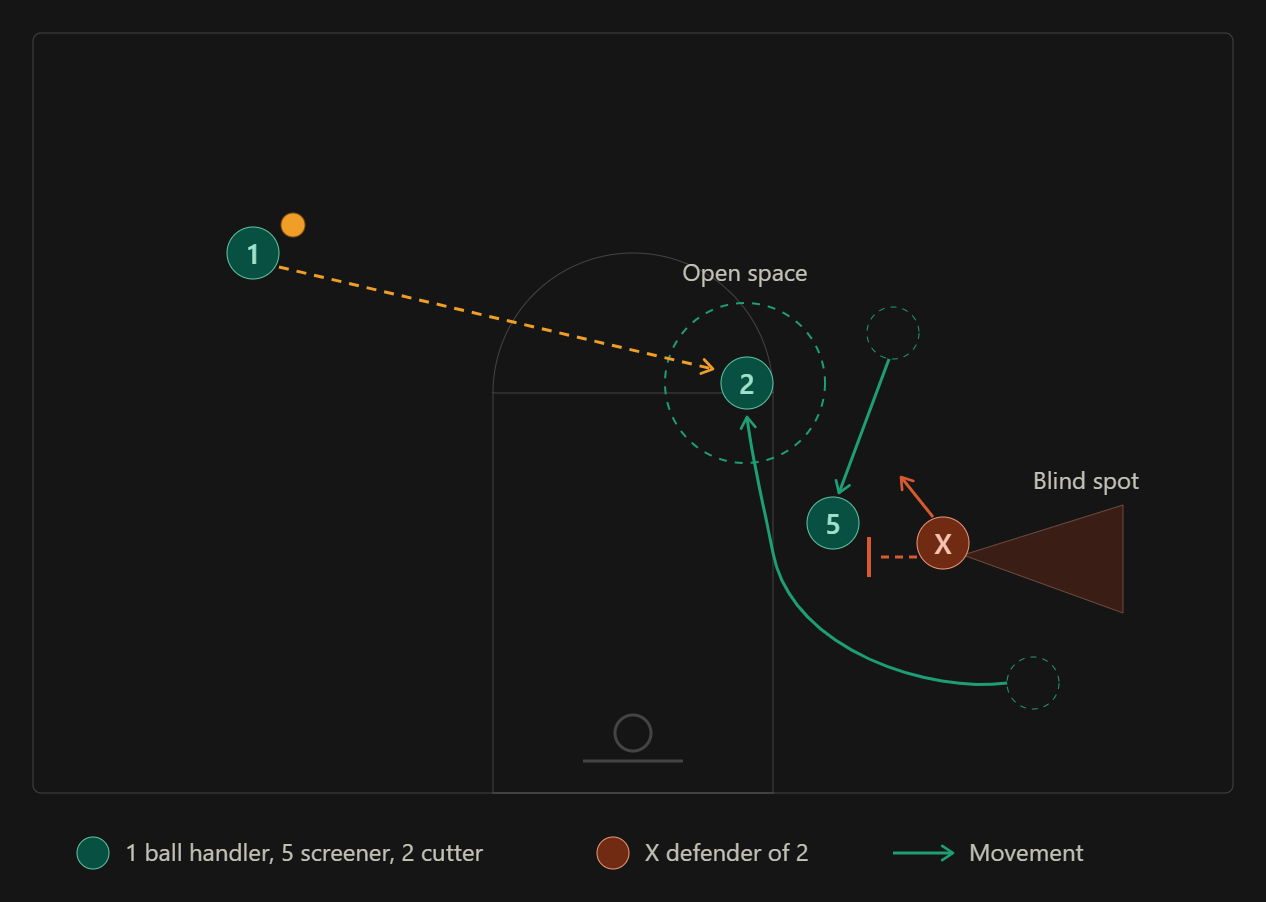
A screen that moves a player away from the ball. It is especially effective because it takes advantage of a defender's blind spot and gives the player momentum into open space.
Flare screen slip
If both defenders follow the player coming off a flare screen, the screener can often slip toward the basket because the defense has committed to the movement.

Iverson screen
A screen used when a player cuts across the court. It can clear out the lane and allow the player receiving the screen to catch and attack immediately.

Combining off-ball actions
Multiple actions can be combined, such as having two players come off an action while the second player ghosts a screen to demand defensive attention and create a downhill driving lane.
,
,
Zoom
A down screen followed by a handoff. It frees a player to come off the handoff with an early 2-on-1 advantage, forcing the defense to scramble and creating opportunities elsewhere.
Pistol
A three-player setup in which players start roughly in the corner, wing, and slot, with the ball on the wing. It provides many options, including handoffs, ball screens, and other actions, making it a strong way to begin an offense.
Pistol Chase
A pistol variation that can involve a handoff into a ball screen, lifting the corner player into a stagger ball screen, and many other combinations. The possibilities are extensive.
Spanish screen
A ball screen combined with a second screen on the big defender who is guarding the rolling player. The second screen can stop both defenders from defending the roll, open the screener, or create enough chaos and space for the ball handler to attack or shoot.
Blind pig
A guard under defensive pressure has a big flash up to catch the ball, and the pressured guard then cuts behind the big for a handoff. It creates significant momentum but requires precise timing.

Post split
A post action made famous by the Warriors in their prime. The ball goes into the post while two other players split by running past each other, potentially screening or cutting to confuse defenders and create an easy scoring opportunity.

Horns
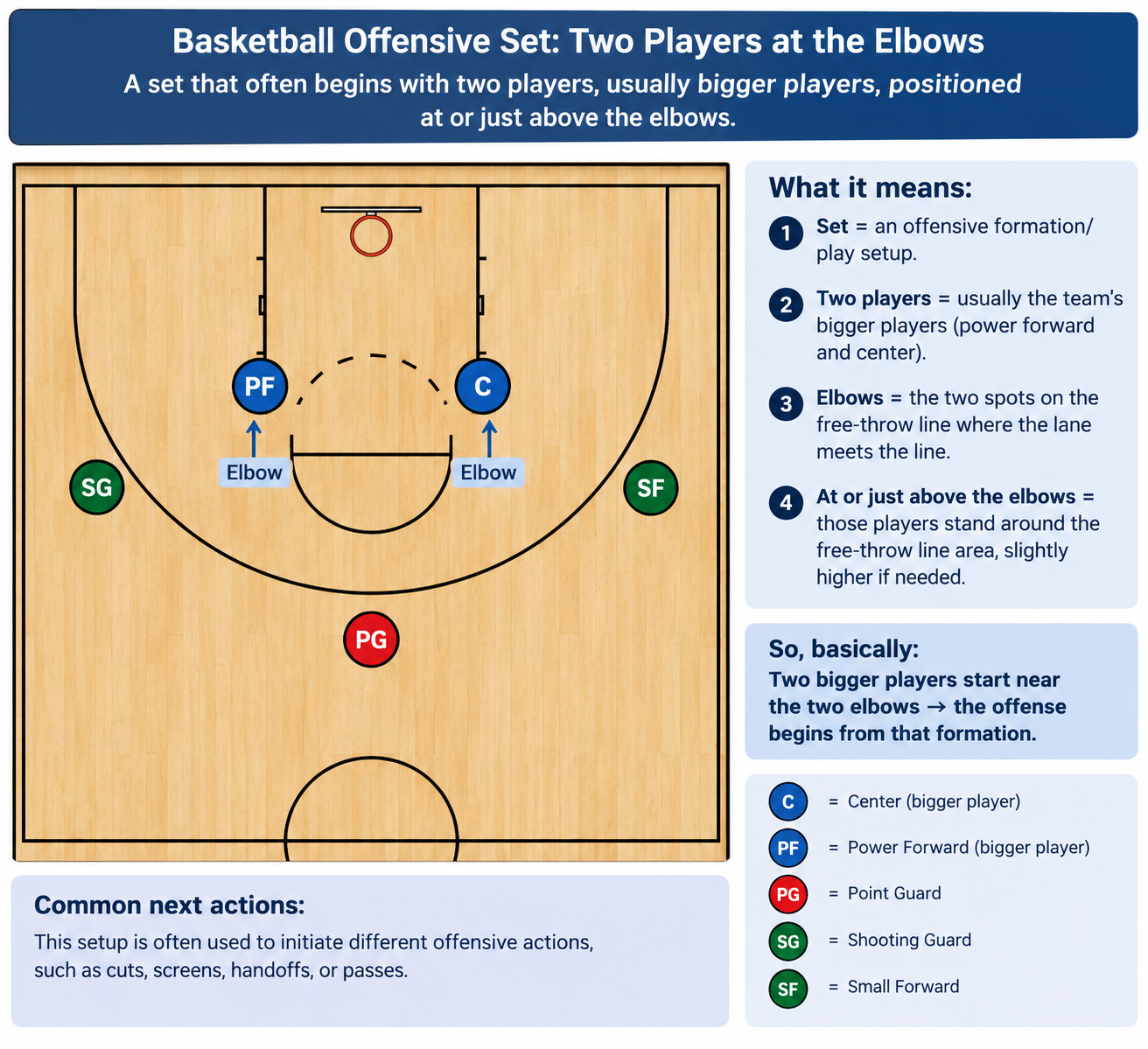
A set that often begins with two players, usually bigger players, positioned at or just above the elbows. There are thousands of possible options from this formation, often involving a ball screen.
45 cut
A cut from the wing toward the basket, often occurring when a player drives toward the middle. The defender becomes distracted by the drive, leaving the cutting lane open for a potential finish.
Baseline cut
A cut along the baseline. It can become available during a cross-court drive, a backdoor action, or whenever a teammate in the middle of the court attracts significant defensive attention.
Secondary/follow-up cut
A second cut that occurs after a teammate catches the ball on a cut. Because the defense looks toward the first cutter and reacts to them, the second cut is often even more open.
Hockey assist
The pass that occurs before the actual assist. The concept comes from hockey, where the player making the pass before the assist is also credited. In basketball, setting up the player who eventually creates the scoring opportunity is an important skill.
Importance of hockey assists
Sometimes a player does not have the angle or timing to make the final pass, but they can make the pass that sets up a teammate who does. Creating the opportunity is valuable even without receiving the official assist.
Skip pass
A pass across the court that flips the ball from one side to the other and shifts the defense.
Skip pass advantage
A skip pass may not immediately create an open shot, but it takes advantage of the defense shifting toward the strong side, forces them to shift back, creates long closeouts, and creates space early in the possession.
Swing pass
A basic pass that moves the ball between teammates. It is often underused by young players but is necessary on high-level teams.
Weak-side distraction
The activity of players away from the ball that occupies help defenders. Since much of basketball's action occurs on one side, active weak-side players can prevent defenders from fully focusing on helping against the ball.
Importance of weak-side activity
If weak-side players remain stagnant, help defenders can focus completely on stopping the drive. Keeping them active can create open driving lanes and easy scoring opportunities.
Gaps
The spacing between offensive players that creates room for a ball handler to attack. A major offensive goal is to create large gaps for drives.
Double gap
A driving situation in which the closest teammate is spaced two spots away from the ball handler, giving the ball handler a large amount of open space to attack.
Double-gap 2-on-1
When a defender overcommits to help on the ball handler because of the driving threat, the ball handler can pass to an open teammate, creating a 2-on-1 advantage.
Overall offensive principle
Good basketball offense is about creating advantages through screens, cuts, spacing, movement, handoffs, passing, and teamwork rather than simply trying to beat defenders 1-on-1.
,
,
DHO/ Hand off
offensive tactic that involves one player literally handing the basketball off to a teammate.
hockey assist
an informal statistic that credits the pass made one step before the official assist
egPlayer A is behind the net and makes a sharp pass out to Player B at the top of the circle. Player B, without shooting, immediately one-times a pass across to Player C, who buries a one-timer into the open net.
drag screen
a fast basketball play where a trailing big player sets an on-ball screen for a guard during the transition from defense to offense.
How it works:
As the ball-handler pushes the ball up the floor after a rebound, steal, or made basket, a teammate (often a big man) sprints ahead and "trails" or catches up to set a screen for them before the defense is fully set.
Unlike a half-court pick-and-roll (which is set up deliberately after the defense has organized), a drag screen happens on the fly, usually around the top of the key or just past halfcourt, catching defenders still recovering or matching up.

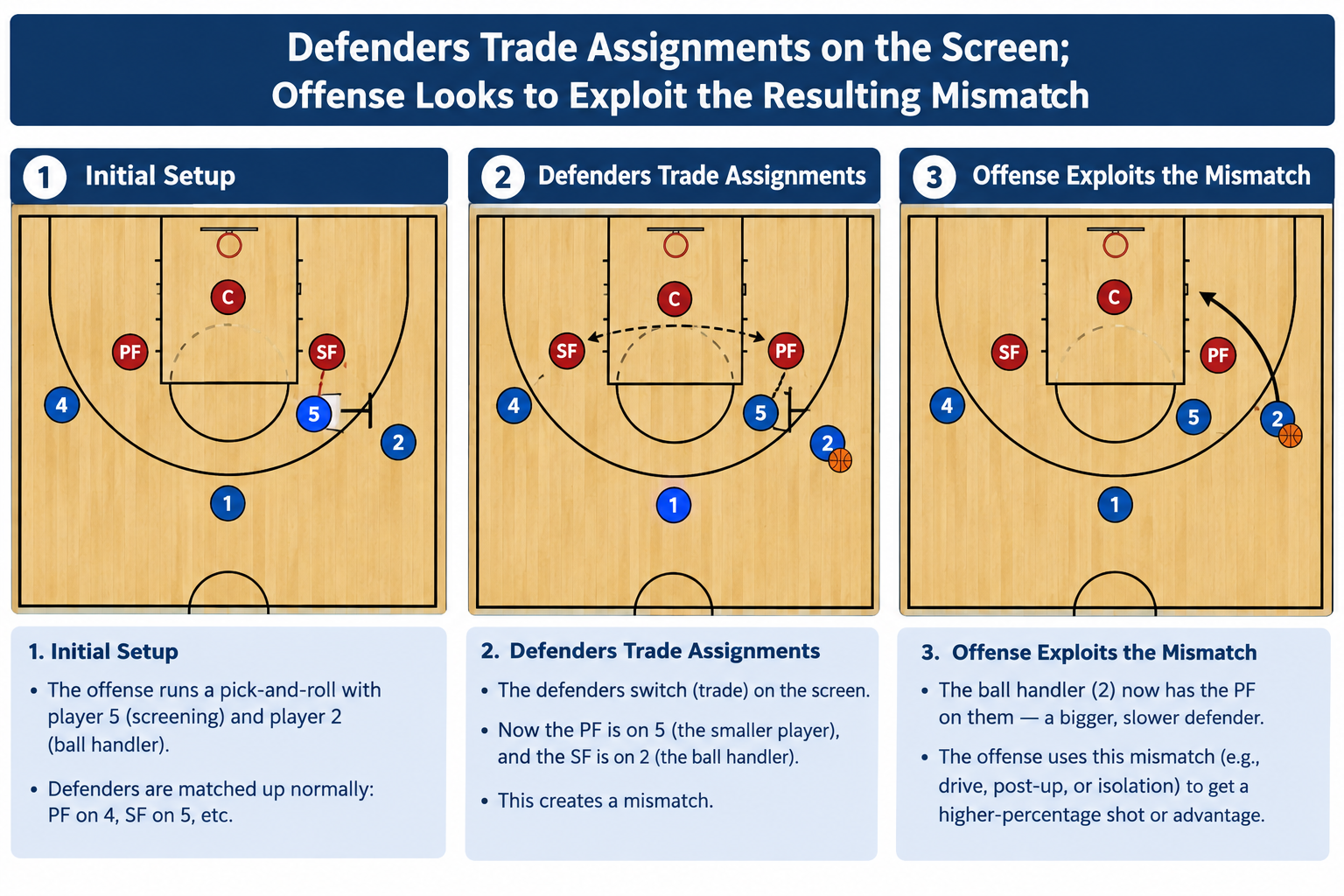
Defenders trade assignments on the screen; offense looks to exploit the resulting mismatch.
Hedge/Show (Coverage)
The screener's defender jumps out to temporarily contain the ball-handler before recovering; offense looks to hit the roller popping open behind the hedge.


lob
a high, arched pass thrown near the basket for a teammate to catch in mid-air and finish with a dunk or a layup, which together complete an Alley-oop