General Mechanisms of Alternative Enzymatic Reaction Routes
 Call Kai
 Learn
 Practice Test
 Spaced Repetition
 Match
 Flashcards
 Knowt Play
1/12

There's no tags or description
Looks like no tags are added yet.
13 Terms
Describe the function of enzymes.
Generally speaking, enzymes are a class of catalytic proteins that accelerate the reaction rate by decreasing the overall activation energy (Ea) barrier.
More specifically, enzymes help to decrease the overall Ea by having preferential affinity for the transition state over the substrate. This can be done by:
Increasing the binding affinity for the transition state through ≥1 mechanism(s) of catalysis.
Decreasing the “entropic cost” of reactions by structurally providing a predictable, pre-organized mechanistic pathway.
Increasing functional group reactivity.
Inducing conformational changes within the substrate-enzyme complex that facilitate bond-breaking interactions ideal for reaching the transition state.
Breaking the original Ea barrier into multiple smaller transition states.
Describe the significance of enzymes.
Obviously, the protein-ligand complex is not the final product of a reaction. The point of the reaction is to convert reactants into products; the activation energy (Ea) barrier is the hill the reaction must overcome to proceed to completion:
During the reaction, the complex undergoes a series of bond forming/breaking reactions that will result in the transition state.
The transition state is a high-energy, transient, unusable arrangement that represents the highest energy state of the reaction pathway.
This transition state represents the peak of an activation energy (Ea) barrier.
All reactions, both endergonic and exergonic, have an Ea barrier. Without enzymes, reactions would take forever to progress in the forward direction trying to overcome the Ea barrier.
This is because if we are banking on random-chance collisions, most of the interactions would yield unproductive arrangements, resulting in complexes that lack the energy to reach the transition state.
By lowering the Ea barrier, significantly more collision interactions will form a complex that possess enough energy to overcome Ea!
A shallow hill is much easier to climb than a steep mountain.
Enzymes accelerate the reaction rate 107-fold!!! CRAZY!!
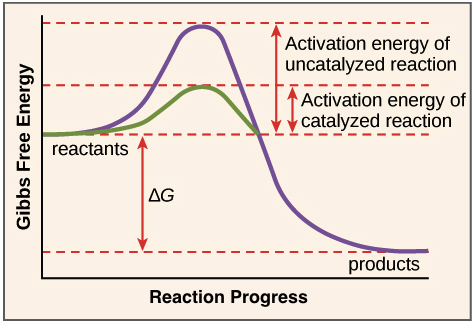
What’s wrong with this diagram?
This diagram is incredibly oversimplified.
Enzymes do not “magically shrink” the original activation energy (Ea) barrier; rather, as aforementioned, enzymes provide an alternative mechanistic pathway that’s not reflective of the original protein-ligand reaction pathway demonstrated above.
Protein-ligand pathway: P + L ⇄ PL ⇄ P’L
Enzyme-substrate pathway: E + S ⇄ ES ⇄ EX‡ → EP ⇄ E + P
It’s very different!
Illustrate and describe how an enzymatic pathway should be graphically represented.
This graph is a representation of the following pathway: E + S ⇄ ES ⇄ EX‡ → EP ⇄ E + P
This alternative mechanistic pathway breaks up the single, giant activation energy (Ea) peak into several smaller transitional humps and troughs, making it easier for the reaction to progress in the forward direction.

Identify the two (2) classifications of enzymatic catalysis.
“Over the Ea barrier” catalysis
“Through the Ea barrier” catalysis (quantum tunneling)
Identify the six (6) general mechanisms of “over the activation barrier” catalysis.
Enzyme-substrate proximity and orientation catalysis
Proton donor + acceptor catalysis
Electrostatic catalysis
Covalent catalysis
Metal ion catalysis
Bond strain catalysis
Explain proximity and orientation catalysis.
This is the basic idea behind of enzymes decreasing the “entropic cost” of reactions. Enzymes confer structural advantages by providing a predictable, pre-organized mechanistic pathway.
Enzyme-substrate interactions will orient reactive functional groups close to one another in a fixed, favorable geometry, increasing the reaction rate by ~107-fold.
It is literally impossible to match these reaction rates with an effective concentration.
Effective concentration: The concentration of free reactant required to match the collisional frequency of enzyme-mediated reactions.
It is important to note that conformational changes can occur during this process (refer to the induced fit model).
Explain proton donors/acceptors and how they’re involved in an alternative mechanistic pathway.
Charged arrangements yield unstable, high-energy molecules. Given this, stabilizing the charges would consequently stabilize the molecule, which is precisely what enzymatic acid-base catalysis achieves.
Enzymes can position acidic and/or basic functional groups at the active site to interact with substrates independent of environmental pH. This altered environment enables enzymes to modify the pKas of functional groups involved in acid-base catalysis.
Caveat: Enzymatic activity itself is still heavily dependent on environmental pH; however, environmental pH does not impact substrate-enzyme interactions at the active site.
The formation of an enzyme-substrate complex, at this point, initiates acid-base catalysis, which typically involves nucleophilic reactions:
This activates nucleophile and electrophile groups, initiating a nucleophilic reaction.
These reactions also stabilize leaving groups.
As a reminder:
Lower pKa = stronger acid = higher propensity for dissolution = proton donor
Higher pKa = stronger base = lower propensity for dissolution = proton acceptor
Explain electrostatic catalysis.
Electrostatic catalysis is THE LARGEST, MOST IMPORTANT contributor to an enzyme’s catalytic properties.
Notice how most of the mechanisms have some sort of overlap with electrostatic catalysis:
Preorganized fields: an enzyme’s active site is a pre-organized, optimized electrostatic environment that stabilizes developing charges as a reaction proceeds.
Desolvation: Enzyme-substrate binding displaces H2O from both the substrate and active site, lowering the local dielectric constant.
This strengthens electrostatic reactions between polar substrates and active sites.
Transition state stabilization: Enzymes form loose substrate-enzyme complexes and preferentially stabilize the transition state via R groups, metal cofactors, and electrostatic interactions (i.e., dipole interactions and ionic bonding).
Explain metal ion catalysis.
Metal ion play a key role in the following catalytic processes:
Charge stabilization and shielding
Caveat: due to a metal’s cationic properties, only negative charges can be stabilized by metal ions.
Oxidation and reduction
Ionizing water by behaving as a Lewis acid
The resulting hydroxide would behave as a stronger nucleophile than standard water.
Explain covalent catalysis.
Covalent catalysis lowers the activation barrier by dividing the original Ea barrier into two smaller transition states with lower Ea barriers, respectively:
(1) TS I: Covalent intermediate synthesis
During covalent catalysis, the substrate forms a transient covalent bond with the active site or a cofactor.
(2) TS II: Covalent intermediate breakdown
The product is formed, and the covalent bond must be broken to regenerate the enzyme.
Explain bond strain catalysis.
Bond strain catalysis is contingent on the principle of induced-fit binding, whereby the enzyme has preferential affinity for the transition state over the substrate.
Induced-fit enzymes initiate the following cascade of steps:
The substrate interacts with an enzymatic active site via long-range and short-range electrostatic interactions.
A loose substrate-enzyme complex is formed.
A series of conformational changes occur in the enzyme-substrate complex that strain the bonds within the substrate, weakening specific bonds.
These weakened bonds are now more susceptible to bond-breaking reactions that modify the substrate to more closely reflect the transition state.
The enzyme itself is already electrostatically pre-optimized for the transition state. The enzyme has stabilized the transition state in several ways in order to have the reaction proceed to completion in an energy-savvy way.
In addition to bond strain in the substrate, bond strain can also be induced within the enzyme to activate catalytic residues inside the active site.

What is “through the activation energy barrier” catalysis?
Some enzymes have been observed to operate with faster kinetics than predicted by standard Gibbs free Ea calculations. The mechanism these enzymes may be operating on is quantum tunneling.
The principle of quantum tunnelling is built upon on the wave properties of protons and electrons:
Quantum mechanics posits the non-zero possibility of particle waves simply “passing through” an Ea barrier instead of going over one, creating a shortcut that enhances rate constants by 1000-fold compared to conventional “over the barrier” mechanisms.