Exam 1 - Microbiology
 Call Kai
 Learn
Learn Practice Test
 Spaced Repetition
 Match
Match Flashcards
 Knowt Play
1/35

There's no tags or description
Looks like no tags are added yet.
Name | Mastery | Learn | Test | Matching | Spaced | Call with Kai | Chat |
|---|
No analytics yet
Send a link to your students to track their progress
36 Terms
Kitasato Shibasaburo’s contribution & Yersin got to name the bacteria
Shibasaburo found the bacteria that caused the bubonic plague, but he didn’t have enough scientific proof. However, Yersin did have enough proof, so he got to name the bacteria.
What is microbiology?
the study of microorganisms
What are considered microorganisms
Prokaryotes (bacteria & archaea), some small eukaryotes (fungi & yeast), viruses
Human Health
they help to digest our food
they make vitamins for us (they are an extension of our genomes)
they help prevent infections by pathogenic microbes
Model systems
for basic studies of biological processes
because microorganisms can reproduce quickly
Nutrient Cycling/global economy
microbes help cycle nutrients and help with new species on our Earth
the process where microorganisms break down, transform, and regenerate essential chemical elements so they can be reused by other living organisms. Microbes act as the primary driving force behind global biogeochemical cycles, turning dead organic matter and rocks into available nutrients
Human use of microbes
Wastewater treatment - microbes are used to clean wastewater
Bioremediation - microbes are used to clean contaminated environments
Biotech applications - microbes can be genetically modified to produce high-values products such as pharmaceuticals and enzymes
Food fermentations - yeast/bread, food
Industrial fermentations - microbes are used at industrial scale to make chemicals, solvents, enzymes, and pharmaceuticals
Biofilms - microbes grow on surfaces and can foul pipes and pipelines
Biofuels - microbes are used to convert biomass into ethanol and wastes into natural gas (methane)
Important facts about microbes
They contain the majority of the biomass on the planet (more than all plants and animals combined)
There are about 1030 microbial cells on Earth
They can be found several kilometers up in the atmosphere and at least 10 km below the Earth’s surface
There are more microbial cells associated with your body than there are human cells
Key historical events
Visual observation of microbes
Defeat of the theory of “Spontaneous Generation”
Demonstration of infectious disease and acquired immunity
Robert Hooke
probably the first person to observe microorganisms
Coined the term “cell”
Wrote the first book on microscopic observations: Micrographia
Antoni van Leeuwenhoek
his hobby was lens grinding
constructed his own single lens microscope
Royal society of London published his letters
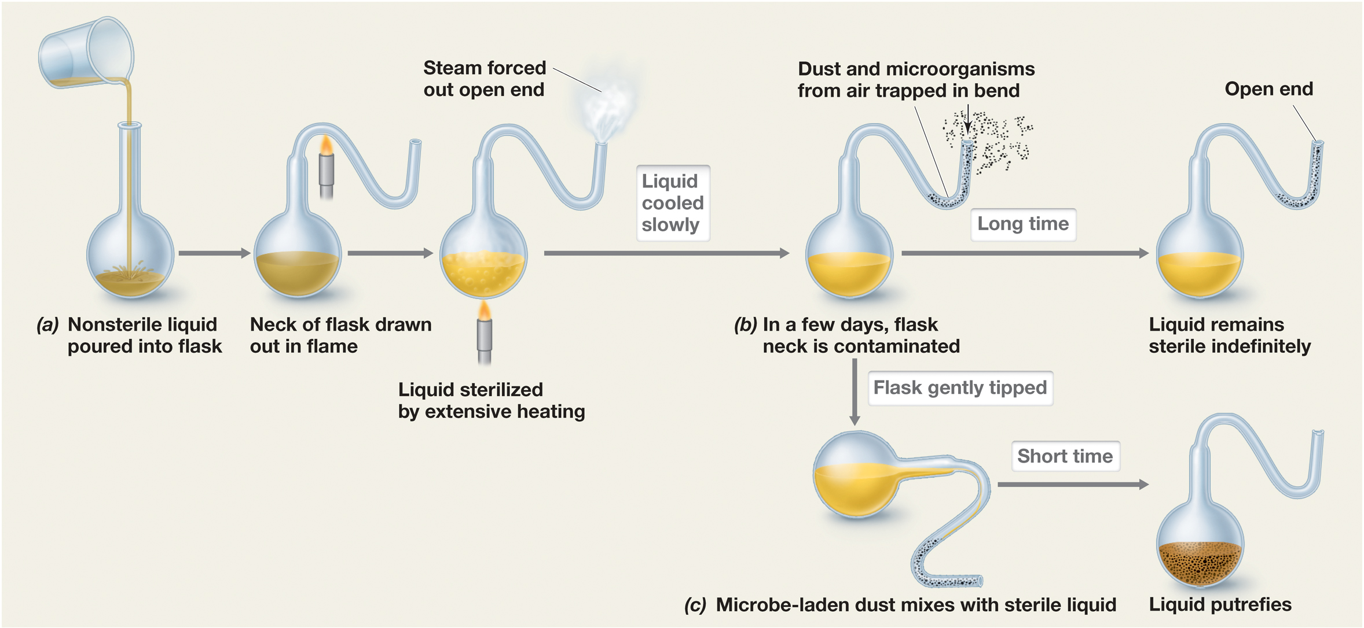
Spontaneous Generation
the idea that living organisms formed spontaneously from natural elements (i.e. germs, maggots, and mice would “magically” appear if you left food to rot)
Early experiments showed that if the food was heated and then sealed from the air, then the rot
Vital force
organic compounds come only from living things because they need a special, God-given life energy that humans cannot make in a laboratory
Seed/germ theory
invisible "seed-like" particles spread infection
Louis Pasteur
Swan-necked flask
to conclusively disprove the theory of spontaneous generation and prove that microorganisms come from other pre-existing microorganisms
Germ theory of Disease
Edward Jenner → vaccination for small pox from cow pox
Louis Pasteur → vaccines for anthrax, fowl cholerae, and rabies
Joseph Lister → concept of disinfection of wounds and surgical rooms
Robert Koch
Pure culture techniques
Koch first used potato slices, gelatin, or starch under a bell jar
Petri dishes, Julius Petri
Gelatin (mp = 28C, metabolized) vs Agar (37C, not metabolized)
Spread plate (dilute in liquid, then plate) vs Streak plate (dilute on plate itself using loop)
Each colony arises from a single cell! All the cells within a colony are identical! Each colony is a “Pure culture”
Koch’s Postulates
Rules for clearly demonstrating the cause of an infectious
The organism should be present in all animals suffering from the disease and should not be present in healthy individuals
The organism should be grown in pure culture away from the animal body
Cells from the pure culture, when inoculated into susceptible animals, should cause the disease symptoms
The organism should be re-isolated from these experimental animals and cultured again in the laboratory, after which it should still be the same as the original organism
Koch Postulates - FAILS
Viruses
Environmental microbiology
not all bacteria cause infections
the scientific study of microorganisms—such as bacteria, fungi, viruses, and algae—and their interactions with each other and their natural or artificial surrounding
Enrichment techniques
Place an environmental sample under conditions that select for optimal growth of an organism with specific metabolic capabilities
Martinus Beijerinck and Sergei Winogradsky
isolates specific microorganisms from environmental soil and water samples
Demonstrated:
Chemolithotrophy
Fixation of CO2 independent of photosynthesis (not always associated with photosynthesis)
Fixation of atmospheric nitrogen into cellular nitrogen
Chemolithotrophy
the use of inorganic compounds (sulfur, ammonia, etc) to obtain energy
Magnification
the extent to which the image of an object is larger than itself
20x = 200x
40x = 400x
100x = 1000x
Magnification Calculation
Object lenses x Ocular lenses = magnification of an image
Resolution or resolving power
the degree to which details are retained in a magnified image; the ability to distinguish between two points
Resolution Equation
R = 0.5(wavelength) / NA

light wavelength (assume ~500 nm)
NA
numerical aperture
the light gathering ability of the lens
Best condition for standard light microscopes
with standard light microscopes, the best resolution with 1000x magnification is 200nm = 0.2 microns = 0.2 µm
Main limiting factor in light microscopy
Resolution
Why use oil in a 100X?
use of an oil immersion lens increases the NA (numerical aperture) of the lens
Bright field microscopy
most common in general microbiology labs
light is transmitted through the specimen
How do you generate contrast
contrast between the background and the cells is generated by absorption or scattering of light
Why cells end up dead
staining of cells is generally required
staining tends to kill cells
dead cells take up more stains than live cells