Bio 104 Exam 1
 Call Kai
 Learn
Learn Practice Test
 Spaced Repetition
 Match
Match Flashcards
 Knowt Play
1/87

Earn XP
Description and Tags
Name | Mastery | Learn | Test | Matching | Spaced | Call with Kai | Chat |
|---|
No analytics yet
Send a link to your students to track their progress
88 Terms
Ecological Footprint
The amount of actively used land needed to provide all the resources that a population uses and to absorb all the waste it creates
Carbon Footprint
The total amount of greenhouse gases emitted directly and indirectly by an individual, organization, or population, measured in carbon dioxide equivalents. One of the main reasons that humanity’s Ecological Footprint has grown so much
Biocapacity
The amount of actively usable land available to meet the resource needs of the human population
Ecosystem Services
The benefits that we, as humans, derive from ecosystems
Supporting Services
Processes needed for the production of other services, such as primary production, nutrient cycling, and soil formation.
Provisioning Services
Goods that people consume directly, like food, water, timber, fuel, etc
Ecosystem Services
The benefits we get from regulating the ecosystem, such as water purification, climate regulation, flood control, disease regulation, and crop pollination.
Cultural Services
Things that benefit humans through their beliefs and other nonmaterial aspects, such as spiritual, aesthetic, cultural, educational, and recreational benefits.
Net Primary Production (NPP)
Net primary production (NPP) indicates how quickly primary producers are adding biomass. More formally, it is the difference between gross primary production and autorophic respiration. Humans take it away not only from other species but also from the ecosystem, straining ecosystem services
Gross Primary Production
A measure of the rate at which new organic matter is being synthesized
Drama of the Commons
With open-ocean fisheries, overfishing is often an issue, even taking into account how valued the resource is. As individual fishers take more than their share of resources- an action that doesn’t necessarily cost them much- their shared actions build up to deplete a resource, causing the potential loss of the entire resource.
What does it mean to be a “biologist?”
Someone who studies life in all of its forms like cells, molecules, entire organisms, or entire ecosystems
Scientific Method & most important step
Its the process used by scientists and people involved in scientific inquiries where you use observations, hypotheses, predictions, experiments, and analysis to answer questions methodically. Most important step is texting of hypotheses through repeatable experiments
Hypothesis vs Theory
A hypothesis is a suggestion for the explanation of the observation. A theory is an explanation that has already been run through the scientific method many times and has been tested and is supported by evidence in those tests.
What is study of natural sciences
It means that you study the natural and physical world like organisms, matter, phenomena and processes within those things.
Natural sciences vs life sciences vs physical sciences
They are all used to study the natural world. Natural science is the most broad, encompassing the others within itself. Life sciences focuses on only on things that are living. Physical sciences mostly focuses on nonliving things and processes.
Primary objective of people who do science
To understand how things and processes within the universe and earth work which they do by asking questions about things they see and gathering evidence to better understand them.
Inductive Reasoning
Using specific observations to create a general conclusion. An example of this is seeing the social behaviors that animals experience and concluding that social behavior might be advantageous in evolution.
Deductive Reasoning
Using a general idea and applying it to a specific prediction. An example is that if warm climate affects where organisms can live then global warming will change where certain organisms live.
Descriptive science vs hypothesis-based science
Descriptive science observes and explores the natural world and tries to identify patterns within it. Hypothesis-based develops hypotheses for phenomena and tries to explain it with tests. They depend on each other because you need observations to create questions and hypotheses.
Steps in scientific process
Observation, question, hypothesis, prediction, experiment, analysis
Hypothesis vs prediction
Hypothesis explains why something happens but a prediction is what should happen if they hypothesis is correct. However they both have to do with what scientists think will happen
Applied vs basic science
Basic science increases knowledge, while applied science uses knowledge to solve practical problems. Neither is better because applied science often depends on basic science.
Scientific paper vs review article
A scientific paper reports original research, while a review article summarizes previously published research.
Properties of life
Order, response to stimuli, reproduction, adaptation, growth, homeostasis, energy use, and evolution. One property alone is not enough to define something as living.
What does living organisms having “order” mean
Living things have organized structures, such as cells forming tissues and tissues forming organs.
How do living organisms respond to stimuli
Plants can bend toward light or fold their leaves when touched, while bacteria can move toward or away from chemicals.
What does it mean for organisms to reproduce
Organisms produce offspring and pass their genetic information to them.
What is adaptation and why is it a hallmark of life
An adaptation is a trait that helps an organism survive and reproduce in its environment.
How does genetic material help with growth and development
Genes contain instructions that direct how cells grow and how an organism develops.
Explain homeostasis in the context of life
Homeostasis is the maintenance of relatively stable internal conditions despite changes in the environment.
In what ways do living organisms use energy
Organisms use energy to carry out metabolism, growth, movement, and other life processes.
How do mutations contribute to diversity and evolution
Mutations create genetic variation, which can lead to new traits that natural selection may favor.
Species Richness
The number of species in a specified area, higher species richness along the equator
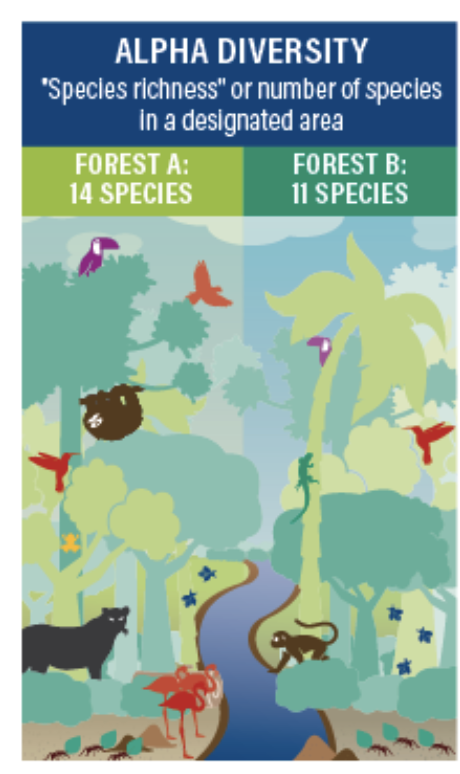
Alpha (local) diversity
The local diversity or the number of species found in a specific, relatively homogenous site
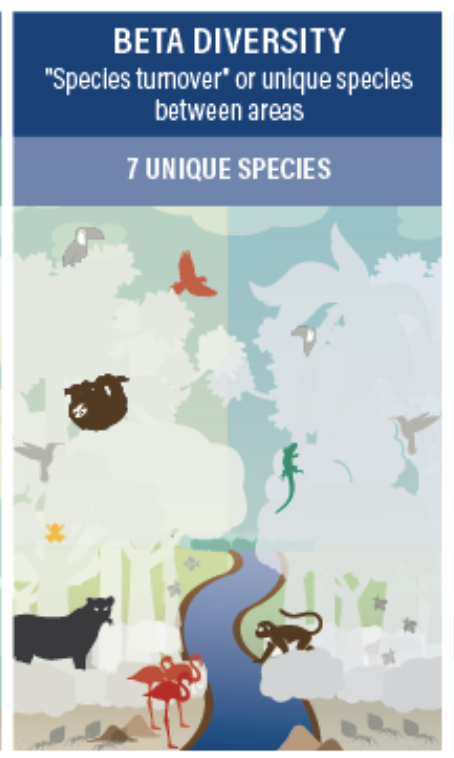
Beta diversity
Species turnover or the change in species composition over short distances (between sites). Higher in distinct habitats because they would house different species, species wouldn’t be the same or moving between the two of them
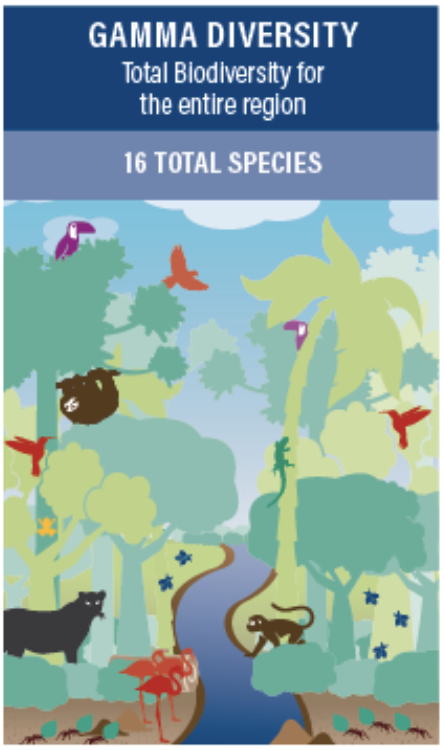
Gamma diversity
Regional diversity, the number or species in a broad geographic region (ranging from communities to biomes, continents, or even entire ocean basins)
Sampling effort
A measure of the effort made when sampling a population or community
Quadrat sampling
A frame that is used to isolate a sample, when the habitat is divided into rectangles of a known size and a certain number of quadrats is examined and the species within it are recorded
Species accumulation curve
A plot of cumulative number of species found, in a defined area, versus sampling effort
Sampling error
When measurements are made from a sample not the whole population and with bigger samples or controlling bias the errors would’ve been eliminated

Shannon-Wiener Index
pi is the proportion of individuals that each species (from i=1 to S=the total number of species) contributes to the total in the sample

Shannon-wiener vs species richness
Species richness shows simply the number of species whereas the Shannon-Wiener index takes into account the evenness of the species, how evenly the individuals are spread among the several species
Transect sampling
When a biologist identifies a straight line of a known distance through the habitat and they record the species within the area of the transect
Rarefaction plots
They consider the number of samples (individuals) relative to the number of species. As more individuals are sampled, generally more species are identified though as the sample size grows, the curve flattens. The flattening tells researchers how close they are to completely quantifying biodiversity
Functional diversity
The role the organism plays in an organism
Endemic species
Species only found in one geographic location
Ecology’s oldest pattern
More species diversity and richness along the equator
Buffon’s law of diversity
The idea that despite the fact that different parts of the globe have similar climates, different regions of the globe have distinct biotas
How many tropical beetle species did Terry Erwin predict exist
30 million
Why is solar radiation more intense at equator than poles?
Because solar radiation hits equator directly, concentrating in one area moving through less atmosphere and covering a larger area. Hits poles at oblique angle
What contributes to seasonality?
The tilt of the Earth's axis and its orbit around the sun, which affects the angle and intensity of solar radiation received at different latitudes throughout the year.
What contributes to Hadley cells?
Solar radiation warming up air, especially at the equator, warm air absorbing moisture and rising with that moisture, rising air cooling and forming clouds with moisture, cool air not holding moisture so precipitation occurs, now dry cool air is pushed away towards poles by still rising air, cool dry air sinks, dense dry air flows towards equator. They all disperse heat from solar energy, drive weather systems, and determine patterns of surface winds across the globe.
Why do we see tropical rainforests at the equator
Because of the consistent, stable precipitation caused at the equator by solar radiation warming air, which picks up moisture and causes precipitation as it rises. There are other factors, like air circulation (Hadley cells) and dense vegetation at the equator, causing much of the water to be put back into the atmosphere through transpiration, causing a continuous cycle of humidity in rainforests.
What makes biomes different or similar to each other?
Biomes differ from one another based on precipitation, types and numbers of species found within them, general temperature, and how easy or difficult it is to sustain life within them. Many biomes with similar longitudes have common characteristics like temperature and rainfall, and biomes closer to or farther from bodies of water tend to have similarities in precipitation and vegetation.
Why are there dry biomes at certain longitudes and wet biomes at the equator
Air circulation like Hadley cells causes strips of desert to appear at certain longitudes of the globe
Ecosystems
All of the biotic (alive) and abiotic (nonliving) factors of a specific location and how they interact, how energy flows through the system, and how matter cycles through it.
What of GPP, NPP, and Ra do Autotrophs do vs Heterotrophs
Autotrophs do all of them whereas heterotrophs only do NPP and Ra because they do not produce their own energy through photosynthesis
Biomass
It is the amount of organic tissue(s) in an organism. It is measuring living tissue though it can sometimes include non-living portions in the estimates.
Net Ecosystem Production vs NPP
It is all the biomass produced through photosynthesis that isn’t used for respiration. The difference between NEP and NPP is that NEP specifically always has to do with an entire ecosystem whereas NPP is more general and can be scaled down all the way to individual organisms or scaled up to multiples or even ecosystems.
Climate vs weather
Weather is a way to describe the attributes of the atmosphere (temperature, rainfall, wind, etc) in a particular place on a short-term scale, only a few days or months in advance. Climate describes the atmosphere in the long-term, usually describing atmospheric behavior over 30 years or more.
What does anomaly mean with climate?
An anomaly is a word used to describe measured or observed data as it is compared to its long-term average.
Why does scale matter with climate trends
When scientists collect data at a smaller scale, like a local scale, it can make it much harder to accurately read the signal because local weather can have much more noise. Collecting data from several sites to make it a more regional or global scale will make the signal much easier to identify and eliminate much of the noise.
How can we measure Earth’s climate from the past?
Ice cores, wood, coral, and plankton
How can we measure global warming through atmosphere, lithosphere, and hydrosphere
The hydrosphere is measured through the attempts of precipitation records (though they contain lots of noise), satellites observing water vapor over land and sea, and regional measures of droughts and precipitation intensity. The atmosphere can be measured in concentrations of greenhouse gases, outgoing thermal radiation leaving the planet, and concentrations of water vapor and aerosols. The lithosphere can be measured in soil and land temperatures, the thawing of permafrost, and the amount of snow cover and the timing of the spring snow.
How are growing seasons affected by global warming?
They have increased, in the US by about 2-3 weeks
What causes dead zones?
Dead zones are primarily caused by excessive nutrient pollution, leading to algal blooms that deplete oxygen in water and cause oxygen usage by decomposers, resulting in hypoxic conditions.
Why are nutrients important for organisms?
Organisms use those nutrients in large amounts to be able to produce biomolecules. Plants and primary producers can usually get their nutrients from inorganic forms, though animals usually obtain nutrients from the organic molecules they eat.
What is a limiting nutrient
A limiting nutrient is a nutrient that stimulates more primary production. Primary production would be limited without it
What does it mean that the nitrogen cycle is biologically mediated?
Biological mediation means that some transformation is being performed by bacteria. The nitrogen cycle is biologically mediated because nitrogen fixation, nitrification, and denitrification are all biologically mediated.
What are the 5 pools of the nitrogen cycle
Atmospheric nitrogen, which is found in the atmosphere as N2; ammonium NH4+, which is found in soils; nitrate NO3-, which is found in soils as well; plant nitrogen, which is found in living plant tissue; and soil organic nitrogen, which is found in the soil.
Nitrification
Where bacteria converts ammonium to nitrate as they synthesize organic matter
Denitrification
where bacteria transform nitrate into dinitrogen gas as they break down organic matter
Immobilization
where bacteria and fungi absorb bioavailable forms of nitrogen—amonium and nitrate from the soil and incorporate it into their tissues
Litterfall
the rate at which nitrogen in dead plant material is added to the pool of soil organic matter like detritus dropped from trees, grasses, flowers, and shrubs
Nitrogen Fixation
where dinitrogen gas is converted into ammonium
Mineralization
where microbes release bioavailable inorganic nitrogen as ammonium. Happens during decomposition
Plant Uptake
where plants take up inorganic nitrogen—ammonium and/or nitrate from the soil and incorporate it into plant biomass
Leaching
Where nitrate is washed away from the soil into water bodies, potentially leading to pollution.
Volitization
The process by which ammonia is converted into gaseous forms and lost to the atmosphere
Disturbances to ecosystems
Disturbances are things that disrupt an ecosystem and are caused by changing abiotic or biotic conditions. They are things like fires and floods, avalanches and landslides, oil spills and clearcuts. They can change soil microbial communities, accelerate or slow down nutrient flows, and cause the loss of nitrogen into water systems or the atmosphere.
Hubbard Brooks Experiment
Scientists clear-cut one watershed and compared it to an untouched one. They found that removing trees caused much more nutrient loss into streams.
How does the nitrogen cycle contribute to acid rain?
Nitrogen oxides enter the atmosphere and react with water to form nitric acid, which falls as acid rain.
Nitrogen cycle in aquatic systems vs terrestrial systems
The cycle is affected by the gravitational pull of a stream, and it is shaped like a spiral. It is also affected by many different things like types of aquatic system it is in, seasonal changes, and water temperature.
What form of carbon does most carbon fluxes involve
Carbon Dioxide CO2
What is the primary regulator of atmosphere CO2?
Oceans
Carbon Fixation
Photosynthesis
Soil Respiration
How soil carbon becomes atmospheric CO2