Dual Chamber Timing Cycles
 Call Kai
 Learn
 Practice Test
 Spaced Repetition
 Match
 Flashcards
 Knowt Play
1/10

There's no tags or description
Looks like no tags are added yet.
11 Terms
Dual Chamber Timing Cycles
Primary device settings which dictate device function
Refractory and alert periods are programmable to allow for customization of the pacemaker to meet the patient’s specific needs
Prevent oversensing of intrinsic events, such as far-field R waves and retrograde P-waves
Help the pacemaker mimic a normal heart’s sinus activity and conduction system
These same timing cycles are used in pacemakers, ICDs, and CRT-Ds
Upper rate behaviors can occur when timing cycles are programmed inappropriately
Dual-Chamber Pacing
Two leads (one in atrium, one in ventricle)
Two “channels” or circuits (atrial and ventricular)
Does everything a single-chamber pacemaker does in each channel PLUS helps atrium and ventricle interact together
Goal is 1:1 AV synchrony
DDD Function
When a pacemaker is programmed to DDD mode, one of four behaviors will occur:
AP-VS
AS-VS
AS-VP
AP-VP
A patient may experience but often one or two states dominate
Atrial Pacing and Ventricular Pacing
Will typically occur in those who require constant AV pacing
Sinus node dysfunction and heart block

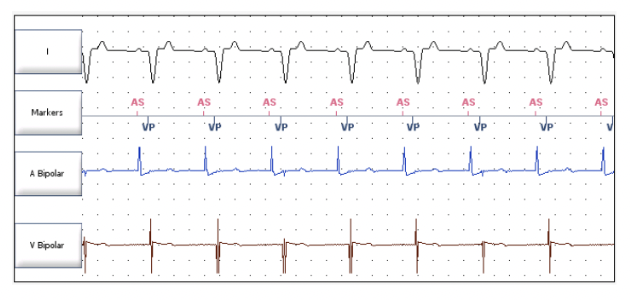
Atrial Sensing and Ventricular Pacing
1:1 AV synchrony can occur when the patient has intrinsic atrial activity
Pacemaker senses atrial activity and paces ventricle in response
Known as atrial tracking
Often occurs in those with normal sinus activity and intermittent or complete heart block
Atrial Pacing and Ventricular Sensing
Pacemaker consistently paces the atrium and the impulse conducts down the AV node to create a ventricular contraction
Often observed in patients with sinus node dysfunction and intrinsic AV conduction

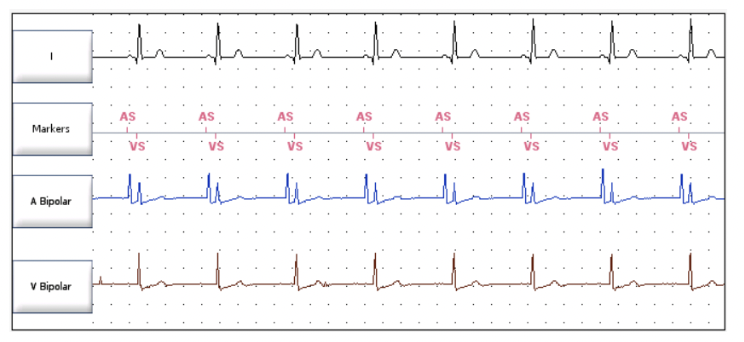
Atrial Sensing and Ventricular Sensing
No need for pacing most of the time
Intrinsic activity inhibits the pacing pitputs
Often seen in those with intermittent cardiac dysfunction
Sinus arrest
Neurocardiogenic syncope
Timing Cycles
Exist on each channel and interact with the other channel
Atrial
Ventricular
Have an affect on when and where the device paces and senses
Refractory Periods
Device can “see” signals, but does not respond to or track them
Blanking Periods
Device’s sensing circuits are completely closed, no activity is seen
Alert Period
Device is able to sense and respond to intrinsic activity