ap chem equilibrium
 Call Kai
 Learn
 Practice Test
 Spaced Repetition
 Match
 Flashcards
 Knowt Play
1/31

There's no tags or description
Looks like no tags are added yet.
32 Terms
chemical equilibrium
state where concentrations of products and reactants remain constant
top curve reactants
bottom curve products
+ forward reaction rate equals reverse reaction rate
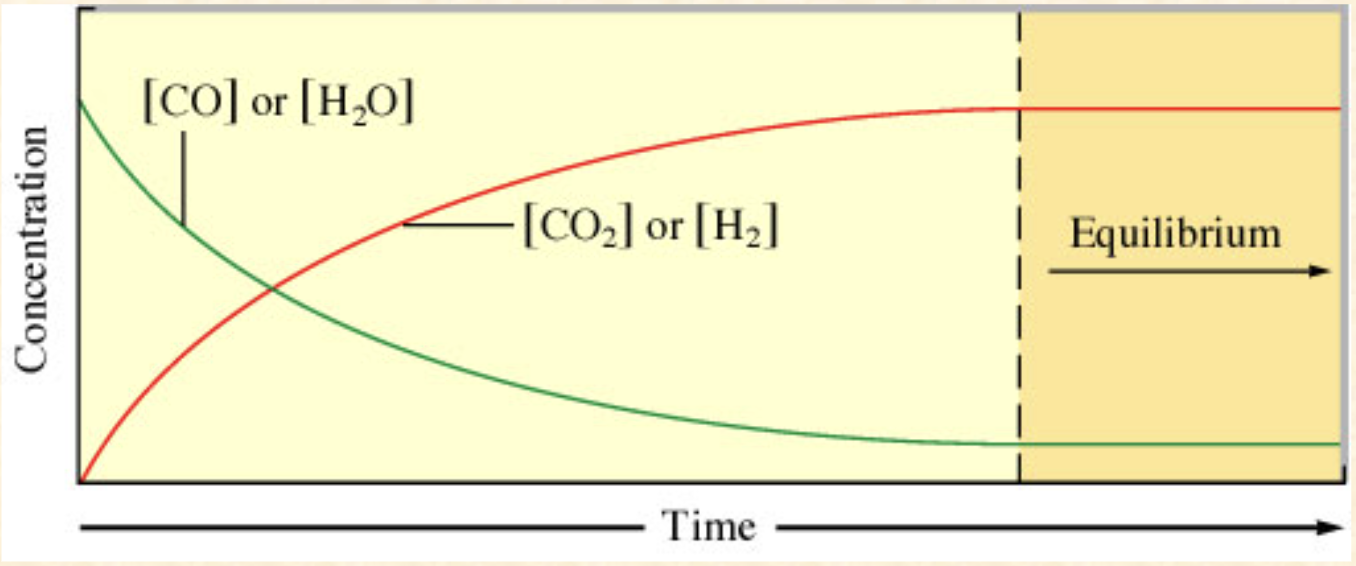
equilibrium reaction rate vs time
top curve: forward rate
bottom curve: reverse rate

big K
Kc = K = Keq
K changes with temperature (not [ ] or pressure)
size of K and time needed to reach equilibrium unrelated
Shortcuts
reversed products and reactants: Kc’ = 1/Kc
original reaction multiplied by some factor (coefficient n in front of it): Kc’ = Kcn
2 step reaction: K3 = K1 * K2
Kp TTR
DONT USE BRACKETS
measured in atm
Kc and Kp relationship
if diff amount of gas moles in prod/reactant:
Kp = Kc(RT) Δn R = 0.08206 Latm/molK
T = Kelvin temperature
Δn = #moles gaseous product - # moles gaseous reactant
if same amount of gas moles in prod/reactant:
Kc = Kp
dont include what in equilibrium expressions
pure solids (s) and pure liquids (l), these have no effect on position of equilibrium
(known as Heterogeneous Equilibria)
K>1 and K<1
K>1 means that the equilibrium is far to the right (mostly products).
K<1 means that the equilibrium is far to the left (mostly reactants).
**Values for K in the range of 0.001 to 1000 describe reactions where reactants and products are both present in significant quantities at equilibrium.
big Q
calculated like Kc, but uses initial concentrations instead of equilibrium concentrations
Q=K
then system is at equilibrium (no shift occurs)
Q > K
too much products, [product]/[reactant] is too large (system shifts to produce more reactants or the reverse reaction is favored)
Q < K
too much reactants, [product]/[reactant] is too small (system shifts to produce more products, or the forward reaction is favored)
what happens to K in LeChatelier’s
DOES not change when there are stressors, remains equal
K only changes with temp
not concentration, pressure/volume, catalysts, inert gasses
What’s happening in the graph?
T1: equilibrium is established, flattening
T2: Nitrogen injected into system
between T2 - T3: reaction is favoring the formation of products to reestablish equilibrium
T3: equilibrium is re-estalished

exothermic
reactants → products + heat
delta H is negative
An increase in temperature of an exothermic reaction will cause equilibrium to favor the reverse reaction → K will decrease. ([reactants] will increase, [products] decrease)
A decrease in temperature of an exothermic reaction will cause equilibrium to favor the forward reaction → K will increase. ([reactants] will decrease, [products] increase)
endothermic
reactants + heat → products
delta H is positive
An increase in temperature of an endothermic reaction will cause equilibrium to favor the forward reaction → K will increase. ([reactants] will decrease, [products] increase)
A decrease in temperature of an endothermic reaction will cause equilibrium to favor the reverse reaction → K will decrease. ([reactants] will increase, [products] decrease)
changes in pressure only affect
equilibrium system with GASEOUS products/reactants
Increasing the pressure of a gaseous system will cause equilibrium to shift to the side with fewer gas particles.
Decreasing the pressure of a gaseous system will cause equilibrium to shift to the side with more gas particles.
If the system has the same number of moles of gas on each side, changes in pressure do not affect equilibrium.
Adding an inert gas does not affect equilibrium since the partial pressures of the gases in the reaction are not affected.
inert gases
noble gases (row 18)
adding a catalyst
doesn’t affect equilibrium position, only affects the time it takes for a reaction to reach equilibrium
lechat secondary reactions
Common secondary reactions:
Reaction forms a precipitate
Acid/Base reactions: Acids (for now compounds starting with H) = produce, H+ Bases(for now ionic hydroxide compounds) = produce OH-
Net ionic equation: H+(aq) +OH-(aq) → H2O
review SNAP solubility rules
ionic compounds containing sodium Na⁺, nitrate NO₃⁻, ammonium NH₄⁺, and potassium K⁺ are always soluble in water
no precipitate formed
usually spectator ions in net ionic eq.
solubility
max quantity of a substance that dissolves to form a saturated solution at a given temperature
molar solubility
max number of moles of the solute that dissolves to form a liter of saturated solution; given in mol/L. (S = molar solubility)
saturated solution
solution that contains the max amount of solute for a given temperature.
The rate at which the solid solute dissolves equals the rate at which the dissolved solutes precipitate
Ksp (solubility product) - “insoluble salts are actually slightly soluble”
the equilibrium constant for the equilibrium between an ionic solid and its saturated solution (no unit of measurement)
or a special type of equilibrium constant that measures how much of a poorly soluble ionic solid can dissolve in water at a specific temperature
ksp often only contains aq products side
below, equal, and above to ksp meaning; or comparing Q to Ksp to see if ppt forms
below (<): unsaturated, no solid precipitates
equal (=): exactly saturated, no solid precipitates (yet)
above (>): supersaturated, solid precipitates
smaller ksp values indicate
lower solubility (reactants dominate final reaction mixture, more solid present)
… so larger ksp values indicate more solubility (products dominate final reaction mixture, more ions present)
Ksp values cannot be directly compared if
if the compounds dissociate into different numbers of ions
ex. AgI and Ca3(PO4)2
need to solve for S (solubilities) in order to compare
even if the volume of water changes in a saturated solution, the concentration of ions
will stay the same
proof:
• If you add water (increasing the volume), the system is temporarily diluted, so some of the extra solid dissolves until the solution becomes saturated again.
• If you remove water (evaporating it down), some dissolved ions precipitate out as solid.
• In both cases, once the system re-reaches equilibrium at the same temperature, the concentration of the ions goes right back to its original solubility limit
common ion
when an ionic compound, which is added to an aq. solution, that has an ion in common with the equilibrium reaction —> decrease the solubility of a compound
when to ignore +x or +2x of common ion
small Ksp (less than 10-4) meaning very little solid dissolves at equilibrium
The initial concentration of the common ion ex. 0.050 M I- is significantly larger than the amount that will dissolve.
dont ignore it when: Ksp is greater than 10-4
dilution shortcut
when volumes are equal and then combined, concentrations are halved
ex. if 400 mL of each solution in the previous problem were combined, the resulting concentrations would be
[Ba2+] = 0.0400/2 = 0.0200M
and
[SO42-] = 0.0800/2 = 0.0400M
For solids, as temperature increases, solubility...
increases: the added heat supplies the energy needed to break the bonds holding the solid particles together
pH and solubility, Compounds with anions exhibiting basic properties…
(e.g., Mg(OH)2 / OH–, CaCO3 / CO32–, CaF2 / F–)
inc in solubility as solution becomes more acidic.
H+ removes the OH-, leads to shift right, solubility increases
if you add like NaOH what happens
if H+ or like H3O+ is on product side OH- removes it and makes H2O, so rxn will shift right to make up for lost products