MBB2 - Personality Psychology
 Call Kai
 Learn
 Practice Test
 Spaced Repetition
 Match
 Flashcards
 Knowt Play
1/45

There's no tags or description
Looks like no tags are added yet.
46 Terms
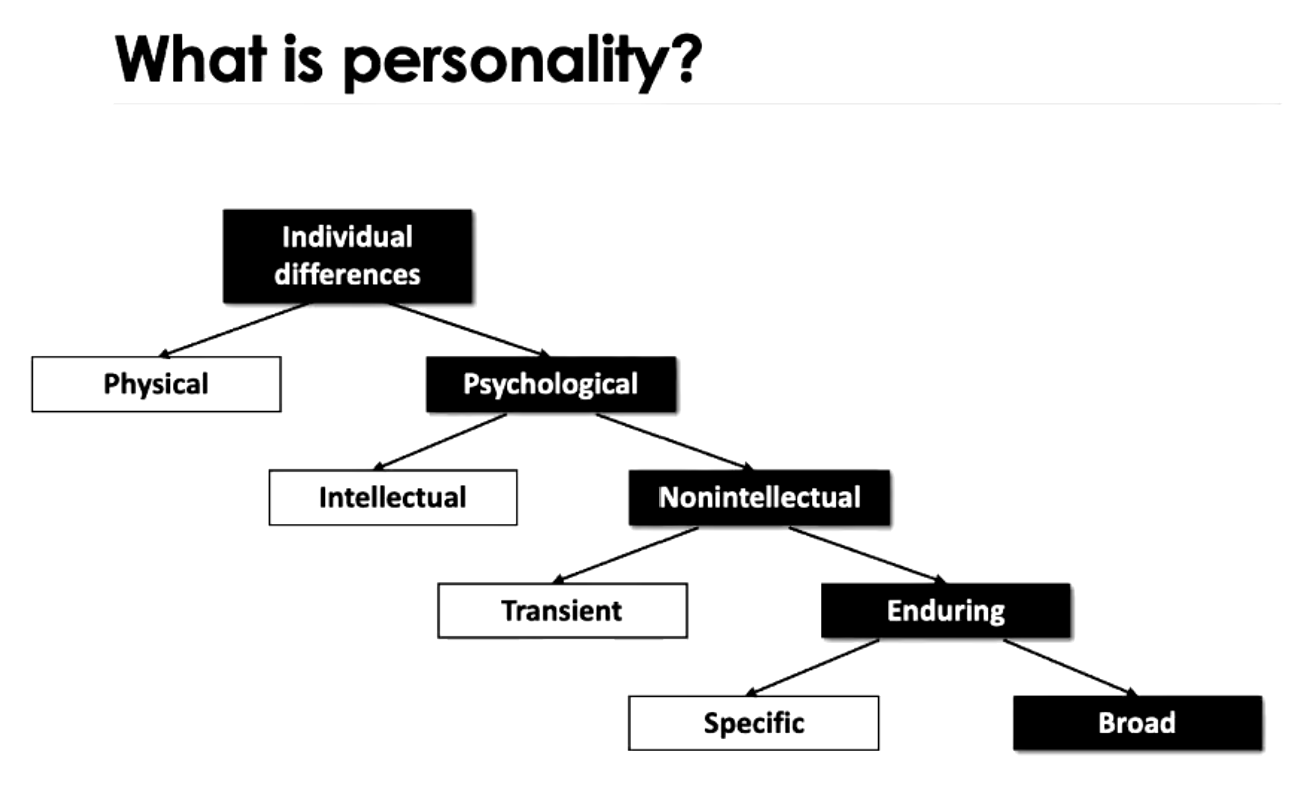
PERSONALITY
how we are psychologically diverse. refers to enduring relatively broad psychological differences between people, excluding cognitive abilities
PERSON PERCEPTION
judging other peoples personalities - usually happens in 250ms or less
STEREOTYPES
personality traits believed to be associated with social groups
PERSONALITY TRAITS
the way you think feel and behave is consistent over time and in different situations
CARTELL’S 16 PERSONALITY FACTORS

THE BIG FIVE
5 dimensions of which all personality traits are influenced
O - Openness to Experience
C - Conscientiousness
E - Extraversion
A - Agreeableness
N - Neuroticism
EXTRAVERSION (the big 5)
HIGH
sociable, energetic, enthusiastic, assertive
LOW
shy, reserved, quiet, retiring
low cortisol arousal leading to desire for stimulation
AGREEABLENESS (big 5)
HIGH
warm, modest, kind, trusting, helpful
LOW
cold, unfriendly, quarrelsome
CONSCIENTIOUSNESS (big 5)
HIGH
efficient, organised, thorough, self-controlled
LOW
careless, irresponsible, frivolous
NEUROTICISM (big 6)
HIGH
tense, irritable, moody, nervous, high-strung, low self esteem,
LOW
stable, calm, contented, unemotional
vulnerability to depression
limbic system reactivity
leads to great autonomic NS arousal to threat and stress
OPENNESS TO EXPERIENCE (big 5)
HIGH
imaginative, original, sophisticated
LOW
simple, shallow, conventional, narrow
VALUES
concepts or beliefs about desirable states or behaviours that transcend specific situations
they are cognitive, linked to motives and desired, they are learned

VOCATIONAL INTERESTS

HERITABILITY
proportion of variance in the trait accounted for by genes
most personality attributes show heritabilities from .3 to .5
SHARED ENVIRONMENTAL INFLUENCES
make sibling more similar
LESS influential on personality
parental education, neighbourhood, class, ethnicity, diet
NON-SHARED ENVIRONMENTAL INFLUENCES
make siblings more different
MORE influential on personality
illness, friend groups, differential treatment by parents
BEHAVIOURAL ACTIVATION SYSTEM (BAS)
linked to reward sensitivity and pleasure
hope and elation
extraversion
BEHAVIOURAL INHIBITION SYSTEM (BIS)
linked to sensitivity to punishment and pain
fear, anxiety, avoidance
neuroticism
COGNITIVE THEORY - PERCEIVING (PERSONAL CONSTRUCTS)
humans are driven to understand, predict and control their environment
we develop theories to do so, called PERSONAL CONSTRUCTS
thus we inhabit the world as we construct it
idiographic approach - each person writes their own perception
constructs can be analysed to map individuals construct systems (ranging from very simple to very complex)

COGNITIVE THEORY - EXPLAINING (ATTRIBUTIONAL STYLE)
ATTRIBUTIONS how we explain events and experiences
internal vs external
stable vs unstable
global vs specific
attributional style predicts many phenomena
vulnerability to depression
poorer academic performance
worse physical health
shorter life span

ATTRIBUTIONS - PESSIMISM
the tendency to explain events with INTERNAL, STABLE, and GLOBAL causes
pessimists may also explain positive events as due to chance
COGNITIVE THEORY - THINKING (EMOTIONAL INTELLIGENCE)
COMPONENTS OF EI
perceiving emotion
accurate recognition of emotions in self and others
using emotion
use of emotions to guide and plan behaviour
understanding emotion
predicting others emotional states and reasoning about them
managing emotion
ability to control and regulate emotion
correlates with OPENNESS and AGREEABLENESS
academic performance
social sensitivity
COGNITIVE THEORY - REPRESENTING (THE SELF)
self-complexity
degree to which the self’s structure is complex
defined as a number and distinctness of ‘self aspects’
associated with greater depression
can lead to less self concept clarity
self-esteem
degree to which the self is positively valued
little evidence that it promotes overall life performance
the stability and consistency of self esteem matters more than its level
‘fragile’ self esteem may be high by unstable
self concept clarity
clear understanding of self identity / self beliefs
PERSONALITY INTERVIEWS
rarely used in personality assessment
time consuming and labour intensive
subjective
prone to bias
sometimes they are used for assessing attributes where interpersonal/nonverbal behaviour may be revealing (ie personality disorders)
FORMS
structured
semi structures
unstructured
‘provocative’
designed to lead the participant to behave in a specific way
type a personality
PERSONALITY INVENTORIES
questionaire, self report personality tests
items form scales
omnibus test measures multiple scales
generally 10 items per scale
variety of response scales
true/false
likert scales (strongly agree - disagree)
vulnerable to response biases
longer tests check for this
lie scales
infrequency scales
defensiveness scales
inconsistently scales
PERSONALITY INVENTORY DEVELOPMENT
item generation
pilot testing
item analysis
check consistency
select optimal items for final scales
re-test on new sample
correlate with other tests and prediction cirteria
develop norms to allow score comparison
the MMPI personality test
developed in the 1940s for comprehensive clinical personality assessment
10 clinical scales, 3 validity scales, 566 items
scale scores converted into t-scores
PROJECTIVE TESTS
developed to bypass probels of self-report
aim to penetrate to deeper levels of personality
allied with the psychoanalytic approach
involve deliberate ambiguity and open endedness
THEMATIC APPERCEPTION TESTS
developed by Henry Murray
idiographic approach
series of monochromatic images
person tells a story about whats in the picture
responses coded for repeated themes in the stories
rigorous scoring systems for defense mechanisms
RORSCHACH TEST
inkblot tests
IMPLICIT TESTS
testing based on rapid ‘autonatic responses’
hypothetically difficult to fake because it is a subconscious response
2 pairings, you make more errors when attempting the pairing that doesnt match your personality
does not demonstrate retest reliability
