FNS 200 - Lecture 3 Food Product Flow
 Call Kai
 Learn
 Practice Test
 Spaced Repetition
 Match
 Flashcards
 Knowt Play
1/35

There's no tags or description
Looks like no tags are added yet.
Name | Mastery | Learn | Test | Matching | Spaced | Call with Kai | Chat |
|---|
No analytics yet
Send a link to your students to track their progress
36 Terms
What is food product flow?
The path food takes from receiving to service to the customer.
What are the four types of foodservice operations?
Conventional
Ready prepared
Commissary
Assembly/serve
What is conventional foodservice?
Food is purchased, prepared and served on-site, usually on the same day
What is ready prepared foodservice?
Food is prepared in advance, chilled or frozen, stored and reheated when needed
What is commissary foodservice?
Food is prepared in a central kitchen and transported to other locations for final preparation or service.
What is assembly/serve foodservice?
Commercially prepared food is purchased, stored, assembled or reheated, and served with little or no on-site cooking.
What are the main characteristics of conventional foodservice?
Food is prepared on-site in a centralized kitchen.
Mainly raw ingredients are purchased, with some convenience foods.
Food is usually served the same day.
Requires preparation, cooking and serving equipment.
Uses skilled cooks and less-skilled workers.
Common in restaurants, hospitals, long-term care facilities and universities.
What are the advantages and disadvantages of conventional foodservice?
Advantages:
Flexible menus.
Less freezer storage.
Low distribution costs because food is prepared on-site.
Minimal need for frozen entrées.
Disadvantages:
High labour costs.
Stressful workloads during busy service periods.
Requires more skilled workers.
Employee scheduling can be difficult.
What are the main characteristics of ready prepared foodservice?
Food is cooked in advance, chilled or frozen, stored and reheated later.
Tray assembly may happen at a separate service location.
Requires large refrigerators and freezers, plus rethermalization equipment.
Fewer skilled workers are needed during service.
Common in large hospitals, universities and commercial businesses.
What are the storage periods for cook-chill, cook-freeze and sous vide?
Cook-chill: 1–3 days.
Cook-freeze: 45–60 days.
Sous vide: 30 days.
What are the advantages and disadvantages of ready prepared foodservice?
Advantages:
Reduces stressful workloads during service.
Reduces labour costs.
Can have low distribution costs when preparation and service are in the same facility.
Disadvantages:
Requires large cold-storage areas.
Rethermalization equipment can be expensive.
Food must be cooled, stored, thawed and reheated safely.
What are the main characteristics of commissary foodservice?
Food is prepared in a central kitchen separate from serving locations.
Mainly raw ingredients are purchased, often in bulk.
Food is transported hot for immediate service or chilled/frozen for later service.
Requires large production equipment, food-safe containers and transport equipment.
Trained workers are needed for large-volume production and food safety.
Common in airlines, large school districts, catering and vending operations.
What are the advantages and disadvantages of commissary foodservice?
Advantages:
Bulk purchasing can reduce costs.
Central production helps maintain consistent quality.
Disadvantages:
Contamination can occur during production, packing and transportation.
Specialized equipment and trucks are needed.
Equipment and maintenance can be expensive.
What are the main characteristics of assembly/serve foodservice?
Commercially prepared food is purchased off-site.
Foods may be frozen, canned, dehydrated or pre-peeled.
Little or no cooking is done on-site.
Requires freezers and reheating equipment, such as ovens, steamers and microwaves.
Less-skilled workers can assemble, reheat and serve meals.
Common in hospitals, long-term care facilities and some grocery stores.
What are the advantages and disadvantages of assembly/serve foodservice?
Advantages:
Low labour requirements.
Minimal equipment and kitchen space.
Simplifies food preparation and service.
Disadvantages:
Higher food costs.
Limited menu choices.
May require extra freezer space.
Packaging creates recycling and disposal concerns.
Which system has the lowest labour requirements, and which systems generally have high labour requirements?
Assembly/serve — lowest labour requirements
Conventional and commissary — high labour requirements.
Which system uses bulk purchasing to reduce ingredient costs?
Commissary foodservice
Which system usually offers the most flexibility for menu changes?
Conventional foodservice
Which system requires the most attention to chilling, cold storage, thawing and reheating?
Ready prepared foodservice
What is food distribution?
Food distribution is the movement of prepared food from the production area to the service area.
What factors affect food distribution?
Distance between production and service.
Time between preparation and service.
Transportation equipment and containers.
Temperature requirements.
Food safety during transportation, holding and reheating.
What is the difference between centralized and decentralized meal assembly?
Centralized: Meals are assembled in or near the production area.
Decentralized: Food is transported in bulk to separate serving areas, where trays are assembled closer to service.
What are hot holding, cold holding and rethermalization?
Hot holding: Keeping food hot until service.
Cold holding: Keeping food cold until service.
Rethermalization: Reheating previously cooked, chilled or frozen food before service.
What is the difference between product flow and traffic flow?
Product flow: Movement of food through the operation.
Traffic flow: Movement of employees through the operation.
What is the general direction of product flow?
Receiving → Storage ↔ Production ↔ Service
What are the three main goals of foodservice design?
Food safety, employee safety and work efficiency.
Why is good kitchen flow important?
Improves work efficiency.
Reduces unnecessary movement.
Prevents congestion and interruptions.
Supports food safety
Application: A university wants to serve lasagna in a conventional foodservice. Using the five application questions, explain how this foodservice system works.
In what form is the food purchased?
How long does preparation take, and when is it prepared?
When and where is it served? Is production centralized or is final assembly decentralized?
What equipment is needed?
How skilled does the labour need to be?
Food purchased: Mainly raw ingredients such as pasta, meat, tomatoes, cheese and vegetables. Some convenience foods may be used.
Preparation time: The lasagna is prepared and cooked before service on the same day. 1-2 hours needed for preparation/assembly
Service location and timing: Prepared and served on-site, usually the same day. The kitchen is centralized at the serving location.
Equipment: Preparation tables, knives, refrigeration, cooking equipment, ovens and serving equipment.
Labour: Skilled cooks and preparation workers are needed, along with less-skilled workers for basic preparation and service.
Application: A hospital serves lasagna in a ready prepared foodservice. Using the five application questions, explain how this foodservice system works.
In what form is the food purchased?
How long does preparation take, and when is it prepared?
When and where is it served? Is production centralized or is final assembly decentralized?
What equipment is needed?
How skilled does the labour need to be?
Food purchased: Mainly raw ingredients used, some convenience, some frozen.
Preparation time: The lasagna is prepared and cooked in advance. It is then cooled, stored for 1-3 days and reheated later.
Service location and timing: Prepared ahead and served later. Decentralized: food may be transported in bulk to a separate area for tray assembly before reheating and service.
Equipment: Preparation equipment, ovens, large refrigerators or freezers, and reheating or rethermalization equipment.
Labour: Skilled workers prepare the lasagna initially, but less-skilled workers can assemble trays and reheat meals during service.
Application: A central production kitchen prepares lasagna in a commissary foodservice.Using the five application questions, explain how this foodservice system works.
In what form is the food purchased?
How long does preparation take, and when is it prepared?
When and where is it served? Is production centralized or is final assembly decentralized?
What equipment is needed?
How skilled does the labour need to be?
Food purchased: Mainly raw ingredients bought in large quantities.
Preparation time: A large quantity is prepared and cooked centrally. may be transported for immediate service or chilled for later
Service location and timing: Prepared in a central kitchen separate from the serving locations. Centralized production.
Equipment: Large preparation equipment and ovens, food-safe containers, transport equipment and reheating equipment if needed.
Labour: Trained workers are needed for large-volume production, specialized equipment and food safety during transportation.
Application: A long-term care home buys lasagna in an assembly/serve foodservice. Using the five application questions, explain how this foodservice system works.
In what form is the food purchased?
How long does preparation take, and when is it prepared?
When and where is it served? Is production centralized or is final assembly decentralized?
What equipment is needed?
How skilled does the labour need to be?
Food purchased: Commercially prepared frozen lasagna.
Preparation time: Little or no cooking is required on-site. Staff mainly need to store, reheat and serve the portions.
Service location and timing: The lasagna is prepared off-site by the supplier, delivered to the care home, stored and reheated before service.
Equipment: Freezers or refrigerators, ovens or other reheating equipment, and serving equipment.
Labour: Less-skilled workers can store, reheat, portion and serve the lasagna. Skilled cooks are generally not required.
What foodservice system is used in Tim Hortons?
Assembly
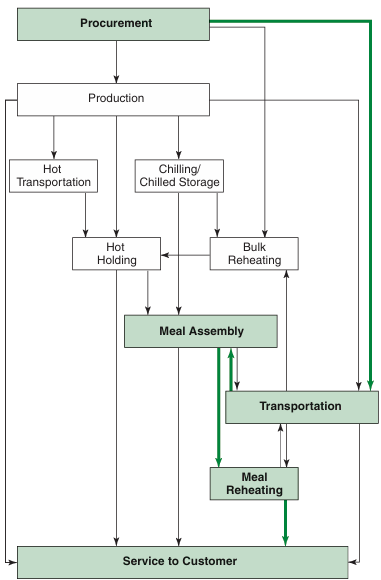
What is the flow diagram of a CONVENTIONAL foodservice system?

What is the flow diagram of a READY PREPARED foodservice system?

What is the flow diagram of a COMMISSARY foodservice system?

What is the flow diagram of a ASSEMBLY foodservice system?