Unit 7 Genetics, populations, evolution and ecosystems
 Call Kai
 Learn
Learn Practice Test
 Spaced Repetition
 Match
Match Flashcards
 Knowt Play
1/7

There's no tags or description
Looks like no tags are added yet.
Name | Mastery | Learn | Test | Matching | Spaced | Call with Kai | Chat |
|---|
No analytics yet
Send a link to your students to track their progress
8 Terms
Explain the principles of natural selection in the evolution of populations
Random gene mutations result in new gene alleles.
Due to specific selection pressures, the new gene alleles benefit its possessor, meaning the organism has a high selective advantage.
Then the possessor is more likely to survive and reproduce and have increased reproductive success.
Then the possessor passes on its advantageous alleles to its offspring.
Over many generations, the frequency of alleles increases in the gene pool.

Explain the effects of stabilising selection
Organisms with alleles that code for average variations of a trait have a selective advantage. [e.g babies with an average weight]
So the frequency of alleles that code for the average variation of the trait increases while the alleles that code for the extreme variations decreases.
So the standard deviation reduces.
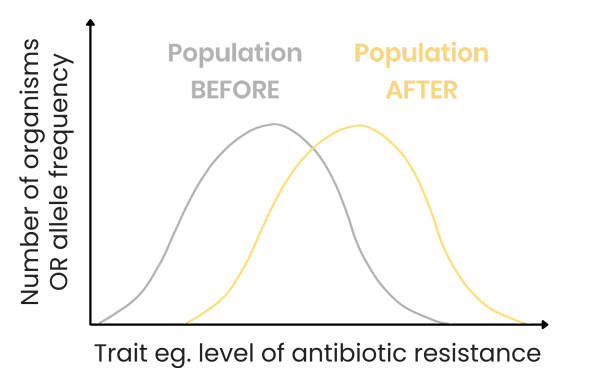
Explain the effects of directional selection
Organisms have alleles that code for one extreme variation of a trait have a selective advantage. [e.g. antibiotic resistance in bacteria]
This means the frequency of alleles that code for the extreme variation increases and the alleles that code for the other end of the extreme decreases.

Explain the effects of disruptive selection
Organisms with alleles that code for either extreme variations of the trait have a selective advantage.
This means that the allele frequency for both extreme variations increases and the allele frequency of the average variation of the trait decreases.
This can lead to speciation.
Describe speciation (how new species arise from existing species)
There is reproductive separation of two populations of the same species.
This can lead to an accumulation of differences in their gene pools.
This then results in an inability of two members of the populations to interbreed and produce fertile offspring due to the genetic differences.

Describe allopatric speciation
The population is split due to geographical isolation.
This leads to reproductive isolation, separating gene pools by preventing interbreeding between populations.
Random mutations result in genetic variation within each population.
Then different selection pressures act on each population.
This means that different advantageous alleles are passed on in each population.
So the allele frequencies in the gene pool change over many generations.
So eventually the populations cannot interbreed and produce fertile offspring.
Describe sympatric speciation
The population is geographically isolated.
Mutations lead to reproductive isolation, separating gene pools by preventing interbreeding within populations.
Different selection pressures act on each population
So different advantageous alleles are selected for / passed on in each population
So allele frequencies within each gene pool change over many generations
Eventually different populations cannot interbreed to produce fertile offspring
Explain genetic drift and its importance in small populations
Genetic drift is a mechanism of evolution in which allele frequencies in a population change over a generation due to chance
1. As some alleles are passed onto offspring more / less often by chance
Regardless of selection pressures and whether alleles give a selective advantage
● So strongest effects in small populations as gene pool is small and chance has a greater influence
○ Eg. when a population is sharply reduced in size (bottleneck effect)
○ Eg. when a small, new colony forms from a main population (founder effect)
● This can reduce genetic diversity - some alleles can become fixed or lost entirely