Unit 17: Digestive System
 Call Kai
 Learn
 Practice Test
 Spaced Repetition
 Match
 Flashcards
 Knowt Play
1/309

Earn XP
Description and Tags
Welsh: 17, Saladin: ?
310 Terms
What are the 2 types of digestion?
Mechanical: breaks large food → small, NO change in chemical composition
Chemical: enzymes break food by changing them into simpler chemicals
What do the organs of the digestive system do? (5)
Chemical/mechanical digestion
Ingestion
Propulsion
Absorption
Defecation
What does the digestive system consist of? (2)
Alimentary canal
Accessory organs
Alimentary canal:
Description
Organs
Food passageway
Organs that extend from mouth → anus: mouth, pharynx, esophagus, stomach, small intestine, large intestine, and anal canal
What are the accessory organs of the digestive system? (4)
Salivary glands
Liver
Gallbladder
Pancreas
What are the 4 layers of the alimentary canal?
Mucosa: inner, mucous membrane
Submucosa: CT
Muscularis (externa): muscle tissue
Serosa: outer w/ serous fluid
What is the mucosa layer of the alimentary canal? (5)
Inner layer
Mucous membrane
Surrounds lumen (passageway)
Folded in some areas to increase surface area
Absorbs dietary nutrients, secretes mucus and enzymes
What is the submucosa layer of the alimentary canal? (4)
Second innermost layer
CT layer
Contains blood and lymphatic vessels, nerves, and glands
Nourishes cells and tps absorbed food molecules
What is the muscularis (externa) layer of the alimentary canal? (3)
Second outermost layer
Composed of muscle tissue w/ circular and longitudinal layers
Moves tube and food materials
What is the serosa layer of the alimentary canal? (3)
Outermost layer
Contains serous fluid to eliminate friction
Serves as visceral peritoneum of abdominal cavity organs
What are the 2 movement types of the alimentary canal?
Mixing: muscle in small sections contract rhythmically, NOT in one direction
Propelling: peristalsis; moves in one direction
What is peristalsis?
Contraction that propels food particles down in a wavelike motion
What innervates the alimentary canal?
Branches of the para/sympathetic divisions of the ANS
What 4 branches innervate the alimentary canal?
Intrinsic:
Submucosal plexus: controls secretions
Myenteric plexus: controls GI motility
Extrinsic:
Parasympathetic impulses: increase activities of digestive system (secretions and motility)
Sympathetic impulses: inhibit digestive actions (secretions and motility)
What are enterendocrine cells? Where are they found?
Secrete chemical messengers to regulate GI organs/processes
Stomach and SI
Which organ is the first part of the alimentary canal?
Mouth
What is mastication?
Mechanical breakdown of solid particles, mixing them with saliva
Cheeks
Location
Composition
Lateral walls of mouth
Inner lining of STSE
What are the lips a boundary between?
Skin and the mucous membrane inside the mouth
What is the lingual frenulum?
Connects tongue to floor or mouth
What are papillae (tongue)?
Projections that move food; contain taste buds
What are lingual tonsils?
Lymphatic tissue masses on root of tongue
What does the hard palate consist of?
Palatine processes of maxillae and palatine bones
What does the soft palate consist of?
Muscular arch that ends in the uvula
What are palatine tonsils?
Lymphatic masses on sides of tongue
What are pharyngeal tonsils (adenoids)?
Masses of lymphatic tissue in posterior wall of pharynx
What are the primary teeth called? How many are there?
Deciduous/baby teeth, 20
What are secondary teeth called? How many are there?
Permanent/adult teeth, 32
What are the 7 types of teeth?
Central incisors
Lateral incisors
Canines (cuspids)
First premolars (bicuspids)
First molars
Second molars
Third molars
What are the different types of teeth used for?
Incisors: biting
Canines: grasping and tearing
Pre/molars: grinding
What components do teeth consist of? (5)
Crown and root: meet at neck
Enamel: covers crown
Dentin: makes up most of tooth; surrounds pulp cavity
Periodontal ligament: holds root in place
Cementum: anchors to jawbone
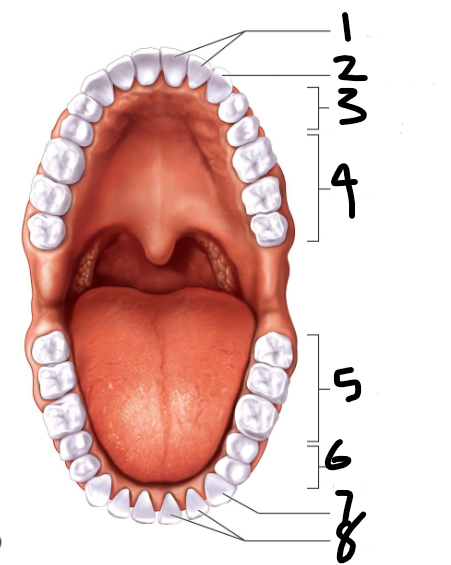
1
Incisors

2
Canine (cuspid)

3
Premolars (bicuspids)
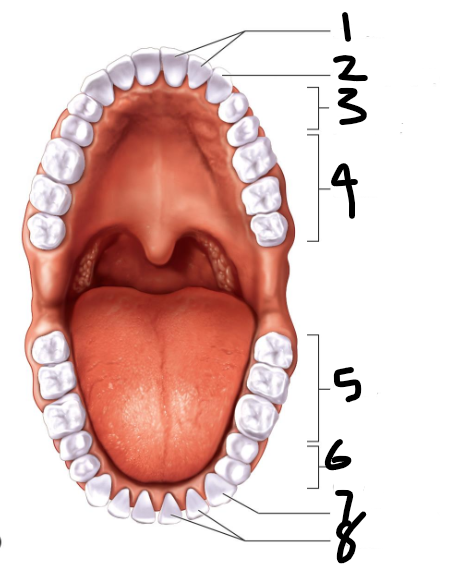
4
Molars

5
Molars

6
Premolars (bicuspids)

7
Canine (cuspid)

8
Incisors
Type: Incisor (central)
No. primary teeth:
No. secondary teeth:
Age of permanent tooth eruption:
4
4
6-8
Type: Incisor (lateral)
No. primary teeth:
No. secondary teeth:
Age of permanent tooth eruption:
4
4
7-9
Type: Canine (cuspid)
No. primary teeth:
No. secondary teeth:
Age of permanent tooth eruption:
4
4
9-12
Type: premolar (bicuspid (first))
No. primary teeth:
No. secondary teeth:
Age of permanent tooth eruption:
0
4
10-12
Type: premolar (bicuspid (second))
No. primary teeth:
No. secondary teeth:
Age of permanent tooth eruption:
0
4
10-12
Type: molar (first)
No. primary teeth:
No. secondary teeth:
Age of permanent tooth eruption:
4
4
6-7
Type: molar (second)
No. primary teeth:
No. secondary teeth:
Age of permanent tooth eruption:
4
4
11-3
Type: molar (third (wisdom tooth))
No. primary teeth:
No. secondary teeth:
Age of permanent tooth eruption:
0
4
17-25
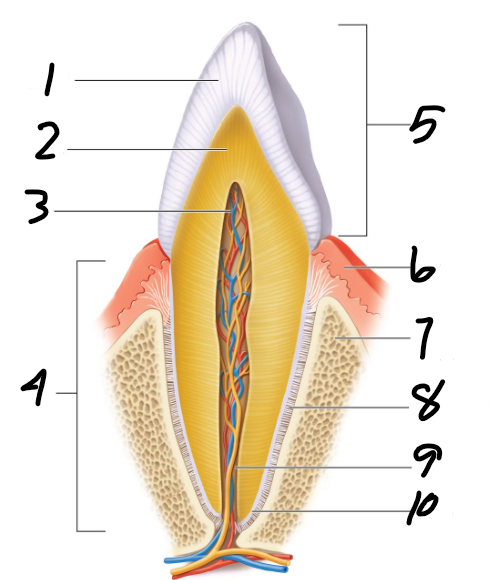
1
Enamel

2
Dentin

3
Pulp (in pulp cavity)
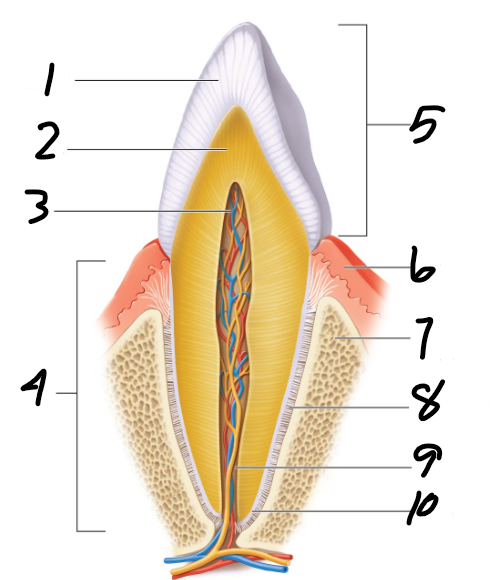
4
Root

5
Crown

6
Gingiva

7
Alveolar process

8
Periodontal ligament

9
Root canal

10
Cementum
What are dental caries?
Cavities within enamel
Formed when sticky foods lodge between teeth
Bacteria on teeth metabolize sugars; prod acidic byproducts that destroy enamel and dentin
What does fluoride do to enamel?
Strengthen it
Why are sealants used in crevices?
Prevent acids from remaining in crevices and destroying enamel
Part: cheeks
Location
Function
Form lateral walls of mouth
Hold food in mouth; muscles chew food
Part: lips
Location
Function
Surround mouth opening
Contain sensory receptors that judge food characteristics
Part: tongue
Location
Function
Floor of mouth
Mixes food w/ saliva; move food → pharynx; contains taste receptors
Part: palate
Location
Function
Forms roof of mouth
Holds food in mouth; directs food → pharynx
Part: teeth
Location
Function
In sockets of mandible and maxillae
Break food particles into smaller pieces; mix food w/ saliva during chewing
What secretes saliva?
Salivary glands
What does saliva contain & what is their function?
Enzymes: begin chem digestion of carbs
Bicarbonate ions: keep pH favorable for enzyme activity; prot teeth from acidic foods
What are the 3 major salivary glands?
Parotid glands: largest; secrete serous saliva w/ amylase
Submandibular glands: floor of mouth; serous + mucous
Sublingual glands: under tongue; mainly mucous
What are the 2 different secretory cells?
Serous cells: prod watery fluid containing a digestive enzyme, salivary amylase
Mucous cells: secrete mucus
What does amylase do?
Splits starch and glycogen into disaccharides
What does mucus do?
Binds food particles and lubricates food while swallowing
Gland: parotid glands
Location
Duct
Secretion
Between skin of cheeks by the ears
Pass through buccinator muscles and enter mouth opposite the upper second molars
Clear, watery serous fluid, rich in salivary amylase
Gland: submandibular glands
Location
Duct
Secretion
In floor of mouth on inside surface of mandible
Ducts open inferior to the tongue near the frenulum
Some serous fluid w/ some mucus; more viscous than parotid secretion
Gland: sublingual gland
Location
Duct
Secretion
In floor of mouth inferior to tongue
Many separate duct
Primarily thick, stringy mucus

1
Parotid duct

2
Parotid gland

3
Masseter muscle
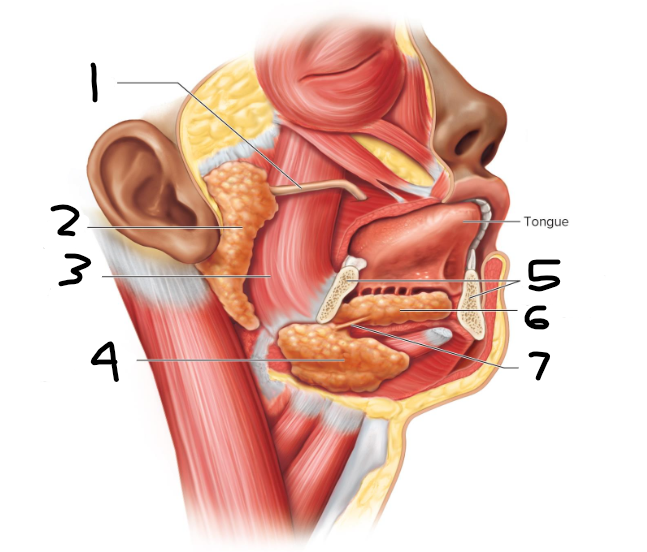
4
Submandibular gland

5
Mandible

6
Sublingual gland

7
Submandibular duct
What role do the pharynx and esophagus play in food digestion?
They do not participate

1 (muscles of pharyngeal wall)
Mandible

2 (muscles of pharyngeal wall)
Superior constrictor muscles

3 (muscles of pharyngeal wall)
Middle constrictor muscles

4 (muscles of pharyngeal wall)
Inferior constrictor muscles
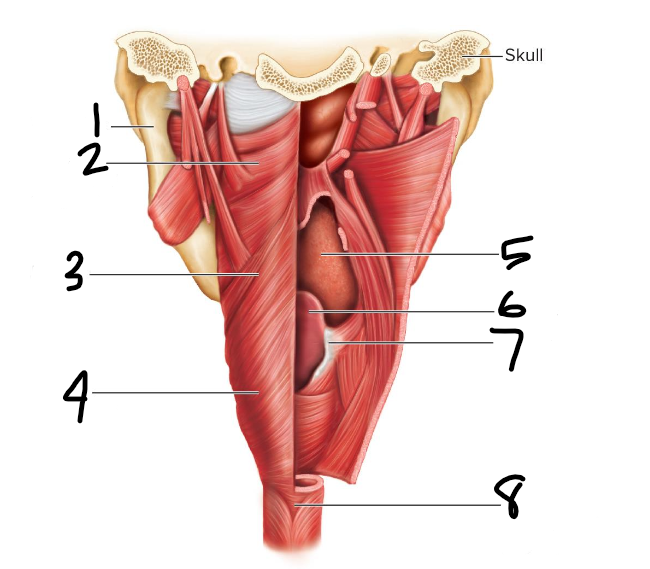
5 (muscles of pharyngeal wall)
Posterior surface of tongue

6 (muscles of pharyngeal wall)
Epiglottis

7 (muscles of pharyngeal wall)
Larynx

8 (muscles of pharyngeal wall)
Circular esophageal muscle

What are the 3 steps of swallowing divided into?
Voluntary stage; saliva mixed w/ chewed food forming bolus
Starts when food reaches oropharynx, stim sensory receptors, and triggers swallowing reflex
Peristalsis tp food in the esophagus to the stomach

What occurs during the second stage of swallowing? (6)
Soft palate and uvula rises to prot nasal cavity from food
Hyoid bone and larynx elevate
Epiglottis closes off top of larynx to prot trachea
Longitudinal muscles of pharynx contract
Inferior constrictor muscles relax and esophagus opens
Peristaltic waves force food into esophagus
What is the length of the esophagus?
25cm
What is the esophageal hiatus?
Where the esophagus penetrates the diaphragm
What gland(s) do/does the esophagus have?
Mucous glands in submucosa; moisten and lubricate lining of inner wall w/ mucus
What type of muscle is the muscularis composed of?
Superior: 1/3 skeletal
Middle: 1/3 skeletal + smooth
Inferior: 1/3 smooth
What does the lower esophageal (cardiac) sphincter do?
Regulates food passage into stomach & prevent regurgitation

1
Esophagus
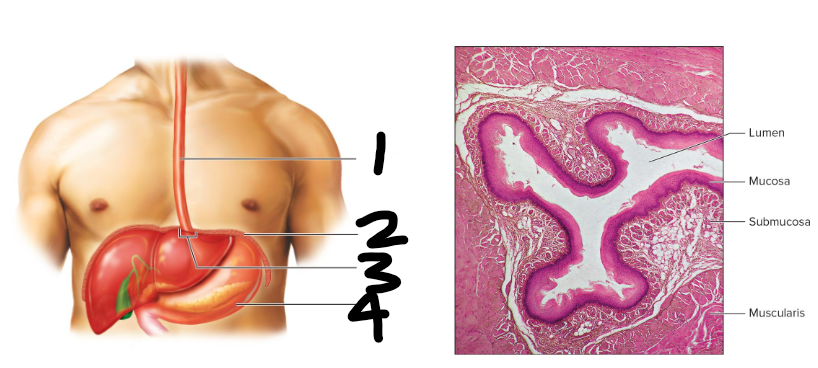
2
Diaphragm

3
Esophageal hiatus