2.1.3 Nucleic acids
 Call Kai
 Learn
 Practice Test
 Spaced Repetition
 Match
 Flashcards
 Knowt Play
1/136

There's no tags or description
Looks like no tags are added yet.
137 Terms
monomer of nucleic acids
nucleotides
polymer of nucleic acids
polynucleotides
what are the different widths between the coils of the double helix called
major and minor groove
what does 5’ mean
5 prime- carbon 5 is at the end
what does 3’ mean
3 prime- carbon 3 is at the end
how are the two strands of DNA described compared to eachother
anti-parallel strands
what is the name for what sugar and phosphate form
sugar-phosphate backbone
what bond do the bases form between each other
hydrogen bonds
what are the complementary base pairings in DNA
adenine with thymine, guanine with cytosine
how many hydrogen bonds do adenine and thymine form
2
how many hydrogen bonds to guanine and cytosine form
3
what is the overall shape of DNA
double helix
what are the 2 categories of bases in terms of number of rings
purines and pyrimidines
how many rings do purines have
2
how many rings do pyrimidines have
1
why must purines pair with pyrimidines
so the width of the helix is constant
what are the nucleic acids
DNA, RNA and ATP
what are the processes involving nucleic acids
DNA replication, transcription, translation
what type of nucleotide is in DNA
deoxyribonucleotide
what type of nucleotide is in RNA
ribonucleotide
what reaction and bond joins nucleotides together
condensation reaction forms a phosphodiester bond
what are the parts of a nucleotide
phosphate group, pentose sugar, nitrogenous base
what is a phosphate group
a phosphate attached to an organic molecule- negatively charged
what are the type of pentose sugar
deoxyribose and ribose
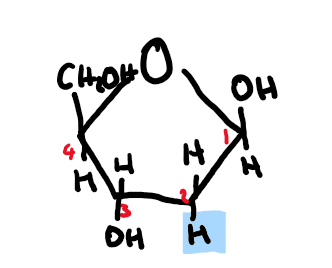
deoxyribose structure and formula
C5H10O4
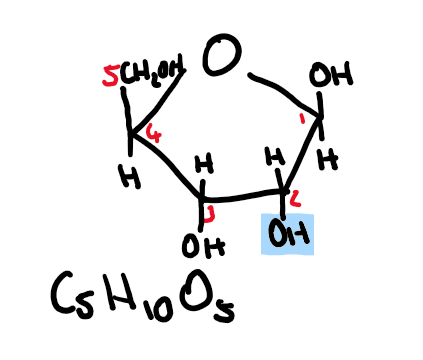
ribose structure and formula
C5H10O5
which bases are purines
adenine and guanine
which bases are pyrimidines
cytosine, thymine and uracil
what is the energy currency of all cells
ATP
what does ATP stand for
adenosine triphosphate
what is cellular respiration
the conversion of consumed/stored energy into ATP
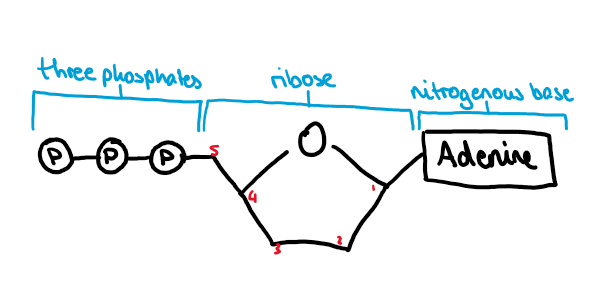
what is the structure and components of ATP
three phosphate groups, ribose sugar, adenine
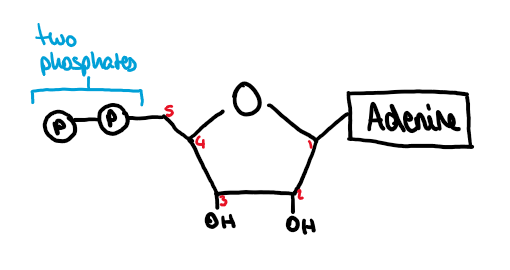
structure and components of ADP
two phosphate groups, ribose sugar, adenine
how does ATP release energy
ATP is hydrolysed into ADP and a phosphate ion, releasing energy
how is ADP converted back into ATP
energy released in the breakdown of carbohydrates and fats is captured by ADP and used to add another phosphate group on to make ATP
what is it called when a phosphate group is added to ADP
phosphorylation
how much ATP is stored in cells
not much
why is not much ATP stored in cells
due to it’s instability
why is it not a problem that not much ATP is stored in cells
the interconversion of ATP and ADP is happening constantly
what are the properties of ATP
small- moves into, out of and within cells easily
water soluble/hydrophilic- energy-requiring processes happen in aqueous environments
contains bonds between phosphates with intermediate energy released in small quantities- large enough to be used for cellular reactions but not so large energy is wasted as heat
easily regenerated- can be recharged with energy, reformed from ADP and Pi in one reaction
how much energy is released in the breakdown of ATP to ADP
30.6 kJ mol-1
what is the release of energy from ATP used for
to do work:
exocytosis/endocytosis
active transport
synthesis (anabolism)
cytoskeletal movement
muscle contraction
what are the nucleotides which are hydrogen acceptors/ coenzymes in respiration
NAD and FAD
what are the nucleotides which are hydrogen acceptors in photosynthesis
NADP
what are the nucleotides which are second messengers in hormone signalling
cyclic AMP/ cAMP
what is chromatin
nuclear DNA wrapped around histones
what are histones
positively charged proteins which eukaryotic DNA is wrapped around
what enzymes are used in DNA replication
gyrase, helicase, DNA polymerase, ligase
what does gyrase do
uncoils the helix/ relaxes the supercoils of the DNA helix
what does helicase do
unwinds the helix and breaks hydrogen bonds between base pairs to separate two strands
what does DNA polymerase do
catalyses the formation of a phosphodiester bond between the deoxyribose and phosphate of two adjacent nucleotides on the daughter strand through a condensation reaction
what are the new strands in DNA replication made from
free deoxyribonucleotides
what is the name of the strand in DNA replication that is unzipped 3’ to 5’ and what replication does it undergo
leading strand, continuous replication
what is the name of the strand in DNA replication that is unzipped 5’ to 3’ and what replication does it undergo
lagging strand, discontinuous replication
from which end is the leading strand in DNA replication unzipped
3’ end
from which end is the lagging strand in DNA replication unzipped
5’ end
which direction does DNA polymerase work
can only bind to 3’ end of parent strand- new daughter strand can only have nucleotides added in 5’ to 3’ direction
what is the name for the short stretches of new strands made on the lagging strand in DNA replication
okazaki fragments
how are okazaki fragments joined together
ligase enzyme forms phosphodiester bonds between them
what does ligase enzyme do
joins okazaki fragments in lagging strand of DNA replication
what happens to incorrect bases inserted by DNA polymerase in DNA replication (mutations)
checked and corrected in G2 checkpoint of interphase
which strand is a template strand in DNA replication
both strands
what happens to the free nucleotides when they are added to the new strand in DNA replication
added as triphosphates and lose two phosphate molecules in the condensation reaction when added to the growing daughter strand
what is the name of the type of replication in DNA replication
semiconservative replication
what does semiconservative replication mean
each new daughter molecule of DNA contains one new daughter strand and one old parent strand
who discovered evidence for semiconservative replication
Meselson and Stahl
what did Mesolson and Stahl do
provided evidence for semiconservative replication: grew E-coli cultures in 15N-containing mediums and then in 14N- containing mediums, each generation was spun in a centrifuge to see where the molecule would sit between the light and heavy bands of density
what are the historical models of DNA replication
conservative, semiconservative, dispersive
what is the conservative model of DNA replication
a whole new molecule of DNA is formed with 2 new daughter strands, whilst the other molecule stays intact with two parent strands
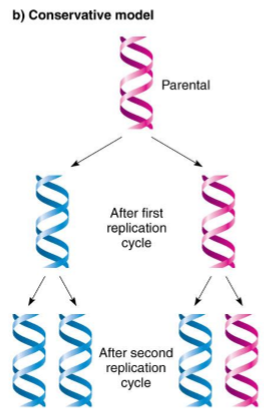
what is the dispersive model of DNA replication
the parents molecule would break around crossing over sections and chunks of both strands would be present in the new daughter molecule
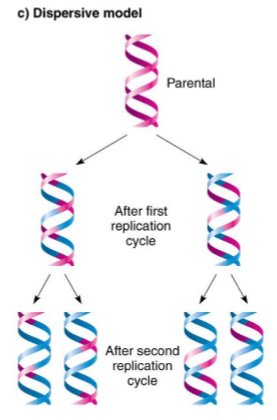
genetic code definition
the base or nucleotide sequence of the DNA which codes for the aa sequence of proteins
the name for 3 bases which code for 1 amino acid
a codon
what type of code is the genetic code
a triplet code
how many possible codons are there
64
how many different amino acids in proteins are there
20
what is in between genes on a DNA molecule/chromosome
intergenic region/ satellite region
codon definition
3 adjacent bases/nucleotides that code for an amino acid
gene definition
a sequence of DNA, organised into codons, that codes for a protein/polypeptide
genome definition
all the DNA that is present in an organism
what are the properties of the genetic code
it is a triplet code
it is degenerate
it is non-overlapping
it is universal
what does it mean that the genetic code is degenerate
most amino acids have more than one codon coding for them as there are 64 codons but only 20 amino acids
what does it mean that the genetic code is non-overlapping
each codon is read separately from the codon before it and the codon after it, no base is shared between adjacent codons, codons are discrete units
why is it important that the genetic code is non-overlapping
it doesn’t limit the amino acid sequence of a protein
what does it mean that the genetic code is universal
the same specific codons code for the same amino acids in all living organisms
what can cause a mutation
during DNA replication or from environmental causes e.g. UV light/radiation
what does the degenerate nature of the genetic code allow for
a change in base sequence from a mutation may still code for the same amino acid
what is it called when a change in the base sequence of a codon still codes for the same amino acid
a silent mutation
what happens from advantageous mutations
brings about evolution by natural selection
what is it called when a codon of a gene is changed and the wrong amino acid is coded for
deleterious mutation
what are the stages in protein synthesis
transcription and translation
what happens at transcription
synthesis of RNA from DNA
why is transcription needed
DNA is too large to leave the nucleus but proteins are synthesised on ribosomes in the cytoplasm so a copy of the gene must be made so it can leave via nuclear pores
what is the name of the copy of DNA made in transcription
mRNA (messenger RNA)
what is the name of the strand that contains the code for the protein to be synthesised in transcription
sense strand/ coding strand
what is the sense strand
contains the triplet code in the correct order for the protein to be synthesised
what is the name of the strand that is used as a template in transcription
antisense strand
what is the antisense strand
template strand complementary to the coding strand, used in transcription, allows a molecule of mRNA to be made which is a copy of the coding/sense strand
what enzyme makes the mRNA molecule in transcription
RNA polymerase
what unwinds the DNA in transcription
helicase
what is the mRNA molecule made out of in transcription
free ribonucleotides