Nutrition Learning Objectives
 Call Kai
 Learn
Learn Practice Test
 Spaced Repetition
 Match
Match Flashcards
 Knowt Play
1/134

There's no tags or description
Looks like no tags are added yet.
Name | Mastery | Learn | Test | Matching | Spaced | Call with Kai | Chat |
|---|
No analytics yet
Send a link to your students to track their progress
135 Terms
What 4 things make up nutrition?
Ingestion, Digestion, Absorption into the blood, Assimilating and using nutrients
What are the 6 nutrient Classes?
Carbohydrates, fats, proteins, vitamins, minerals and water
What is the building block of Carbohydrates?
Monosaccharides (simple sugars)
Are Carbohydrates Required?
No
Do Carbohydrates provide energy?
Yes
What are the major functions of carbohydrates?
Energy, and being building blocks for lipids
What is the basic structure of a carbohydrate?
C(n) H(2n) O(n).

What is the building block of lipids?
Fatty Acids
Are lipids required?
Yes
Do lipids provide energy?
Yes
What are the major functions of lipids?
Energy, Cell Membranes, Carrying lipid-soluble vitamins, providing essential fatty acids and Biosignaling.
What is the basic structure of a lipid?
HO connected to O and then a bunch of zig zags

What does a triglyceride look like?
Three fatty acid chains together.

Which lipid source is the best?
Animal
Which nutrient provides the most amount of energy?
Fats.
Is Water Required?
Yes
Does water provide energy?
No
What are the major functions of water?
Being a solvent, aiding in transport, heat dissipation, being a source of minerals, and glycolosis
What % of the body is made of water?
~75%
What sources can we get water from?
Drinking water, water in feedstuffs, and metabolically creating water.
What is the building block of protein?
Amino Acids
Is protein required?
Yes
Does protein provide energy?
Yes
What are the major functions of protein?
Structure, Metabolic, Immune, Energy, Movement
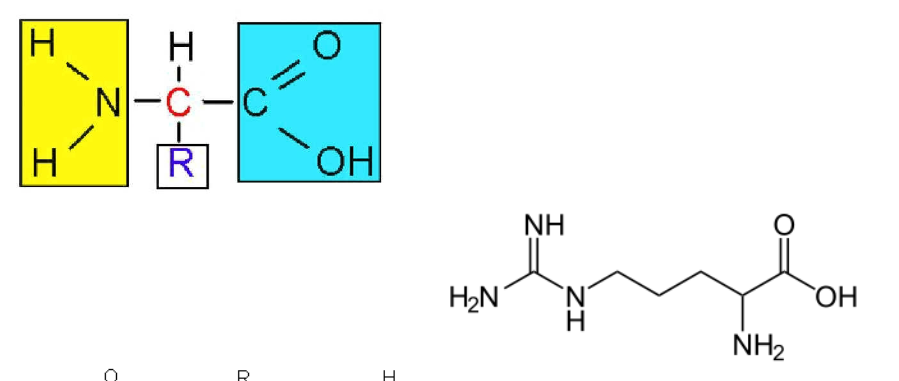
What is the basic structure of protein?
While the overall structure is similar to a fat and lipid when it comes to the zig-zag feature, there is always a double bond to oxygen, and a single bond to OH at the end of the structure.
Which protein source is better?
Animal
What is important to note about Amino Acids that is different to other building blocks?
We cannot store Amino Acids in the body, instead excess Amino Acids will be broken down into fats and stored that way.
What is the building block of Vitamins?
Organic Compounds (carbon containing!)
Are Vitamins required?
Yes
Do vitamins provide energy?
No
What are the major functions of Vitamins?
Enzyme function, Immune, Hormone Regulation, Bone formation, Antioxidants, Vision, Blood Clotting, and more.
What is the difference between a water soluble and fat soluble vitamin?
Water soluble vitamins have B complexes + Carbon and CANNOT be stored.
Fat soluble vitamins do not have B complexes and CAN be stored.
What are the fat soluble vitamins?
ADEK
What is the building block of Minerals?
Inorganic Compounds (Not containing carbon)
Are minerals required?
Yes
Do minerals provide energy?
No
What are the major functions of minerals?
Providing co-factors for enzymes, metabolic, body structure, pH, and water balance.
What is the difference between a macro mineral and a micro mineral?
Macro minerals are needed in larger amounts and micro minerals (trace minerals) are needed in smaller amounts
What are the 8 roles of the Digestive Tract (DIT)
Digestion
Absorption
Immune/barrier
Movement of digesta
Removal of waste
Acquiring food
Adaptation
Regulation
What are the 4 GIT types and the 2 categories they live in?
Monogastric - Omnivores (complex foregut), Carnivores (simple), Herbivores (complex hindgut)
Pre-Gastric Fermenters - Herbivores (ruminants)
Provide an example of a Complex Foregut Omnivore
Human
Pig
Dog
Provide an example of a Simple Carnivore
Cat
Provide an example of a Complex Hindgut Herbivore
Horse
Rat
Provide an example of a Ruminant Herbivore
Cattle/Cow
Sheep
Where do Omnivores perform fermentation?
Large Intestine
What differentiates an omnivore’s teeth?
Incisors for cutting, Canines for ripping/tearing, and molars for grinding
What does the size comparison of parts of an Omnivore’s GIT look like?
Each section is relatively equal in size
Where do carnivores perform fermentation?
They do not.
How does a carnivore’s teeth differentiate from other diet types?
Fewer molars, extremely pronounced and sharp canines and incisors
What does the size comparison of parts of an Carnivore’s GIT look like?
The stomach is larger in size compared to other parts of the GIT.
Where do Complex Hindgut Herbivores perform fermentation?
The Large Intestine (Cecum and Colon)
What differentiates a Complex Hindgut Herbivore’s teeth?
No canines, Many large, flat molars, and few sharp incisors
What does the size comparison of parts of a complex hindgut herbivore’s GIT look like?
The large intestine is the largest size in comparison to the rest of the GIT
Where does a ruminant herbivore perform fermentation?
The RRO (Rumen, Reticulum, Omasum) AND The Large Intestine
What does the size comparison of parts of a ruminant herbivore’s GIT look like?
The stomach has the largest size compared to the rest of the GIT
What differentiates a ruminant herbivore’s teeth?
No canines, Many large, flat molars, and few sharp incisors
What differentiates Avian teeth?
Avians typically do not have teeth, and use their beaks to break up feed when necessary
What is the order of an Avian’s GIT?
Mouth
Esophagus
Crop
Proventriculus
Gizzard
Small Intestine
Large Intestine
Cloaca
What is the purpose of the Crop?
A flexible storage pouch in avians that stores food before entering the proventriculus
What is the proventriculus?
Gastric Stomach of Avian species
What is the purpose of the gizzard?
Grinding up food before entering the Small Intestine
What is the ventriculus?
Another term for the Gizzard
What is the effect of the GIT on Birds?
Avians need a low fiber diet, most do not ferment.
Why is the gizzard important to avian species?
Without teeth an avian species can not break down food particles. The gizzard allows smaller particle size, increasing surface area and digestibility of feed.
Why is a small particle size important for digestion?
Smaller particle size allows for a larger surface area of the food particles, therefore allowing easier digestion
Which bird species can ferment food?
The Stink Bird
What is special about a hindgut fermenter’s Large Intestine?
It is much larger than other species, is ensacculated, and contains many ridges.
What is the major difference between the relationship of nutrients between microbes and the animal in Hindgut fermenters vs. Foregut fermenters?
In Hindgut fermenters the animal gets the nutrients before microbial fermentation, whereas in Foregut fermenters the microbes obtain the nutrient before the animal does.
What is the difference in length of time that digesta remains in the GIT between hindgut and foregut fermenters?
The digesta in in foregut fermenters travels much quicker than the digesta of in a hindgut fermenter
What is the definition of fermentation?
Microbes are metabolizing nutrients to gain energy for themselves and in the process, co-products are formed.
Who does fermentation?
Microbes
What are microbes doing during fermentation?
Breaking down and metabolizing nutrients
Why do microbes ferment food?
To gain energy for themselves
What is the benefit of the host in fermentation?
Volatile Fatty Acids
What is the benefit of microbes in fermentation?
energy, a place to live, and nutrients.
What is the order of the digestive tract of a Ruminant?
Mouth, esophagus, Rumen, Reticulum, Obasum, Abomasum, Small Intestine, Large Intestine, Anus
Where is Protein Digested?
Gastric Stomach and Small Intestine
Where are Fats Digested?
Mouth and Small Intestine
Where are Carbs Digested?
Mouth and Small Intestine
Where are Vitamins and Minerals Digested?
Gastric Stomach and Small Intestine
Which nutrients are absorbed in the Small Intestine?
Amino Acids, Fatty Acids, Glucose, Vitamins and Minerals
Which nutrients are absorbed in the Large Intestine?
VFA’s, Water and Electrolytes
How does Pepsinogen get converted into Pepsin?
Pepsinogen + HCL = Pepsin
What are the 4 roles of the mouth?
Food Acquisition
Mechanical Digestion
Chemical Digestion
Immune Defense
What are the 2 roles of the stomach?
Chemical Digestion
Immune Defense
What are the 2 functions of HCL?
Kill Pathogens and Microbes
Denature Proteins
What are the 5 functions of the Small Intestine?
Chemical Digestion
Absorption
Immune Defense
Adaptation
Movement of Digesta
What are the 3 functions of the Large Intestine?
Absorption
Fermentation (hindgut fermenters only)
Shaping and expelling waste
What are the 3 Functions of the Pancreas?
Metabolizing/Producing Hormones (Insulin!)
Secreting Digestive Enzymes
Producing Bicarbonate
What is the importance of bicarbonate?
Bicarbonate is a buffer in the Small Intestine from the acidity of HCL
What are the 6 Functions of the Liver?
Production of Bile (MOST IMPORTANT)
Metabolizes things like steroids
First dibs at blood nutrients
Short term energy storage (glycogen)
Detoxification
Stores some Vitamins and Minerals
What is the function of the gallbladder?
Storing and Releasing Bile
Which Specialized organ is NOT present in all mammalian species?
The gallbladder
What are the 4 functions of the Kidneys?
Detoxification
Urea Cycle
Excretion of Waste
Water Balance
What are the 5 functions of the Brain in nutritional science?
Controling nervous system
Highly involved in satiety
Produces metabolic and gastrointestinal hormones
Target of Hormones
Regulation of secretion, motility and so much more
What is a species-based difference between simple monogastrics and a hindgut fermenting monogastric like horses?
A large intestine (cecum and colon) that is much larger in size, performs fermentation, and is ensacculated.
What is the function of Salivary amylase?
An enzyme that breaks down monosaccharides like starch in the mouth
What is the function of Pepsin?
An enzyme that breaks down proteins.
What is the function of Rennin?
An enzyme that coagulates milk in baby mammals.
What are 4 ways the stomach protects itself from HCL?
Mucus Layers
The way parietal cells regulate HCL secretions to only when there is food intake
Stratified squamous epithelium protect newly growing cells
Production of Bicarbonate