Introduction to Strategic Management
 Call Kai
 Learn
 Practice Test
 Spaced Repetition
 Match
 Flashcards
 Knowt Play
1/65

There's no tags or description
Looks like no tags are added yet.
66 Terms
strategy definition
long-term direction of an organisation. expresses the organisation's purpose through its mission, vision, values and objectives
the exploring strategy framework
three parts:
understanding the strategic position
making strategic choices
managing strategy in action
four lenses for viewing strategy critically
design, experience, variety, discourse
PESTEL
political risk, varies by country & sector
economic cycles and the industries most exposed to them
social: demographics, distribution, geography, culture, and the networks and organizational fields that shape effectiveness, power, and innovativeness
technological: indicators of innovative activity
ecological: pollution, waste, climate change
legal: formal & informal institutions
three forecasting approaches
signle point: one number, high certainty, easy to turn into budgets
range: central projection with likely outcomes around it
multiple futures: several distinct alterantives, used when high uncertainty
scenario analysis
decision-making and planning method
evaluates how outcomes change across plausible future states
does this by shifting several variables together
e.g. higher inflation paired with higher interest rates and slower growth
steps
define scope and horizon (set the decision and time frame)
identify key drivers (external factors with high impact and uncertainty)
build coherent scenarios
quantify and evaluate impacts (model cash flows etc. under each case)
plan responses and triggers (define actions and early warning signals for each outcome)
porter’s five forces
→ determine how attractive an industry is
rivalry
supplier power
buyer power
threat of entry
threat of substitutes
rivalry is high when..
There are many competitors
Industry growth is low
Fixed costs are high, which leads to price wars
Exit barriers are high
Products are poorly differentiated
supplier power is high when..
Suppliers are concentrated
Switching costs are high
Suppliers can integrate forward
Their products are differentiated or have no substitutes
They include labour and finance, not just materials
buyer power is high when..
Switching costs are low
Buyers can integrate backward
Buyers have low profits, or the quality of what they buy matters little to them
The buyer is not always the consumer: Tesco is the buyer, not the shopper
threat of entry is lower when..
there’s barriers to entry:
scale, experience, and capital requirements
access to supply or distrubtion channels
legislation and government action, such as patents
threat of substitutes depends on what
substitute’s price/perfomrance ratio, not price alone
network effects
Each extra user makes the product more valuable to the others (Facebook)
They can make an industry attractive: high entry barriers, low rivalry and locked-in buyers
strategic lock-in
users depend on a supplier because switching is too costly
lets the firm keep prices above cost
especially valuable to differentiators
steps of doing an industry analysis
Define the industry clearly.
Identify the actors behind each force.
Work out the underlying factors and overall strength of each force.
Assess overall industry structure and attractiveness. Which forces control profitability?
Assess recent and expected changes in each force
Decide how to position the business. It can exploit weak forces, exploit industry change, or try to change the industry structure.
monopoly
one unique product and no rivalry. network effects can create monopolistic industries (Instagram).
oligopoly
a few large firms dominate, and their actions strongly affect one another
perfect competition
low barriers to entry and countless rivals with similar products
industry life cycle
Development: low rivalry, differentiated products; innovation is key.
Growth: low rivalry, weak buyers, low barriers to entry.
Shake-out: slower growth; managerial and financial strength are key.
Maturity: low growth, high barriers to entry; market share and cost are key.
Decline: many exits; price competition cost, and commitment are key.
what are strategic groups
organisations in the same industry with similar strategic characteristics distinguished by:
Scope: product range, geographical coverage, distribution, and segments served.
Resource commitment: brands, marketing spend, vertical integration, and quality.
use of strategic groups
Identify direct competitors
Spot gaps in the market
Analyse mobility barriers (the equivalent of entry barriers between groups)
critical success factors (CSFs)
things customers value, or things that give a cost advantage
blue ocean strategy
looks for new market spaces with minimal competition, in contrast to crowded red oceans
a strategy canvas plots performance on each CSF as a “value curve” for each competitor
value innovation means excelling on established CSFs where rivals are weak, or creating new CSFs
two principles are focus (concentrate on few factors) and divergence (a value curve that differs from rivals’)
purpose of resources and capabilities
they contribute to an organization’s long term survival and potentially to competitigve advantage
resources = assets a company has
capabilities = how those assets are used
threshold resources and capabilities
ones that let you compete at all
distinctive resources and capabilities
required to achieve competitive advantage
tools for diagnosing them
VRIO analysis
activity systems mapping
SWOT analysis
benchmarking
dynamic capabilities
ability to adapt and change resources and capabilities when the environment shifts
economic sub-cycles
the kitchen/’stock’ cycle → 3-5 years
driven by inventory adjustments
turning up point comes when stocks are run down and firms fuel the upturn by building up stocks again
the juglar/’investment’ cycle → 7-11 years
driven by surges of investment in capital equipment
downturn comes once these investments have been made. turns up when firms have to invest again
the kuznetsk/’infrastructure’ cycle → 15-25 years
cycles follow the life-spans of infrastructural investments
cycles triggered by inital surges of infrastructural investment
porter’s generic strategies
cost leadership
differentiation
focus (for niche markets)
hybrid strategy (combines cost leadership and differentiation
porter warns about being “stuck in the middle”
under what conditions does porter allow hybrid strategies
organizational separation: separate SBUs pursue different strategies
technological/managerial innovation: improves cost and quality at once
competitive failures: rivals also suck in the middle, or the firm dominates its market
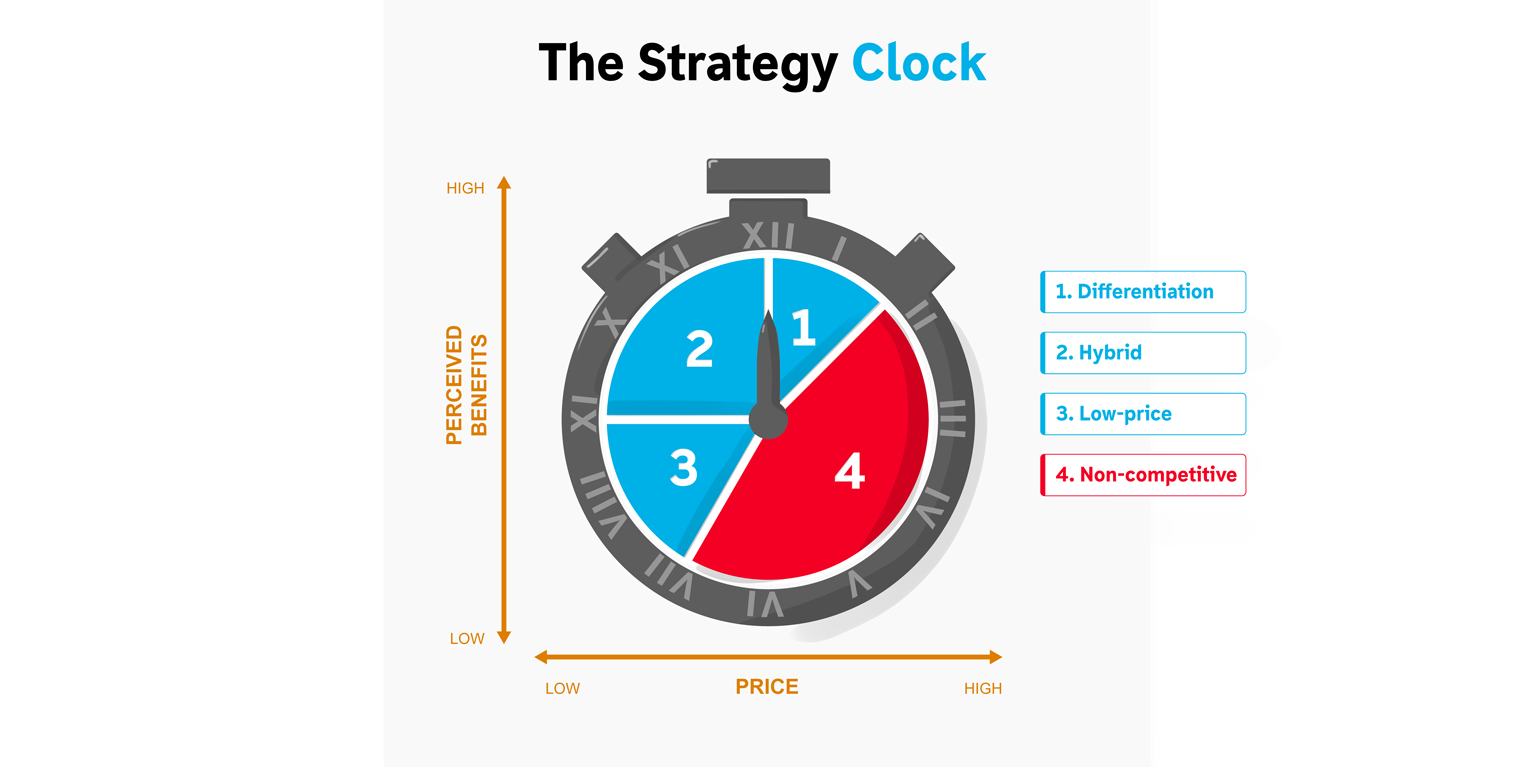
strategy clock
based on price vs perceived benefits
businesses move around the clock: e.g. start from low-price to gain market share and then move to differentiation strategy to increase profits and then back to hybrid to defend market share
more flexible than porter’s generic strategies
what does successful focus strategy depend on
distinct segment needs → having a distinct market adds barriers to entry
distinct segment value chains → focus strategies strengthened if they have distinct value chains that are difficult/costly for rivals to copy. if production and distribution processes are similar, it’s easier for a mass market differentiator to enter with a low cost than the rival focuser.
working segment economics → segments can easily become too small to serve economically as demand and supply conditions change
hypercompetiton
advantage may be temporary in fast-moving markets
comeptitors keep shifting the “value line” → the trade-off between price and perceived quality that customers accept
interactive strategies
when facing a low-price competitor:
threat assessment → don’t immediately lower prices (likely to lose a price war)
differentiation response → high-cost company can seek new differentiation strategies
cost response → merger with another high-cost company can help to reduce fosts and match prices through economies of scale
game theory
→ provides insight into competitor interaction
game theory encourages an organization to consider competitors’ likely motives and implications of these moves for its own strategy
especially relevant if competitors are interdependent → outcome of choices made by one competitor is dependent on the choices made by another competitor
value creating drivers
economies of scope (when a business produces a wider variety of goods)
stretching corporate management competences
superior internal processes, in places where capital and labour markets are weak
market power through cross-subsidy and mutual forbearance
value-destroying drivers
responding to market decline
spreding risk
managerial ambition
three parenting roles
portfolio mangers
synergy manager
parental developer
BCG matrix
stars, question marks, cash cows, dogs
allocate revenue from cash cows to investment into stars, remove dogs, choose best question marks to invest in
the parenting matrix background explained
tells a company to keep its businesses that it understands and can improve and to sell the resst
two questions the parent asks about each business:
feel: does the parent understand this business?
does the parent know what it takes to succeed in this industry → what customers want and how competition works
benefit: can the parent actually make it better?
does the business have problems or potential that the parent’s skills, brand or resources can fix?
the parenting matrix
alien: low benefit & low feel
value trap: high benefit & low feel
ballast: low benefit & high feel
heartland: high benefit & high feel
value creation
key part of business model that describes what’s offered and how value is created
main focus is on how the target customer segment’s needs are met
value configuration
explains how resources and activities in the value chain underlie the value proposition → see what creates value and what participants perform those value-adding activities
value capture
explains revenue streams and cost structures that allow the organization and other stakeholders to gain a part of the total value created
shows how the value created will be divded between the company and stakeholders
three typical business model patterns
razor and blade
primary focus on capturing value → makes it a revenue model
builds on gillette’s strategy of selling razors at a low price and the replacements at a high price
freemium
online businesses
basic version of a product is free → build a high volume of customers and eventually convince a part of them to buy premium
multi-sided platforms
brings together two or more distinct but interdependent groups of customers on one platform
five ways that a parent adds value
envisioning: giving a common vision
facilitating synergies
coaching managers
providing central services and resources
interveining to fix performance
three ways a parent destroys value
management costs
bureaucratic complexity
obscuring weak financial performance
portfolio manager
acts like an active investor
buys undervalued businesses → improves/sells them
sets financial targets
synergy manager
adds value by getting the business units to work together
provides a shared vision, encourages cooperation
it works best when businesses are closely related
its challenges are excessive costs, business unit managers’ self-interest, and illusory synergies
parental developer
uses the parent’s own central capabilties to improve each business
these could be a strong brand, financial skills, R&D
the difference from the synergy manager is direction → synergy is about value created between businesses; here the parent is the source of value for each unit
the “crown jewel” problem → if the parent can’t add value to a profitable business, it should sell it anyway
portfolio matrices
→ help the centre decide where to invest and divest
BCG matrix
directional policy matrix
parenting matrix
directional policy matrix background explained
head office has to choose which business to invest in, which to keep as they are, and which to sell
two questions about each business
how attrative is the market it’s in?
use PESTEL and porter’s five forces
how strong is the business within that market?
can the business beat its rivals? can use a strategy canvas to compare
directional policy matrix
grid with nine cells
attractive market & strong business: invest to grow
unattractive market & weak business: divest/harvest
rest: be selective
Yip’s four internationalisation drivers
market
cost
government
competitor’s strategies
porter’s diamond
explains why some places produce companies with lasting competitive advantages in certain industries → locational source of advantage (one a company gets from where it comes from)
four things about a location work together (corners of the model):
factor conditions: what the place has to work with
basic inputs a business needs → raw materials, labour
home demand conditions: what local customers are like
having demanding customers at home trains a company to be good enought for the world
related and supporting industries: who’s nearby
when suppliers and similar industries cluster, everyone benefits
firm strategy, structure, and rivalry: how local companies behave and compete
rivalry is a good thing → a company won’t lose its edge abroad
the international value system
put each value chain activity in the country where it can be done most efficiently & effectively
can be done through FDI, joint ventures, global sourcing
three kinds of locational advantage:
cost advantages
unique local capabilities
national market characteristics
the value chain
every step should add value to the product:
designing
sourcing
making
marketing
delivering
four international strategies
export
multi-domestic (treat each country separately)
global (one world market) → works if customer needs similar around world
transnational → most complex strategy
what to consider in market selection
attractiveness (porter’s five forces)
institutional voids
multi-dimensional measures of distance (e.g. CAGE)
expected competitor retaliation
entry modes to an industry
export
licensing
franchising
joint ventures
wholly owned subsidiaries
why is fast second better than first-mover
the first-mover pays the cost of providing demand, educating customers, and making early mistakes
fast second enters with better data, lower risk, and cheaper R&D
four factors that affect the choice between an acquisition, an alliance, and organic growth
urgency
uncertainty
type of capabilities
modularity of capabilities
gap analysis
shows how far achieved or projected performance falls short of what’s desired
steps
define the future state
assess the current state
identify and measure the gap
find root causes
build and track an action plan
SAF criteria
for judging strategic options:
Suitability: fit with the opportunities and threats in the environment
Acceptability: is it acceptable to key stakeholders? covers return, risk. and stakeholder reactions, and sensitivity analysis is used here
Feasibility: can the organization actually implement it, in terms of finance, people, and resources?
emergent strategy is explained by..
logical incrementalism and organizational learning
political bargaining, which produces a negotiated strategy
structures, systems, and culture that favour some projects and encourage continuity
McKinsey 7-S framework
evaluates how well 7 interdependent (changing one requires changing others) internal elements work together to drive performance and support change
strategy: the plan to build and sustain a competitive advantage
structure: how the organization is divided and coordinated
systems: daily processes, workflows, policies, and routines
shared values: core beliefs and guiding purpose
style: the leadership approach and patterns of group behaviour/culture
staff: workforce management and roles
skills: distinctive capabilities and core competencies the organization has
