protozoa: select sporozoa plasmodium & babesia
 Call Kai
 Learn
 Practice Test
 Spaced Repetition
 Match
 Flashcards
 Knowt Play
1/16

There's no tags or description
Looks like no tags are added yet.
17 Terms
sporozoa
group of protozoa that have no obvious means of locomotion
macrogametocyte
female sex cell of plasmodium spp. compact chromatin material surrounded by cytoplasmic material. pigment possibly present. crescent shaped in plasmodium falciparum. round to oval in other plasmodium spp
microgametocyte
male sex cell of plasmodium spp. diffuse chromatin mass that stains pink to purple and is surrounded by cytoplasmic material. pigment may be present. crescent shaped in plasmodium falciparum. round to oval in other plasmodium spp.
merozoite
asexual sporozoa trophozoite
ring forms
ringlike structure that appears initially after invasion of RBC by plasmodium spp. appears as blue cytoplasmic circle w/ red chromatin dots on giemsa stain. area within ring known as vacuole

schizogony
asexual multiplication that occurs in humans prior to invasion of the RBCs
schizont
morphologic form responsible for the development & maturing of merozoites critical to parasite survival.
developing trophozoites
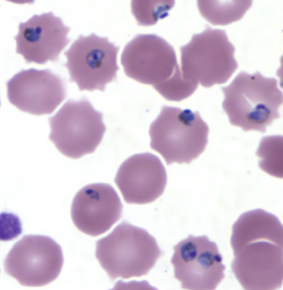
appearance varies by plasmodium spp. ring form is much more pleomorphic & ameboid. circle of ring & chromatin dots may still be present. brown pigment may be present. infected young, pliable RBCs are usually larger due to growing parasite.
immature schizonts
growing chromatin & visible cytoplasmic material surrounds growing chromatin. brown pigment granules may be present. parasite occupies more space within RBC.

mature schizonts
fully developed merozoites emerge (sexual sporozoa trophozoites). number & arrangement of merozoites vary w/ malarial spp. cytoplasmic material is presumed to be absent except w/ plasmodium vivax.

sporogony
sexual multiplication that occurs in mosquitos
sporozoite
infective stage transferred by vector
RBC inclusions in P. vivax & P. ovale
schuffner’s dots (tiny granules)
RBC inclusions in P. malariae
ziemann’s dots (fine dust-like dots)
RBC inclusions in P. falciparum
maurer’s dots (irregular to comma-shaped dots)
plasmodium sporozoites general life cycle
vector: mosquito anopheles, transfers infective sporozoites w/ blood meal. sporozoites enter liver to multiply (schizogony), aka exoerythrocytic cycle. liver cells rupture to release merozoites & they infect RBCs (erythrocytic cycle): can infect new RBCs, develop into micro & macrogametocytes, destroyed by immune system. mosquito ingests microgametocytes & macro initiate sexual cycle to form sporozoites.

laboratory diagnosis of plasmodium spp
multiple sets of giemsa-stained peripheral blood smears. thick smear for screening, thin smear for differentiation of spp. optimal time of blood collection is b/t characteristic cycles of fever & chills called paroxysms: greatest # of parasites in blood, results from release of merzoites & toxic waste products. timing varies by spp. serologic & PCR.