GENETICS EX3 Chromosome Variation (topic 10)
 Call Kai
 Learn
 Practice Test
 Spaced Repetition
 Match
 Flashcards
 Knowt Play
1/57

There's no tags or description
Looks like no tags are added yet.
58 Terms
What kind of mutation contributes the most to human disease?
Missense and nonsense in protein coding
Describe duplication (chromosomal mutation)
Part of the chromosome has been doubles
Does duplication result in a normal amount of genetic material?
No. it results in extra material
Describe tandem duplications
The ‘extra copies’ are right next to the original

What is dispersed duplications?
When the extra copies are not directly next to the original gene
Are duplications always in the same order?
No, they can be the same OR reversed
What is a deletion (chromosomal mutation)
When a segment of the chromosome is lost
Does a deletion result in the same amount of genetic material
No it results in the loss of genetic material
Can a deletion impact more than one gene?
Yes it can affect several genes
If a deletion affects several genes it can lead to…
Unbalanced gene expression in region
What is haploinsufficiency
When only one copy of the gene is not enough to produce the normal phenotype
How do deletions impact heterozygotes?
They can expose recessive alleles in heterozygotes
What is pseudodominace
When a recessive allele appears and behaves as dominant allele
If you are homozygous for a particular deletion what is a common side effect…
That becomes lethal (if necessary for development)
What is a copy number variant?
Genetic variation resulting from duplications or deletions
What is a homologous gene
Evolutionarily related genes with a similar sequence
What are paralogs
Homologs in one species that arise from duplication
What is a gene family
multiple copies of similar genes in a genome
What is neofunctionalization
When one of the paralogs develops a new role due to mutation

What is an ortholog
Homologs in the same species that evolved from a common ancestor
What is an inversion
When a chromosome segment is turned 180 degrees and reattaches in opposite orientation
What is a PARAcentric inversion
NOT including the centromere
what is a PERIcentric inversion
INCLUDES centromere
How does an individual being heterozygous for a PARAcentric inversion impact its ability to cross over?
It forms an inversion loop so that the regions can line up in the correct order
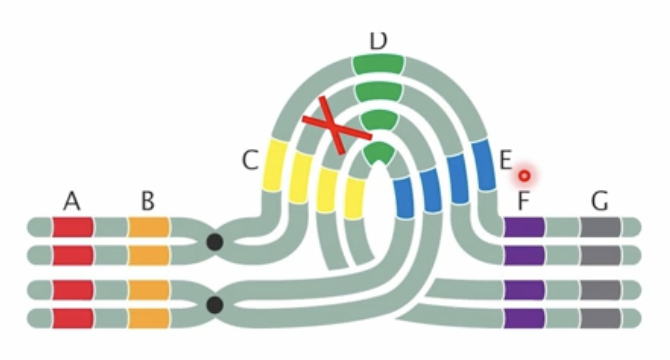
What is a dicentric bridge
A bridge that forms in the crossing over between two centromeres (when one is inverted)
What are the products of a heterozygous cross (with one chromosome inverted)
There is an Acentric chromatid, a normal non recombinat gamete, a non recombinat gamete with PARAcentric inversion, and a broken DIcentric chromatic

What happens to the acentric chromatid after a paracentric inversion heterozygous cross
it is lost because it doesnt have acentromere
What happens to the dicentric chromatid after a paracentric inversion heterozygous cross
it breaks because it has two centromeres and the gene info is nonviable
What are the products of a heterozygous cross that involves a PERIcentric inversion
1 normal nonrecombinant gamete, 1 non recombinant gamete with the inversion, and two nonviable recombinant gametes (with developmental abnormalities)

Describe a common cause of infertility
If an individual is heterozygous for an inversion, and crossing over occurs within inversion the recombinant gametes will be inviable
Is crossing over more common in large or small inversions
Large inversions
Which is more common in humans large or small inversions
Small inversion are more common because large inversions usually result in complete infertility
How can large inversions impact evolution?
They can lead to recombination suppression or reproductive isolation (and speciation)
What is a translocation
The movement of one part of one chromosome to a non-homologous chromosome
Describe non reciprocal translocation
When one segment moves to another chromosome with no exchange occuring
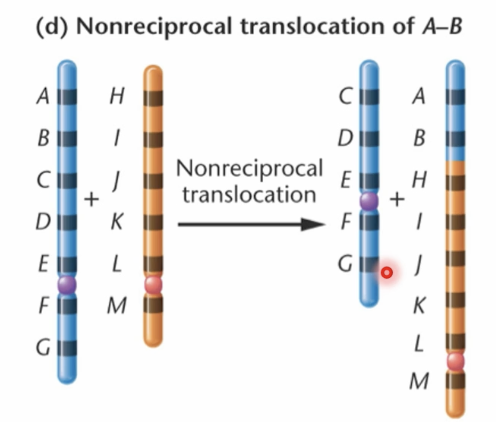
Describe reciprocal translocation
the exchange of genetic material between chromosomes

What structure forms during prophase 1 following a translocation?
The quadravalent structure where each homolgous region is lined up

How many different outcomes are there of meosis 1 if a translocation occurs
3!

When are gametes of translocated chromosomes INVIABLE
when there is an unbalanced amount of genetic material

What is robertsonian translocation
when a reciprocal translocation occurs at or near the centromeres of two acrocentric chromosomes.
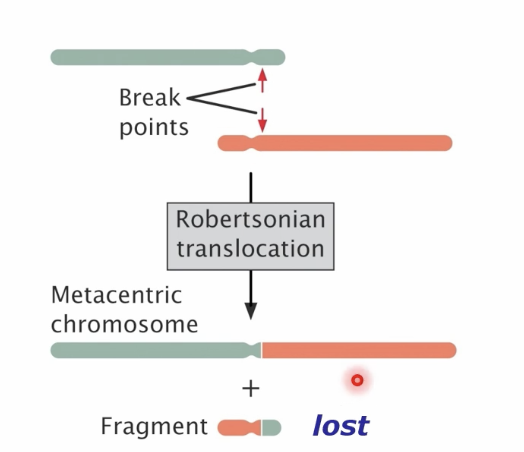
What are the products of a robertsonian translocation
A metacentric chromosome and a chromosome fragment
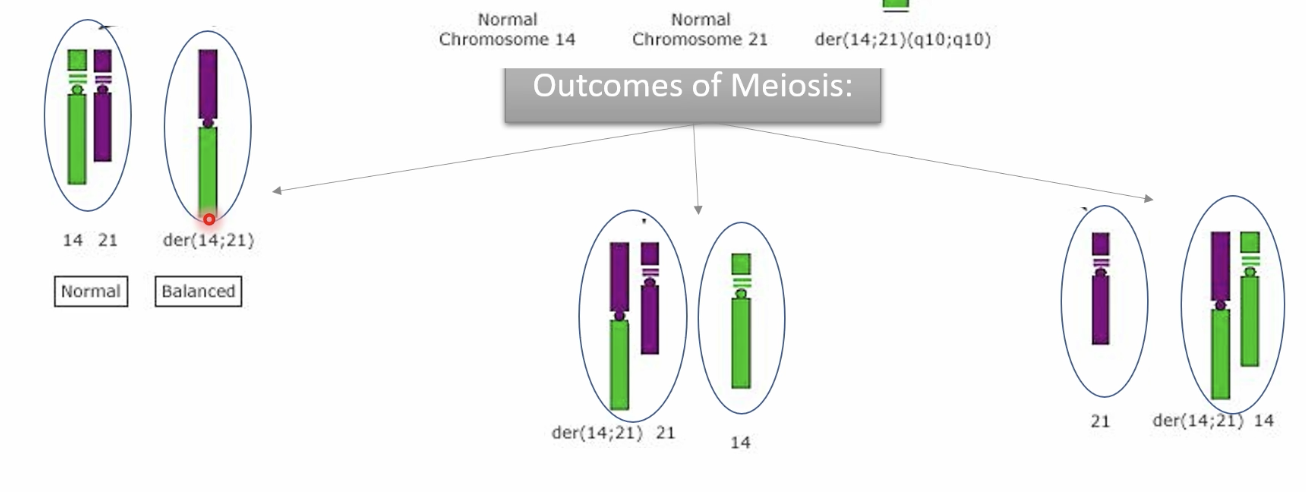
What are the outcomes of meiosis for a robertsonian translocation
A balanced outcome and two unbalanced outcomes
How do chromosomal rearrangements arise?
Chromosomal breaks induce rearrangements when repaired
What phenomenon allows for recombination between non homologous positions?
Dispersed repeats
What is autopolyploidy
When there are multiples of one species’ haploid number
What causes autopolyploidy
Failure of mitosis or meiosis
Describe a phenomenon that arises from autopolyploid reproduction
More autopolyploidy because their gametes would have an abnormal number
What is allopolyploidy
Chromosome sets from DIFFERENT species
What does allopolyploidy produce?
Mostly sterile hybrids of two species (eg. donkey)
In what case will an allopolyploid be fertile?
If there are matching haploid numbers with similar chromosome structure & gene order
What is aneuploidy
A change in the number of individual chromosomes
Is aneuploidy a category of polyploidy?
NO!
What causes aneuploidy?
Nondisjunction or deletion of a centromere
What is nondisjunction
Failure of separation during cell division
What is Nullisomy
2n - 2 (both copies of 1 chromosome are missing)
What is monosomy
2n - 1 (1 copy of a chromosome is missing)
What is trisomy
2n + 1 (extra copy of one chromosome)
What is tetrasomy
2n + 2 (two copies of the same chromosome)