Unit 3 Chemistry
 Call Kai
 Learn
 Practice Test
 Spaced Repetition
 Match
 Flashcards
 Knowt Play
1/60

There's no tags or description
Looks like no tags are added yet.
61 Terms
Continuous Spectrum
a unbroken range of frequencies, wavelengths. Happens when light from sun/ light bulb passes through prisim.

Balmer series
quantanized energy level transitions that give off visible light
crest
highest point of a wave
speed of light
speed of all electromagnetic radiation
quantized energy meaning
you can’t just stop in between, you have to stop in a certain point
ex: like an elevator, you can’t stop in between floors
trough
lowest point of a wave
ways to look at atoms location and movement
1) emission spectroscopy
2) ionization energy
electron light admission explanation
when electrons absorb heat, they get excited so the jump away from the nucleus
when they go back down is when the light is admitted
ion
a atom with a unequal amount of protons and electrons bc they gained or losses electrons
Cation
positive ion, when atom loses a electron
anion
negative ion, when a atom gains a electron
Photon
packet of energy with both particle and wave characteristics that travels at the speed of light. used in lasers for narrow wavelengths
High energy photons have…
short wavelengths
low energy photons have…
long wavelengths
atomic spectrum
light edmitted from heated elements through prisim. Lines of different colors separated by dark areas. This separation of colors indicates that only certain wavelengths of light are produced when an element is heated
lines in atomic spectrum mean…
there is a change in energy, electron drop
excited state
happens when atom absorbs energy, when an electron moves to higher state of energy. Less stable
when electron falls from excited state…
falls to a lower-energy state by emitting a photon of a specific energy. If the energy emitted is in the visible range, we see one of the colors of visible light
max number of electrons in energy level
2n²
sublevels
A group of orbitals of equal energy within energy levels. The number of sublevels in each energy level is the same as the principal quantum number (n).
ex: 2p, 3f, 4s, ect.
sublevel letters and order increasing energy
s,p,d,f
orbital
3 dimensional volume where electrons have highest probability of being found
ex: s, p, d, f
s orbital
sphere shape, most basic one and get progressively bigger as the number goes up

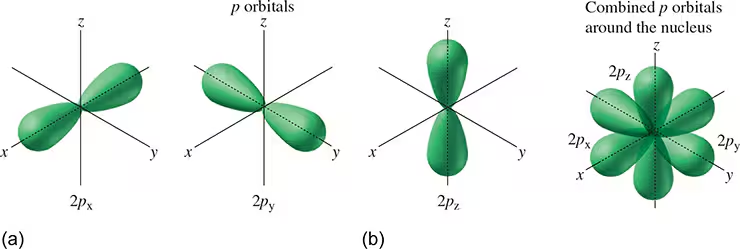
P orbitals
3 different types (x y and z axis) , looks like a balloon with tie in the middle
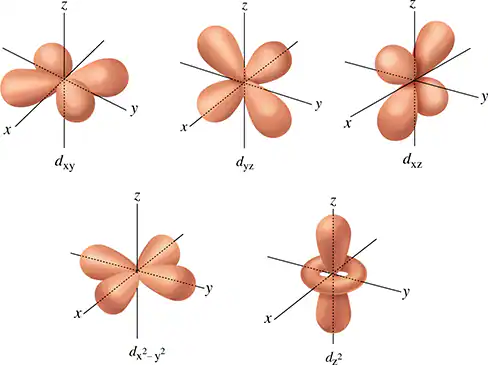
D orbital
looks like 4 leave clover, way weirder and 5 different types
F orbital
you dont need to know, 7 different orbitals
electrons per orbital
max 2, Pauli exclusion principle ( think arrows up and down )
orbital diagram
shows placement of electrons on orbitals with increasing energy
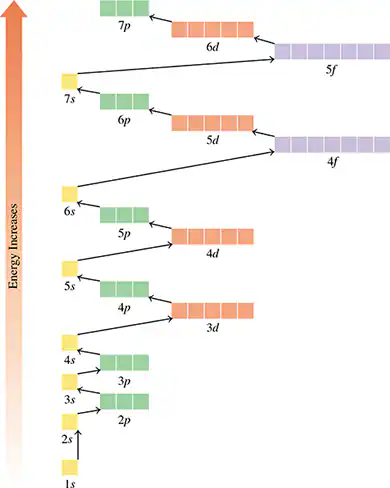
Hunds Rule
lowest energy state is attained when electrons are placed singly in available orbitals of the same sublevel with the same spin. fill up every orbital one by one before adding in more then one electron.
electron configuration
A list of the number of electrons in each sublevel within an atom, arranged by increasing energy.
valence electrons
electrons on the outer most shell, the same going down a group
atomic size
The distance between the outermost electrons and the nucleus
atomic size increases (group)..
going from the top to bottom, because the outer most electron shell is father from the nucleus, making it have less of a intense pull
atomic size increases(period)...
right to left because increase in protons means increase in positive charge, pulls in the electrons
Atomic size transition metals…
relatively the same because there is little change in the nuclear attraction for the valence electrons
ionization energy
The energy needed to remove the least tightly bound electron from the outermost energy level of an atom.
energy is required..
to remove a electron from a atom (more if closer to nucleus)
ionization energy decreases(group)…
going down the group because as those electrons are farther from the nucleus, attraction decreases
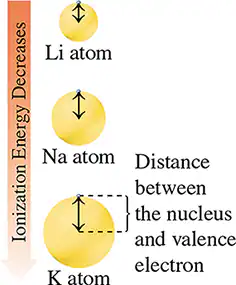
ionization energy increases(period)…
left to right, the positive charge of the nucleus increases because there is an increase in the number of protons.
metallic character
A measure of how easily an element loses a valence electron.
metallic character is more important..
on the left side of the periodic table, less so on the nonmetals because they do not easily loose electrons; less metallic
metallic character increases…(group)
top to bottom, more electron levels at the bottom making it easier to lose them
metallic character decreases…(period)
left to right, atoms gain more protons and a higher nuclear charge, pulling valence electrons closer and making it harder to lose electrons
frequency (v)
amount of waves that pass through a observer if standing still per second
wavelength (λ)
length of a wave from peak to peak (meter)
velocity constant
3×10^8 meters/sec
velocity equation
C = v x λ
(velocity)=(frequency)(wavelength)
electromagnetic radiation
a form of energy that moves through space or matter as a wave
ex: literally the entire spectrum we have been learning
Plancks constant
6.626×10^-34
used in equation as h
energy equation
E=h x v
(Energy)=(plancks constant)(frequency)
energy mesurement
Joules (J)
Color order of wavelengths
violet (400m), indigo, blue, green, yellow, orange, red (700nm)
High energy waves to low energy waves
X rays/gamma rays
Ultra violet
visible light
infared
microwaves
“water”
AM/FM/TV/phone
element used by bohr for light spectrum
hydrogen
organization order for orbitals ( least to most speicifc)
Principal energy levels
Sublevels
orbitals
each principal energy level has _ orbitals
n²
Aufbau Principal
Building up, when adding electrons, must occupy the orbital at the lowest energy level
Pauli Exclusion Principle
no 2 Es are the same, 2 electron in the same orbital must have equal but oposite spin (arrows)
FILL OUT/GO OVER
PERIODIC TABLE/IRREGS
goal for irreg configurations
to maintain symmetry or partial symmetry, and to benefit for energy
ions v atoms
ions are slightly smaller then atoms, but the pattern of size still holds