ANSC EXAM IV
 Call Kai
 Learn
 Practice Test
 Spaced Repetition
 Match
 Flashcards
 Knowt Play
1/102

There's no tags or description
Looks like no tags are added yet.
103 Terms
(T/F) Each skeletal muscle contains multiple nuclei?
True
What is a sarcomere made out of?
Z line, A band, I bank, and M line
What protein is thick filament primary composed of?
Myosin
What connective tissue layer surrounds an entire muscle?
Epimysium
What connective tissue layer surrounds a muscle bundle (fascicle)?
Perimysium
What is a single muscle cell called?
Muscle fiber
What are the long, cylindrical organelles inside a muscle fiber that are made of repeating sarcomeres?
Myofibril
What are the three layers of the connective muscle tissue?
Epimysium, perimysium, and endomysium.
Skeletal muscle is the most abundant tissue in animals and makes up about what percentage of body weight?
40%
The endomysium surround what?
Individual muscle cells (aka muscle fiber)
The sarcolemma is the what of the muscle fiber?
Cell membrane
Invaginations of the sarcolemma into the muscle fibril is called?
Transverse tubule (t-tubule)
What is the function of the sarcolemma?
Transport nerve impulses into muscle cells and facilitate contraction.
Sarcoplasmic reticulum is a specialized form of what?
Smooth endoplasmic reticulum
What is the function of Triad?
Release of calcium from the SR causing muscle contraction by coupling excitation to contraction.
What is the function of sarcoplasmic reticulum?
Stores and releases calcium ions, regulating muscle contraction and relaxation.
What is the function of terminal cisternae?
Specialized sections of the sarcoplasmic reticulum that store calcium ions and facilitate rapid release during muscle contraction.
What is the function of T-tubule?
Conducts action potentials into the muscle fiber, facilitating calcium release from the sarcoplasmic reticulum during contraction.
Which region of the sarcomere contains the overlap of both thin and thick filaments?
A band
Which region of the sarcomere contains thin filaments only?
I band
Which structures form the lateral boundaries of a sarcomere and anchor the thin filaments?
Z lines
What is the lighter region within the dark A bad where there is no overlap between thick and thin filaments?
H zone
What is the very thin, dark line within the H zone that structurally holds thick filaments in position?
M line
What is the primary function of the head of a thick filament?
Actin binding
What is the primary function of the tail of a thick filament?
MHC assembly
Which organelle is calcium stored in skeletal muscle cells before contraction?
Sarcoplasmic reticulum
Which protein does calcium directly bind to during muscle contraction?
Troponin
What happens to calcium during muscle relaxation?
It is pumped back into the sarcoplamic reticulum
(T/F) Cholinesterase breaks down acetylcholine as the synaptic cleft of neuomuscular junction
True
What process contributes to the hydrogen ion accumulation in muscle under anaerobic condition?
ATP Hydrolysis
Type 1 muscle fibers are known for?
Slow contraction, highly oxidative, fatigue resistant
Which muscle fiber type is most prone to fatigue?
Type IIX/Type IIB
Which muscle type is generally associated with muscle of support that maintain posture?
Type 1( slow oxidative)
Which of the following fat deposits is associated with the perimysium surrounding muscle fiber bundles?
Intramuscular fat

What type of muscle is A and B?
Muscle A is an extensor; muscle B is a flexor
What is Adipocyte?
Cells which specialize in storing fat
Intermuscular fat is associated with what?
Epimysium
Intramuscular fat is associated with what?
Perimysium
Connective tissue can characterized by what?
Having relatively few actual cells
Connective tissues is the ___ most critical component to the muscle system behind muscle tissue?
Second
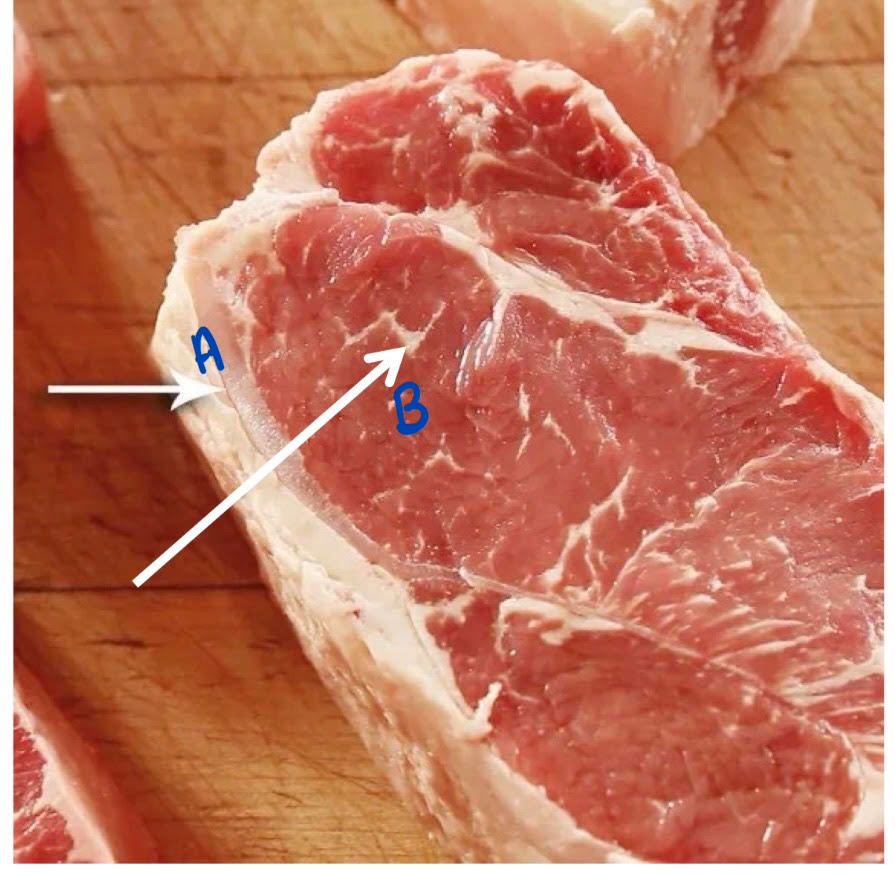
What is A and what is B
A → connective tissue
B → adipose tissue
What are adductors?
Muscle that tend to pull a limb toward the median plane
What are Abductor?
Muscle that move the limb away from the medial plane
What is a Flexor muscle?
A muscle that is located on the side of a limb toward which the joint bends
What is an Extensor muscle?
A muscle located on the opposite side of the joint
What does Triceps brachii do?
Extends the elbow and helps straighten the forelimb
What does Biceps femoris do?
Helps extend the hip and contributes to forward propulsion
What is the purpose of the locomotive muscle?
To move the animal around
Locomotive muscle have a greater or lower connective tissue content?
Greater
Locomotive muscle are typically more fast-twitch (Type II) fibers which are?
Capable of rapid, powerful contractions
What is the purpose of support muscles?
To support the rest of the body — postural stability
Support muscles remain active for what?
Extended periods of time through sustained or repeated contractions — fatigue resistence
What type of fibers are associated with support muscles?
Slow-twitch (type I) fibers
What type of muscles is associated with support muscles?
Parallel or fusiform muscle
What type of parallel muscle has fibers that run strictly lengthwise?
Strap muscle
What type of parallel muscle features a thick middle with tapered ends and fibers running mostly lengthwise?
Fusiform muscle
Penniform muscle has a what type arrangement?
Feather like, shorter fibers
What type of penniform muscle has fibers approaching from only one side of a tendon?
Unipennate muscle
What type of penniform muscle has fibers approaching from two sides of a central tendon?
Bipennate muscle
What type of penniform muscle has fibers approaching from three or more sides of a tendon?
Multipennate muscle
What is Hyperplasia?
Increased muscle fiber established before birth
What is Hyperthrophy?
Enlargement of existing fibers after birth
It total fiber number largely determined before or after birth?
After
What does MHC isoform determine of muscle fibers?
Contraction speed and oxidative capacity
Which muscle fiber subtype has high oxidative capacity with multiple mitochondria for ATP production and endurance?
Type A
Which muscle fiber subtype has intermediate oxidative capacity with a moderate number of mitochondria for sustained energy?
Type X
Which muscle fiber subtype has low oxidative with few mitochondria, making it suitable for short bursts of activity?
Type B
Which muscle fiber type is characterized by slow-twitch contraction speed, high resistance to fatigue, and suited for endurance activities.
Type I
Which muscle fiber type is characterized by fast twitch muscle fibers, capable of rapid, powerful contractions, but fatigue quickly.
Type II
(T/F) There is very little ATP in muscle at any one time, to must be constantly regenerated
True
What fuel sources are used during aerobic (oxidative) metabolism for ATP generation?
Glucose, fat, and protein
What fuel source is used during anaerobic (glycolytic) metabolism for ATP generation?
Glucose (glycogen)
Muscle contraction in living muscle is controlled by what?
Calcium
Muscle contraction in dying muscle is controlled by what?
The amount of ATP
What do muscle cells utilize to try to maintain homeostasis and life?
Glycogen stores
Why does rigor mortis occur?
Permanent actin-myosin bonds are formed due to the lack of ATP required to break actomyosin
Rigor Morits Phase is characterized by residual oxygen, glycogen, high ATP and pH, aerobic respiration, and muscles maintaining extensibility?
Delay Phase
Which rigor morits phase is characterized by no oxygen, glycogen, glycolysis, the accumulation of lactate and hydorgen ions, and a decline in ATP and pH?
Onset phase
Which rigor mortis phase is characterized by no oxygen, no glycogen, no ATP, the stabilization of pH, and the muscle is fully contracted and inextensible?
Completion phase
Which rigor motis phase is characterized by the degradation of Z lines and structural proteins by proteolytic enzymes, tenderization, and Actin and myosin cross-bridges are not broken
Resolution Phase
How are the stimuli transferred from nerve to muscle?
Transmembrane potential
What is transmembrane potential?
The unequal distribution of ions between the inside and outside of the cell allows for the transmission of electrical signals from cell to the next
Where do muscle contractions that are initiated by stimuli arrive?
Sarcolemma
Ions can or cannot move through the membrane freely?
Cannot
What is Resting membrane potential?
The difference in electrical potential across the membrane when the cell is not stimulated
How can resting membrane potential be maintained?
Active transport
What is Active Transport?
Where there is a stimulus, electrical impulses travel along membrane surfaces
What occurs during depolarization?
Voltage-gated Na+ Channels open due to response to the electrical impulse
What occurs during repolarization?
Voltage-gated K+ channeles open and K+ rushes out of the cell to “reset” the resting electrical gradient, followed by the K+ channels closing
What happens along membrane surface when there is a stimulus during an action potential?
Electrical impulses travel along the membrane surfaces
What restores everything back to the resting state after action potential?
The sodium-potassium pump via active transport
What happens at the Neruomuscular Junction?
The action potential travels through the nerve fiber to the muscle fiber (one per muscle cell)
How does the signal to contact propagate into a muscle fiber?
Action potential travels along sarcolemma and into muscle fiber via T-tubules
Relaxed muscles have very low levels of what in the sarcoplasm?
Ca2+
What is required for the actin myosin bridge to form?
Ca2+ ions and ATP
What are the two contractile myofibrillar proteins?
Actin and Myosin
What are the two regulatory myofibrillar proteins?
Tropomyosin and Troponin
During contraction, does the length of A-band change?
No
During contraction, does the length of the I-band change?
Yes
During contraction, does the length of the H-zone change?
Yes