Ventricular Function
 Call Kai
 Learn
 Practice Test
 Spaced Repetition
 Match
 Flashcards
 Knowt Play
1/69

There's no tags or description
Looks like no tags are added yet.
70 Terms
CO =
HR x SV
CI (cardiac index) =
CO / BSA
what are the four determinants of cardiac performance?
preload, afterload, contractility, heart rate
__ is muscle stretch / end-diastolic wall stress
preload
__ is the forces opposing ejection of blood
afterload
__ involves intrinsic strength of cardiac muscle
contracility
if increase preload then ___ length and ___ passive force
increase, increase
in isolated muscle, ___ is the passive force needed to stretch the sarcomere to its resting length before contraction
preload
preload ___ with increasing length
rises exponentially
in ventricle, ___ is the passive force in the ventricle at its End Diastolic Volume (EDV)
preload
when sarcomere stimulated to contract, ___ develops
active force
sarcomere length before contraction is set by __
preload
increased preload (length) → ___ active tension (force)
increased
preload sets the ___ of the sarcomere, which affects the ___ developed when muscle stimulated to contract
resting length, active tension
preload = ___ of muscle or intact heart = end-diastolic wall stress
initial stretch
preload is estimated by the ___ or ___
EDP (pressure filling the ventricle, EDV (end-diastolic volume)
Frank-Starling or Starlings Law shows that when there is increased End-diastolic stretch of the ventricle (increased EDV or EDP), there is ___
increased SV and increased CO
based on effects on Starlings Law: RV are ___ while effects on LV are ___
immediate, delayed
length-dependent activation shows that stretching cardiac muscle causes ___ force than predicted from only changes in ___
greater, overlap of thick and thin filaments
with longer sarcomere length (more stretch) there is a ___ between myosin and actin filaments
narrow space
with shorter sarcomere length (less stretch) there is a ___ between myosin and actin filaments
wider space
___ brings actin and myosin closer together, which causes ___ filament lattice spacing → ___ number of crossbridges
Titin, decreased, increased
increased sarcomere length → ___ filament lattice spacing → ___ probability and cooperativity of actin-myosin cross-bridge formation
decreased, increased
increased sarcomere length → ___ Ca++ binding affinity by cardiac TnC → ___ exposure of myosin binding site on actin → ___ actin-myosin cross-bridge formation
increased, increased, increased
mechanisms forming basis of Starlings Law include
changes in overlap of thick and thin filaments
length-dependent activation also contributes
potential mechanisms for length-dependent activation
altered filament lattice spacing
changes in Ca++ sensitivity
cardiac muscle ___ increase tension by summation of contractions
cannot
__ is systolic wall stress produced by ventricular properties with additional properties of the vasculature, during systole
afterload
afterload can be defined by ___ or ___
aortic pressure (for LV), pulmonary artery pressure (for RV) during the interval that the aortic valve or pulmonic valve is open
as afterload increases, SV ___
decreases
increased BP → ___ pressure opposing LV ejection → ___ SV
increased, decreased
Law of Laplace describes that as radius decreases, pressure directed into the LV cavity (inward pressure) ___
increases
with increased r, inward pressure is ___ (end-____)
reduced, diastole
with decreased r, inward pressure is ___ (end-____)
increased, systole
__ is the intrisic force-generating capacity of the cardiac myocyte and heart with fixed __
contractility, preload and afterload
__ is the passive force stretching the sarcomere to its resting length or filling the ventricle to its EDV
preload
stroke work =
SV x MAP
dP/dt =
change in pressure/change
EDP decreases as contractility ___
increases
what common therapy can change Ca++ homeostasis to enhance contractility?
increases phosphorylation of LTCCs (CICR)
how can we physiologically change Ca++ homeostasis to enhance relaxation?
increases phosphorylation of phospholamban → decreases inhibition of SERCA → increased Ca++ reuptake
dP/dtmax is a measure of ___
contractility
more NE and EPI causes ___ contractility
inreased
angiotensin causes ___ contractility
increased
hypoxia and associated acidosis (decreased pH) causes ___ contractility
decreased
hyperkalemia causes ___ contractility
hyperkalemia
sympathetic stimulation → ___ contractility and ___ relaxation
increased, increased
immediate consequence of increased contractility is ___ EDP (EDV) due to ___ SV
decreased, increased
heart rate influences cardiac performance by altering ___ and ___
time for ventricular filling, myocardial O2 supply demand balance by altering time for adequate coronary blood flow/O2 supply
preload: if increase stretch (___ diastolic filling) → ___ SV (systole)
increase, increase
where is preload represented on a pressure-volume loop?
end diastole/begin systole (EDV/EDP), DPVR
how does preload affect the PV loops?
SV
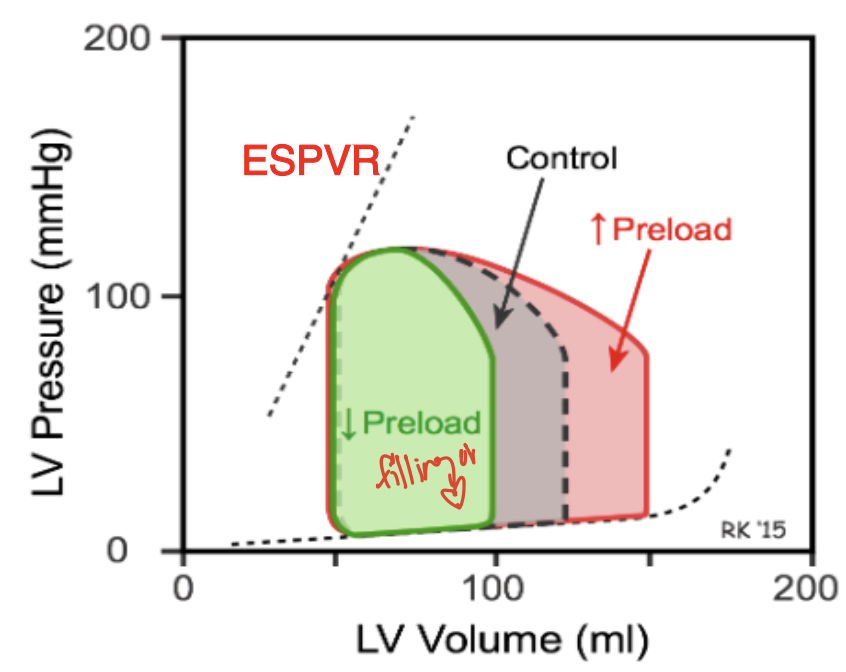
an increase in preload causes ___ in SV
increase
a decrease in preload causes ___ in SV
decrease
how does afterload impact the PV loop?

preload affects ___ while afterload affects ___
preload → SV
afterload → SV and BP
an increase in afterload causes ___ SV and ___ BP
decreased, increased (this is because afterload is how much resistance the heart has to pump against to pump blood out of the LV during systole)
a decrease in afterload causes ___ SV and ___ BP
increased, decreased
contractility is found on the pressure-volume loop by the ___
ESPVR (end-systolic pressure volume relationship)
how does contractility/inotropy affect the PV loop?

an increase in inotropy would ___ SV and ___ ESPVR
increase, increase (greater slope)
a decrease in inotropy would ___ SV and ___ ESPVR
decrease, decrease (smaller slope)
in aortic stenosis, the pressure in the aorta a lot ___ than in the LV
less (because of narrowed valve)
describe a PV loop for aortic stenosis
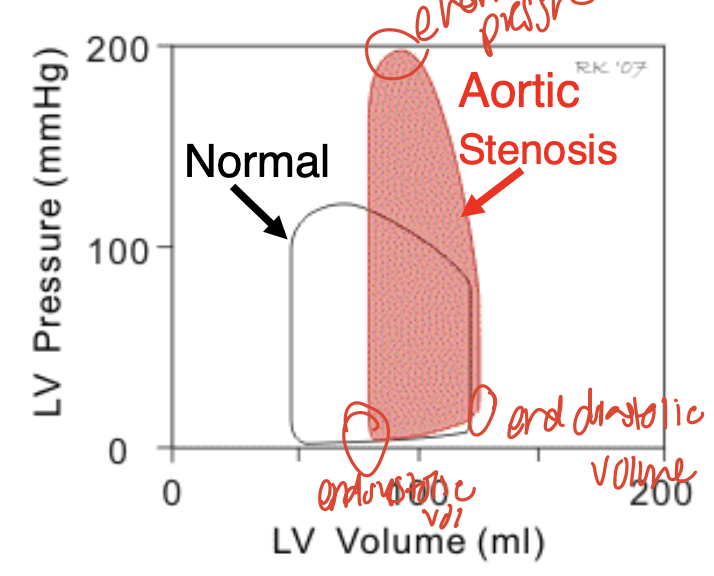
for aortic stenosis, afterload is ___
increased (because increased ventricular pressure)
for aortic stenosis, SV is ___
decreased
for aortic stenosis, ESV is ___
increased
for aortic stenosis, EDV is ___
increased
for aortic stenosis, preload is ___
increased
for aortic stenosis, contractility is ___
increased