Consumer Behavior #2
 Call Kai
 Learn
 Practice Test
 Spaced Repetition
 Match
 Flashcards
 Knowt Play
1/129

There's no tags or description
Looks like no tags are added yet.
130 Terms
Personality
the totality of thoughts, emotions, intentions, and behaviors that a person exhibits consistently as he or she adapts to his or her environment.
Personality qualities
Unique to an individual (twins)
Can be conceptualized as a combination of specific traits or characteristics
Traits are relatively stable and interact with situations to influence behavior
Specific behaviors can vary across time.
Psychoanalytic approach
suggests personality results from struggle between inner motives and societal pressures to follow rules and expectations.
Applicable to motivations and personality inquiry
Highlights the importance of unconscious mental processes in influencing behavior
Components of human personality include id, ego, supere
Id
it
The most basic and unorganized part of our personality
Ego
I
This part of the personality seeks to express the Id’s demands in an acceptable way. Tries to mediate between Id and reality.
Super ego
Super-I
Your conscience and internalization of cultural rules.
Trait
a distinguishable characteristic that describes one's tendency to act in a relatively consistent manner
Trait approach
focuses on specific consumer traits as motivators of various consumer behaviors
Nomothetic perspective
focuses on particular traits that exist across a number of people
Aims to find common personality traits that can be studied across people
Idiographic perspective
focuses on understanding the complexity of each individual consumer.
Major Traits examined in consumer research
Value consciousness, Materialism, Innovativeness, Need for cognition, Competitiveness, Productivity orientation, Frugality,Trait superstition, Trait Impulsivity
Value consciousness
Extent to which consumers tend to maximise what they receive from a transaction as compared to what they give
Materialism
Extent to which material goods have importance in a consumer's life
Innovativeness
Degree to which an individual is open to new ideas and tends to adopt new products, services or experiences.
Need for cognition
Degree to which consumers enjoy engaging in effortful cognitive information processing
Competitiveness
Enduring tendency to strive to be better than others
Productivity orientation .
Tendency of consumers to focus on being productive, making progress, and accomplishing more in less time
Frugality
The tendency of a consumer to exhibit restraint when facing purchases and using resources
Trait superstition
A tendency to follow superstitions and superstitious beliefs
Trait Impulsivity
A tendency to buy products and engage in experiences on impulse.
Five Factor Model
Extraversion- talkative and outgoing
Agreeableness - kindhearted and sympathetic
Openness to experience- creative, imaginative
Stability (neuroticism) - even- keeled, not prone to mood swings
Conscientiousness - precise, efficient, and organized.
Criticism for traits
Personality traits traditionally have not been shown to be strong predictors of consumer behavior
Researchers often select traits for study without any logical theoretical basis.
Personality traits are sometimes hard to measure and researchers often use measures with questionable validity
Personality inventories used to measure traits are often meant for use on specific populations but they are frequently applied to practically any consumer group
Researchers often measure and use traits in ways not originally intended
Consumer traits generally do not predict specific brand selections.
Hierarchical approaches
Begin with the assumption that personality traits exist at varying levels of abstraction
Specific traits- tendencies to behave in very well-defined situations (complaint propensity)
Broad traits- behaviors that are performed across many different situations (extraversion)
Personology approach
combines information on traits, goals, and consumer life stories to gain a better understanding of personality.
Lifestyles
the way consumers live and spend their time and money
Referred to as context-specific personality traits
Influence purchase patterns of consumers
Useful in identifying viable market segments
Psychographics
The way consumers' lifestyles are measured
Quantitative investigation of consumer lifestyles
Involves surveying consumers using AIO statements
AIO statements: Activity, interest, and opinion statements used in lifestyle
Demographics
observable, statistical aspects of populations such as age, gender, or income
Used in conjunction with psychographic analysis
Helps locate and understand lifestyle segments.
Self Concept
totality of thoughts and feelings that an individual has about himself or herself.
Consumers are motivated to act in accordance with their self- concepts
Self- esteem
refers to the positivity of an individual's self-concept
The many self concepts
Actual self , Ideal self, Social Self, Ideal social self, Possible self,Extended self
Actual self
how I see myself actually in this moment (tell me about yourself)
Ideal self
work a little bit harder (this is who I really want to be); achievable now
Social Self
who I see myself as in a social setting and how it involves (core friendship)
Ideal social self
enhanced social self (socially awkward penguin → life of the party)
Possible self
more forward-looking ideal social self (where do you want to be in 10 years)
Extended self
pulls in other elements of why who we are (school pride is who you are) (brand loyalty and important to identity)
Symbolic interactionism
the perspective that proposes that consumers live in a symbolic environment and interpret the myriad of symbols around them and that members of a society agree on the meanings of symbols
Semiotics
the study of symbols and their meanings (the meanings can change)
The self-congruence theory
consumer behavior can be explained by congruence of a consumer's self-concept with the image of typical user of a focal product
Segmentation of self- congruency
Consumers identity and product ownership
Researchers suggest that brands are used to express and validate consumer identity
Organizational identification
Exists when consumers feel close to organizations
Attitudes
Relatively enduring overall evaluations of objects, products, services, issues, or people
ABC approach
Affect - Feelings about an object
Behavior - Overt behavior that consumers exhibit as well as their intentions to behave
Cognitions - Beliefs that the consumer has about the object
utilitarian
Attitudes are used as a method to obtain rewards and to minimize punishment.
High school students wear cool brands so they fit in.
Knowledge
The knowledge function of attitudes allows consumers to simplify their decision-making processes.
A consumer is very loyal to Apple products and believes that they are best, thereby simplifying their search effort
Value-expressive
This function of attitudes enables consumers to express their core values, self-concept, and beliefs to others.
A consumer supports ASPCA because they place much value on animal rights.
Ego-defensive
The ego-defensive function of attitudes works as a defense mechanism for consumers to avoid facts or to defend themselves from their own low self-concept.
Smokers discount information that suggests that smoking is bad for their health.
Hierarchy of effects
the attitude approach that suggests that affect, behavior, and cognitions form in a sequential order
According to this approach, affect, behavior, and cognitions (beliefs) form by following one of four hierarchies
High-Involvement Hierarchy
(or “standard learning”) hierarchy (Cognition—affect—behavior)
High-involvement, or standard learning, occurs when a consumer faces a high-involvement decision or addresses a significant problem. High-involvement decisions are important to a consumer and often contain significant risk.
In high-involvement
In this hierarchy:
1. Beliefs about products are formed first.
2. Feelings or evaluations about the product are formed.
3. The consumer decides to act in some way toward the product.
Low-Involvement Hierarchy
(Cognition—behavior—affect)
Many consumer purchases and problems are not very risky or even significant; instead, they are
routine and boring. When low-involvement purchases are made, consumers often have some basic beliefs about products without necessarily having strong feelings toward them.
Experiential Hierarchy
(Affect—behavior—cognition)
Many purchases are based on feelings, and consumers often purchase products or try experiences simply because they “feel good” or “feel right.”
Impulse purchases can be explained from the experiential perspective.
These are often motivated by feelings.
Consumers buy a product spontaneously and with little concern for consequences.
Behavioral Influence Hierarchy
(Behavior—cognition—affect)
Some behaviors occur without either beliefs or affect being strongly formed beforehand. Behavior is influenced by environmental cues.
Persuasion
Refers to specific attempts to change attitudes
Multi-attribute attitude model
Combines various pieces of information about beliefs and evaluations of attributes of an object
Attitude-toward-the-object (ATO) model
Otherwise known as Fishbein model
Considers three key elements:
Salient beliefs consumers have about product attributes
The factors to consider
Strength of the belief that an object possesses the attribute
How important that factor is to u (1-3 or -1 to -3)
Evaluation of the particular attribute
Highest is the most favorible
NO ZERO ON SCALE
Attitude-toward-the-object (ATO) model formula

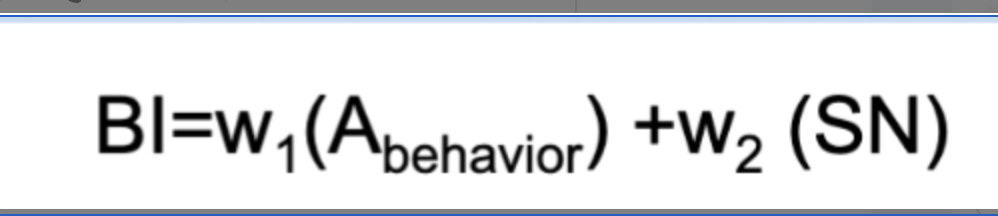
Behavioral Intentions Model
Otherwise referred as the Theory of Reasoned Action
Focuses on-
Behavioral intentions
Subjective norms
Attitude toward a particular behavior
Ex: force a new habit for 2 weeks (drinking more water)
What, how and how u perceive each = formula
Behavioral Intentions Model formula
Attitude-toward-the-object approach
Presents marketers with various alternatives for changing consumer attitudes by attempting to:
Change beliefs and evaluations of product attributes
Create new beliefs about product features
Behavioral influence approach
Proposes that behavior precedes cognition and affect
Schema-based affect approach
Attitude toward a brand or product changes if the affect found in a schema can be changed
Elaboration Liklihood model(ELM) .
Shows that attitudes are changed based on differing levels of consumer involvement through either central or peripheral processing
Balance theory
States that consumers are motivated to maintain perceived consistency in the relations found in a system.
Based on the consistency principle
Consistency principle
states that human beings prefer consistency among their beliefs, attitudes, and behaviors.
Social judgment theory
Consumers compare information to existing attitudes about an object or issue
Attitudes change depending on how consistent the information is with the initial attitude.
Message effects
how the appeal of a message and its construction affect persuasiveness
Message appeal
Conceptualizing how a message may impact the persuasiveness of an advertisement can be done in several ways
Message construction
Impact persuasiveness
Fear appeals
Commonly used
Evokes fear in their target audience as a means of changing attitudes and behaviors
Ads rely on the relationship between a threat and fear. The product is often promoted as a solution to remove a threat
Violent appeals (video games)
Women are less receptive to violence iin ads regardless of level of severity of the violence; younger consumers are generally more receptive to violence in advertising
Many violent ads use elements of humor to lessen the degree to which ad is disturbing.
Sex appeals
Sex sells
Consumers find sexually appealing ads to be persuasive even when they consider them to be exploitative or offensive, but reactions to the ad depend on various factors such as gender, level of nudity, and romantic themes
Humor appeals
Humorous ads can attract attention, create a positive mood, and enhance both attitude toward a brand and purchase attention
Humor appeals can also decrease the credibility of a message source.
types of message appeals
humor, sex, fear, violent
Message Construction
The way that the message is constructed also impacts its persuasiveness.
Primacy effect
an effect that occurs when the information placed early in a message has the most impact
Recency effect
an effect that occurs when the information placed late in a message has the most impact
Source effects
Characteristics of a source that influence the persuasiveness of a message
Includes the following issues:
Credibility
Attractiveness
Likeability
Meaningfulness
Factors that weaken the attitude-behavior model
Time
Specificity of attitude measured
Environment
Impulse
Consumer culture
Commonly held societal beliefs that define what is socially gratifying
Culture, meaning, and value
Functions performed by culture that shape the value of consumer activities
Giving meaning to objects and activities
Facilitating communication
Culture is hierarchical
National culture
Ethnic culture
Regional culture
Generational culture
Cultural norm
Specifies appropriate consumer behavior in a situation within a specific culture
Cultural sanction
Penalty associated with performing non-gratifying or culturally inconsistent behavior
Core Society Value Dimensions
Individualism, masculinity, power distance, uncertainty avoidance, long term orientation, indulgence
individualism
High Score: Society expects one to take responsibility for self and family
Low Score: Life intertwined with large cohesive group
Masculinity
High Score: Society values assertiveness and control
Low Score: Values caring, conciliation, and community
Power Distance
High Score: Society values the division of authority and privilege
Low Score: Society blurs distinction among classes
Uncertainty Avoidance
High Score: Society values novelty, risk taking
Low Score: Society values clarity and familiarity and avoids risk
Long-Term Orientation
High Score: Society values future rewards over short-term rewards
Low Score: Society oriented in the present
Indulgence
High Score: Values happiness and extraversion
Low Score: Values restraint and a reserved personality
CSV scoreboard
Explained using historical CSV dimension scores found in many resources
CSV scores for a country can be essential information for marketers appealing to consumers in another country
Similarity in CSV scores indicate that consumers find value in the same products and experiences
Lower score greater similarities
CSV scoreboard formula
CD = Cultural Distance
TCSV = Target Country Value Score on Dimension i
BCSV = Baseline Country Value Score on Dimension

Enculturation
the way people learn their native culture
Acculturation
the process by which consumers learn a culture other than their native culture.
Shaping
consumers' behaviors slowly adapt to a culture through a series of rewards and sanctions
Modeling
A process of imitating others’ behavior
Verbal communication
transfer of information through either spoken or written word
Difficult within a single language
Translation alone is insufficient to guarantee effective communication
Translation equivalence
two phrases share the same precise meaning in two different cultures.
Metric equivalence
Statistical tests used to validate the way people use numbers to represent qualities across cultures
Necessary to draw comparisons about consumers from different countries
Comparing average attitude scores across cultures requires scalar equivalence.
Nonverbal communication
information passed through some unspoken acts.
elements
Time
mannerisms/ body language
Space
etiquette/manners
Relationships
Agreement
Symbols
BRICS markets
Stands for Brazil, Russia, India, China, and South Africa
Consumers in BRIC nations have rising standards of living and have become attractive markets for many goods and services.
Chindia
combined market and business potential of china and india
Similar to the baby boomer generation in the United States, responsible for tremendous economic growth domestically and abroad.
Glocalization
idea that marketing strategy may be global but implementation at the marketing tactics level should be local.