Module 4 - Response lecture
 Call Kai
 Learn
 Practice Test
 Spaced Repetition
 Match
 Flashcards
 Knowt Play
1/26

There's no tags or description
Looks like no tags are added yet.
27 Terms
Water - Introduction: different states of water
phase diagram

solid = ice → different polymorph crystals
liquid
vapour = steam
if you want to vaporize liquid water, you need a lot of energy (latent heat)D

Density in function of temperature
density frozen temperature < density room temperature
ice is conducting better than water
Water - Introduction: Why do we freeze foods?
effect on shelf life (~ storage temperature)
Water - Introduction: Pressure-assisted freezing and thawing
advantages over confentional freezing and thawing
pressure-assisted freezing
steps: increase pressure until you reach point B → freeze to -20°C (water stays liquid due to high pressure) → lower pressure → crystallization happens all throughout food instead of only on the outside

pressure-assisted thawing
steps: Start in point D → increase pressure until you reach point C → heat up to liquid situation → decrease pressure until point A → thawing all throughout the food
advantages
less cell damage
less leakage
higher quality

Water - water activity and glass transition: Timeline
<1950: higher water content → more risk of spoilage
1957: ‘water activity’ definition
= to which degree the water is associated with food components → will impact its availability to act as a solvent and contribute in physical, chemical and microbiological processes
impact of the solute is depending on type and concentration → affects colligative properties
boiling point
boiling point elevation
freezing point
freezing point depression
vapour pressure
density
osmotic pressure

1988: Glass transition
polymer science → food science
changes
thermodynamic properties
molecular mobility
dielectric constants + mechanical properties
→ influences food quality and stability
Water - Question: The water activity is a measure for the water availability
True
Water - Question: The water activity is a measure for the water content
False

Water - Question: The water activity increases with increasing temperature
True


Below 0.6 → microbiological stability
Water - Water activity meter (niet zo belangrijk denk ik)
headspace equilibration
measurement temperature

Water - Question:
When equivalent weights of either glucose or sucrose are added to a sugar solution, there is a greater change in the colligative properties with the glucose/sucrose solution than the sucrose/glucose solution due to smaller size of sucrose/glucose molecules (higher number of moles for a given weight addition). The interactions between solute and water molecules cause a decrease/increase in the vapor pressure above the solution, which leads to an decrease/increase in the boiling point temperature. The increase/decrease in vapor pressure above a sugar solution means it must be heated to a higher/lower temperature in order for the vapor pressure to be equal to the atmospheric pressure, the condition necessary for boiling to occur.



→ the more sugar present → the higher boiling point elevation
Water - Raoult’s law
calculate water vapor above food/solution based on molar fraction of water
ideal mixture
only for low solute concentrations
not for complex foods

Comparison glucose vs salt
molecular weight sucrose > molecular weight salt
lower molecular weight molecules → larger impact on the collegative properties
ex. salt will dissolve in ice and decrease water freezing point
Water - Time dependent changes in water activity
super saturated sugar sollutions (when you give it time, they will crystallize)
= sugar crystal + solution: complex mixture of sugars (glucose, fructose, sucrose)

→ honey with a high glucose/fructose ratio will crystallize more rapidly
→ paper mentions different strategies to prevent crystallization
→ when the sugar concentration in the remaining liquid decreases, the water activity increases → yeasts can start to grow
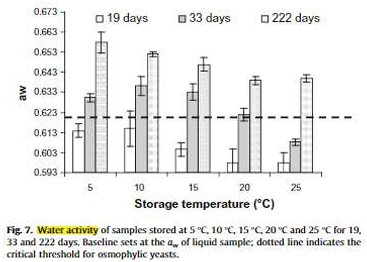
Conclusion
sugar crystallization has an effect
texture
microbiological stability
solubility
Water - Glass transition
Solid: crystalline vs amorphous
Amorphous: glass vs rubber

Phase change vs glass transition
phase change (e.g. melting) | glass transition |
|
|
First order process | Second order process |
Water - Question: Define glass transition temperature in maximum 2 lines using your own words
This is the temperature at which a amorphous food matrix containing water and solutes undergoes a state change from glassy to rubbery. Solutes in glassy state are so concentrated that there mobility is so low and the food is ‘fixed’.
It is the temperature range from which molecular mobility of amorphous material is reduced and molecules cannot move freely, just rotate and vibrate.
The glass transition temperature range is the temperature where an amorphous material transitions from a hard, brittle, glassy state to a soft flexible rubber state upon heating.
Glass transition temperature is the temperature region where an amorphous material changes between a rigid, glassy state to a softer state due to changes in molecular mobility. Water acts as a plasticiser, so increasing water content generally decreases Tg.
Perfect answer:
The glass transition is the temperature range over which an amorphous material changes, upon heating, from a rigid, glassy state to a softer, rubbery state because molecular mobility increases.
Water - Williams-Landel-Ferry (WLF) model

C2 + (T- Tg)
Relaxation time
the shorter relaxation time → the faster molecules can move
Water - Question:

(A: emulsifier started to cake, which is a big problem because it meant that the consumer had problems of using it)

when stored at 5°C it remained perfectly free flowing
above 20°C → more mobility → more stickiness → cake was formed
Water - Question: Freezing does not affect the water activity
False
Water - Question: During freezing, all the water is transformed in the ice state
False
Water - Freezing
Water
cooling → freezing point lower than actual freezing point (= undercooling) → nucleation starts → actual freezing point → further cool ice to deeper temperature
Sugar solution
sugar depresses the initial freezing point
freeze-concentration of the sugars → temperature-dependent equilibrium between ice crystals and unfrozen solution
sufficiently low temperature: freeze-concentrated unfrozen phase → glassy

Water - Freezing graph
ice crystals (pure water) + solutes in unfrozen water
A = 20% sucrose solution (RT)
C = start freeze-concentration
Te = eutectic temperature
= homogenous mixture that has a melting point lower than those of the constituents
B = initial glass transition T unfrozen fraction
→ moves up as a consequence of freeze-concentration
D = max freeze-concentration → solute-specific
1. Thermodynamic vs kinetic
2. Importance of storage T

Water - Question:
A small-scale ice cream manufacturer wants to develop yoghurt ice cream. His first trial contains full-fat yoghurt, cream, sucrose and an emulsifier. His taste panel thought the ice cream has just the right hardness, but it is too sweet for a yoghurt ice cream. Just decreasing the sucrose concentration is an obvious solution but made the ice cream too hard. Can you suggest a strategy to improve the taste without affecting the texture? Hint: Think about Raoult’s law
Raoults law
= change in the vapor pressure of the solvent that occurs when a solute is added to the solvent is proportional to the mole fraction of the solute


Sugars with a lower sweetening capacity and lower molecular weight
Other sugars: glycerol, glucose, sorbitol, maltose, lactose, maltodextrin, polysaccharides
Water - Question:
The microstructure of chocolate can be defined as a dispersion. It contains sugar particles, cocoa particles and/or milk particles in a continuous cocoa butter phase, depending on the type of chocolate. Relate the type of chocolate (dark chocolate, milk chocolate, white chocolate) to the schematic representation of the microstructure (1, 2, 3) and relate the chocolate ingredients (cocoa particle, sugar particle, cocoa butter, milk particle) to their schematic representation (A, B, C, D).

→ see solution in wooclap

Water - White chocolate
Reason of solidifying in Cargill tank: too much amorphous lactose in the chocolate
amorphous lactose → crystalline lactose + H2O → interparticulate bridges → agglomeration → thickening and solidifying above melting point of cocoa butter

Remark
T-dependent
Humidity dependent
at higher T → the transitions can occur at lower moisture content
How does the relaxation time of amorphous sugar in chocolate change when moisture lowers its Tg?
Water - Question

Jelly candy: liquid
water
hydrocolloids
sugars: sucrose + glucose
liquid state
sucrose is completely solubilized

Caramel candy: amorphous
water
milk ingredients: condensed milk and fat
sugars: sucrose + glucose
Caramel and fudge contain lipid emulsions and protein aggregates in an amorphous sugar matrix

Cotton candy: glass
100% sugar
glass state

→ when you start eating it becomes stickier
it attracts water → crosses glass line → becomes stickier
Tablet candy: crystalline
90 - 95% sugar (mainly sucrose)
2-8% binder syrup
Water - Question:
Tagatose has a lower glycaemic impact than sucrose. Would you consider to use it in the production of a lollypop? Explain.
If the goal was producing a candy that has lower impact in the raise of blood glucose it would be useful. However, lollipops are suppossed to be hard candies that would be hard at normal T, since tagatose has a Tgaround 15°c then at room T the can would already be in a more rubber state so it can become more sticky which is not desirable

→ glass transition appearing around room temperature
How to prevent stickiness and structural collapse in amorphous food products when the storage temperature is close to their glass transition temperature
Formulation
Proces: cooling rate, temperature
Storage conditions
Water - Question
The figure represents the state diagram of a sucrose/water mixture (Van der Sman & Renzetti, 2019). Relate the symbols indicated on the state diagram to the correct technical terminology.

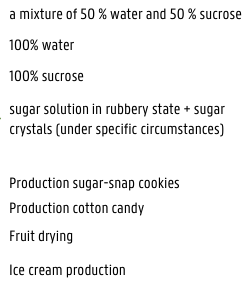

Cookie baking
Flour → starch + proteins
Sucrose
Fat
Water

A or B: dough: crystalline sugar dissolving during mixing
A or B → C: baking
C → E: cooling to partially crystallie/amorphous product
if he gives an equation you need to be able to explain it