L8 Oncology Pharmacotherapy
 Call Kai
 Learn
 Practice Test
 Spaced Repetition
 Match
 Flashcards
 Knowt Play
1/37

There's no tags or description
Looks like no tags are added yet.
38 Terms
What cells does skin cancer originate?
squamous cells
melanocyte
basal cells
What are the types of skin cancers and annual cases
basal cell skin cancer: 3.6m
squamous cell skin cancer: 1.8m
melanoma: 100k
other: <1%
Describe the melanoma stages and 5 yr relative survival rate
local: 99%
regional: 68%
distant: 30%
all stages combined: 93%
pt has UV light exposure, moles, fair skin, freckles, light hair, and fmh of melanoma. What are they at risk of?
skin cancer
pt has UV exposure, >age, genetics, number of moles, male, and fair skin. What are they at risk of?
melanoma
melanoma is the most aggressive and dangerous form of skin cancer. Where does it develop? What is the survival rate?
transformed melanocytes (pigment producing cells)
primary: 98% 5 yr survival rate
metastatic: 23% 5 yr survival rate
What are the ABCDE’s of melanoma?
Asymmetry
Border is irregular/notched/blurred
Color is mixed
Diameter larger than 6mm
Evolves over time
What are the Clark Levels of Melanoma?
lvl 1: confined to epidermis “in situ”
lvl 2: invasion of the papillary dermis
lvl 3: filling of the papillary dermis but not ext to reticular dermis
lvl 4: invasion of reticular dermis
lvl 5: invasion of the deep, subcutaneous tissue
8% of melanoma is familial form. Individuals from melanoma prone families frequently have…
dysplastic nevi, large, irregular, asymmetric, variable pigmented moles.
dysplastic nevi occur on sun exposed skin (not always)
diagnosed in 30s (normal age is 50s)
What must be monitored in familial malignant melanoma?
dysplastic nevi for any change in size, shape, and color for possible evolvement to cancer.
What are the 2 genes associated with familial melanoma?
CDKN2A (20-40%; detected in families from Europe, NA, Australia) and CDK4 (17 cases/rare)
What are the two alternative spliced transcripts from CDKN2A that differ in the first exon?
p16INK4A and p14ARF
this spliced transcript inhibits CDK4/6-cyclin D1 complexes, keeping Rb protein in dephosphorylated state and binds to E2F transcription factor and inhibits transcription of genes regulated by E2F. These gene products are proteins necessary for cell cycle progression. What is this?
p16INK4A
This spliced transcript inhibits MDM2 and stablizes p53. Active p53 induces p21 (negative cell cycle regulator that inhib CDK-cyclinA/B), preventing progression from G2 to M. What is this?
p14ARF
What happens to p16 if CDK4 is mutated?
mutated CD4 binds to p16 and prevent sp16 from carrying out its function in regulation of cell cycle progression (inhib p16)
pt has random acquired mutations, may be due to environment, age, chance or other nonheritable factors. This can occur on the skin, eyes, ears, GI tract, leptomeninges, oral and genital mucous membranes. This type of melanoma has mutations in p16INK4A. What type of melanoma is this?
sporadic melanoma
What is the distribution of sporadic melanoma at time of diagnosis?
local at stage I and II: 85%
regional nodal disease: 15%
distant metastases: 2%

Mole Formation (Proliferation): Mutations (BRAF or NRAS) make pigment cells multiply too much in the top skin layer (epidermis).
Sideways Spread (Radial Growth): The cells gain "immortality" (losing tumor-stopping genes like p16, PTEN, and p14) and spread horizontally across the top skin layer.
Downward Invasion (Vertical Growth): The cells lose their "glue" (E-cadherin) and produce enzymes (MMP2/9) to break into the deeper skin layer (dermis).
Distant Spread (Metastasis): The cancer triggers new blood vessel growth, dodges the immune system, and enters the bloodstream to spread elsewhere in the body.
Look at table for most important genes involved in melanoma susceptibility

What are the 3 aggressive subclasses of melanoma?
uveal: tissue of eye
mucosal: mucosal membranes (mouth, nose, genitals)
acral: non-hair-beaaring sections of skin (palms and soles) higher percentage
T/F the rare forms of melanoma include uveal, mucosal, acral. They have effective diagnostic marker and treatment methods.
false, they aren’t distinctive
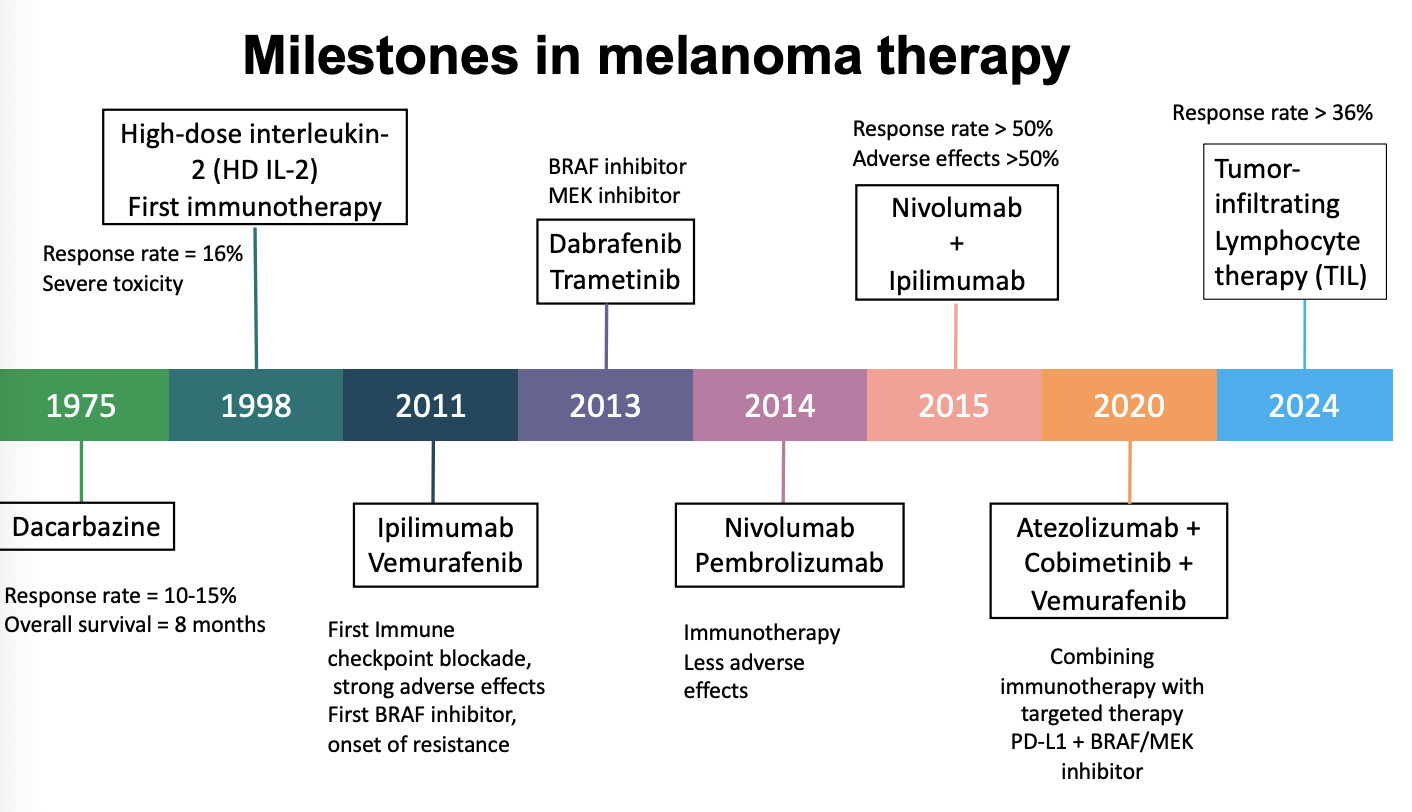
Take a look at milestones in melanoma therapy
Activation mutations in BRAF are present in 40-60% of nevi and melanoma (80% of cases if V600E mutation) SEQ cell proliferation due to BRAF mutation
BRAF mutation at aa residue 600 where the valine is now replaced by glutamic acid, which makes protein active in MAPK signaling cascade → cell proliferation
What are the potent small molecule inhibitors of the kinase domain in mutated BRAF called?
vemurafenib or dabrafenib
What is the disadvantage of targeted therapies with BRAF inhibitor?
they have dramatic anti tumor activity in adv melanoma pts w mutated BRAF BUT every pt experiences relapse and has disease progression
Molecular analyses showed that all BRAF inhibitor resistant tumors demonstarte reactivation of MAPK pathways, resuming uncontrolled cell growth. What is the progression of the disease associated with?
additional NRAS mutation. BRAF and NRAS mutations are mutually exclusive (cant happen at same time)
What is a potent highly specific inhibitor for MEK (downstream component of BRAF in MAPK signaling pathway)
trametinib
What is the standard of care for melanoma patients due to higher response rate and longer surivival? How does it work?
BRAF + MEK inhibitor: BRAF inhib blocks V600 BRAF mutation, MEK inhib blocks MEK which cuts off the signal to ERK, stopping tumor cell survival, proliferation, and invasion.
“coley’s toxins” Dr. Coley (briefly went over)
cocktails of live bacteria that were injected into cancer pts but was assoc w highly mortality than vaccines w dead bacteria.
This was used because it was believed cancers would regress spontaneously when local bacterial infections and abscesses were present.
“tumor immune surveillance” Dr. Burnet (briefly went over)
believed that the immune system detects and destroys pre-malignant cells in addition to protecting against pathogens. Onset of cancer = failed immune surveillance
spontaneous regression of adv melanoma occurs and typically accompanied by vitiligo suggesting immune system was responding to antigens shared by normal and malignant melanocytes
Immunotherapy seeks to develop agents which reactive a pts immune system to exert an anti tumor response. What are the immune checkpoints of immunotherapy? (briefly went over)
PD-1/PDL1 axis, CTLA-4
What are the benefits of immunotherapy? (briefly went over)
use pts own immune system to destroy cancer cells
immunological memory against cancer specific antigens, more durable response
immunotherapy + other agents improve efficacy of drugs
What are the risks of immunotherapy? (briefly went over)
autoimmune disease
resistance
pt response is heterogenous
Describe cancer vaccines
made in a lab to and used to make body’s natural defense system to fight cancer: pts immune cells are removed, exposed to cancer cells/antigens
made from cancer cells, parts of cells, or antigens, bacteria, viruses, immune cells
some used to treat some are used to prevent
HPV: protect several cancers result from an HPV infection
What the a cancer vaccine used to treat prostate cancer that is no longer responsive to hormone therapy?
Sipuleucel-T (Provenge)
SEQ how provenge is made
remove immune cells (WBCs) from pt
combine cells w protein (prostatic acid phosphatase) from prostate cancer cells and GM-CSF
infuse into pt 3x
immune system attack cancer
cancer is not cured but it prolongs life
How do mRNA vaccines work?
genetic sequence of virus spike used ot make mRNA sequence
mRNA packed into nanoparticle (vaccine) to deliver mRNA to immune cells
immune cells follow mRNA code to produce spike protein to stimulate immune response

What is intismeran autogene?
personalized mRNA cancer vaccine dev by Moderna/Merck
in combo w Keytrude (ICI), reduce risk of melanoma recurrance/death by 42% in phase 3 trial
reduce incidence of metastasis 38%
NOT FDA APPROVED