Exam 2 (Ch 6-11)
 Call Kai
 Learn
 Practice Test
 Spaced Repetition
 Match
 Flashcards
 Knowt Play
1/71

Earn XP
Description and Tags
Comprehensive vocabulary flashcards covering BIO221 chapters on sex determination, DNA replication, DNA structure and chromatin organization, gene linkage and mapping, and chromosome number/structure mutations.
72 Terms
Homogametic sex
The sex that produces uniform gametes with respect to sex chromosomes, such as human females (XX) or butterfly females (14 chromosomes, including 2X).
Heterogametic sex
The sex that produces unlike gametes that determine progeny sex, such as human males (XY) or butterfly males (13 chromosomes with 1X).
Klinefelter syndrome
A condition resulting from meiotic nondisjunction of sex chromosomes yielding a 47,XXY karyotype; affected individuals are tall males with rudimentary testes, slight breast enlargement, and rounded hips.
Turner syndrome
A condition resulting from meiotic nondisjunction yielding a monosomic 45,X karyotype; affected individuals are females with rudimentary ovaries, short stature, neck skin flaps, and a broad chest.
Other sex chromosome syndromes
Include conditions such as Triple X syndrome (47,XXX)
Tetra-XYY syndrome (48,XXX) and penta-X (49,XXX) karyotypes have been reported
47, XYY, which result from the presence of extra sex chromosomes and can lead to various physical and developmental differences.
males over 6 feet tall, may have subnormal intelligence, may have
personality disorders
Pseudoautosomal regions (PARs)
Homologous regions located at both ends of the human Y chromosome that pair and synapse with the X chromosome during meiosis.
Male-specific region of Y (MSY)
The non-recombining portion that comprises approximately 95% of the human Y chromosome.
SRY (sex-determining region Y) gene
A gene located in the male-specific region of the human Y chromosome that activates at 6 to 8 weeks of embryonic development to trigger male differentiation.
Testis-determining factor (TDF)
The protein product encoded by the SRY gene in mammals that induces undifferentiated embryonic gonadal tissue to develop into testes.
Transgenic mice research
Mice have Sry gene comparable to human SRY.
Mouse DNA with Sry injected into XX mice eggs → most of the offspring develop into males

Barr body (sex chromatin body)
A condensed, inactive X chromosome that lies against the nuclear envelope of interphase cells in mammalian females to equalize gene dosage with males.
Lyon hypothesis
The hypothesis stating that X chromosome inactivation in female mammalian somatic cells occurs randomly early in development, and all descendant cells maintain the inactivation of that specific homolog.
X-inactivation center (Xic)
A critical control region on the proximal end of the human X chromosome p arm that contains the XIST gene, responsible for initiating X inactivation.
DNA, histone proteins, or both are chemically modified.
– DNA inactivated => silences most genes.
– Creates memory that keeps same homolog inactivated following
chromosome replications and cell division.
Two phenotypes of C. elegans
C. elegans has two sexual phenotypes:
– Males with one testes have only one X chromosome, no Y.
– Hermaphrodites (have both testes and ovaries):
Have two X chromosomes, no Y.
Eggs are fertilized by stored sperm: self-fertilization.
• Majority of offspring are hermaphrodites; less than 1% are males.
Temperature-dependent sex determination (TSD)
An environmental sex determination mechanism in reptiles where the incubation temperature of developing eggs controls whether offspring develop as male or female.
Aromatase
An enzyme controlled by thermosensitive factors that converts androgens (such as testosterone) into estrogens (such as estradiol) in nonmammalian vertebrates.
Aneuploidy
A chromosome abnormality in which an organism loses or gains one or more individual chromosomes rather than a complete haploid set (e.g., monosomy, disomy, trisomy etc).
Monosomy
The loss of a single chromosome from a diploid genome (2n−1); typically poorly tolerated in animals due to haploinsufficiency or unmasking of lethal alleles.
Monosomy for X chromosome occurs in humans.
– Monosomy for autosomes: not tolerated in humans/animals, tolerated in plants
Haploinsufficiency
A condition in which a single functional copy of a gene is insufficient to produce enough gene product to support normal life-sustaining function.
Euploidy
complete haploid sets of chromosomes are present (diploidy, polyploidy, triploidy etc)
Down syndrome
A human aneuploidy resulting from trisomy of chromosome 21 (47,21+), commonly caused by nondisjunction in the maternal ovum during meiosis.
Down Syndrome Critical Region (DSCR)
A dosage-sensitive segment on human chromosome 21 containing genes such as DSCR1 that are responsible for the developmental and physiological phenotypes of Down syndrome.
Other human aneuploidies
Two human trisomies survive to term:
– Patau syndrome (47, 13+) (figure)
– Edwards syndrome (47, 18+)
=> severe malformations and early lethality.
Normal embryonic development requires precisediploid complement of chromosomes to maintain equilibrium in gene expression.
Polyploidy
more than two sets of chromosomes are present.
Autopolyploidy
A polyploid state characterized by the duplication of complete chromosome sets originating from the same species.
Allopolyploidy
A polyploid state resulting from hybridization between two closely related species followed by chromosome doubling to yield an amphidiploid organism.
Tetraploid cells
Tetraploid cells are produced experimentally from diploid cells:
– By applying heat or cold shock to diploid cells undergoing meiosis or
– By applying colchicine to somatic cells undergoing mitosis (interferes with spindle formation).
Allotetraploid
If tetraploid has genomes form separate species
Amphidiploid
When both original species are known,

Chromosome aberrations
Changes that delete, add, or rearrange portions of one or more chromosomes.
• Deletions and duplications: total amount of genetic information in chromosome can change.
• Inversions: genetic material is exchanged with segment of nonhomologous chromosome or transferred to another chromosome.
• Translocations: location of genes altered within genome

Chromosomal deletions
Portion of a chromosome lost due to breaks; called deletions or deficiencies.
• A deletion can occur near one end (terminal deletion) or from the interior of a chromosome (intercalary deletion)
Deletion loop (or compensation loop)
Synapsis occurs between normal homolog and chromosome with intercalary deletion.
• The unpaired region of the normal homolog must “buckle out” into a deletion loop (also called compensation loop) for synapsis to occur.
Cri du Chat syndrome
A human genetic disorder caused by a terminal or intercalary deletion of the short arm of chromosome 5 (46,5p−), causing intellectual disability and a characteristic cat-like infant cry.
Chromosomal duplications
Repeated segment of a chromosome.
• Pairing in heterozygotes produces a compensation loop.
• Arise through unequal crossing over between synapsed chromosomes in meiosis, or through replication error prior to meiosis.

Inversions rearrange linear gene sequence
Segment turned 180˚ within chromosome => no loss of genetic information.
• Two breaks in chromosomes followed by reinsertion of inverted segment.
• Chromosomal loop forms prior to breakage and create “sticky ends” that close together and rejoin.
• Pericentric inversion includes the centromere; paracentric inversion does not
Consequences of inversions during gamete formation
The pairing between one inverted chromosome and its normal non-inverted homolog requires inversion loop

Paracentric inversion heterozygote
Figure: The effects of a single crossover (SCO) within an inversion loop in a paracentric inversion heterozygote, where two altered chromosomes are produced, one acentric and one dicentric. Both chromosomes also contain duplicated and deficient regions.
Paracentric inversion
An intra-chromosomal rearrangement where an internal segment is inverted 180∘ without including the centromere.
Pericentric inversion
An intra-chromosomal rearrangement where an internal segment is inverted 180∘ and spans across the centromere, involving both chromosome arms.

Translocations
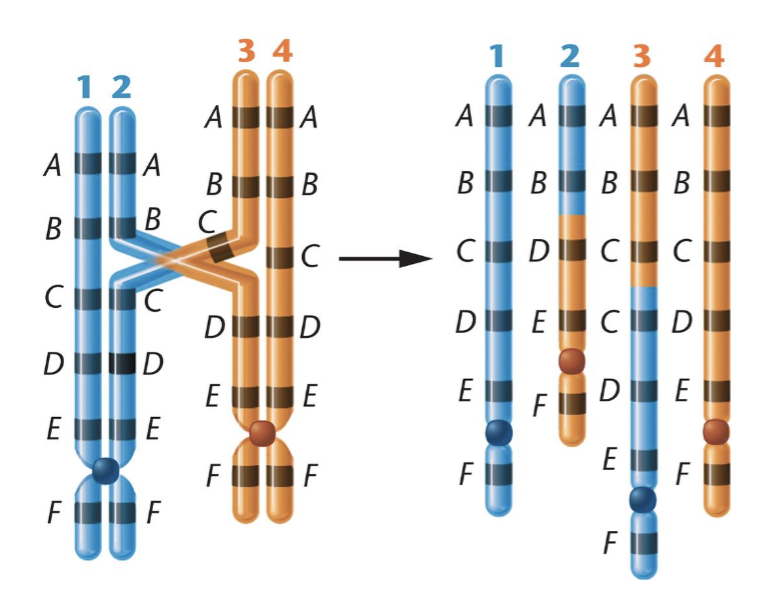
translocation is the movement of a chromosomal segment to a new location in the genome.
Reciprocal translocation
The exchange of segments between two nonhomologous
chromosomes => genetic information not lost or gained, just rearranged.
Homologs that are heterozygous for reciprocal translocation undergo unconventional synapsis during meiosis.
• Genetically unbalanced gametes are produced.
Segregation patterns in reciprocal translocations
Two possible segregation patterns:
– Alternate segregation leads to normal and balanced gametes
– Adjacent segregation leads to gametes containing duplications
and deficiencies.
• Fertilization of genetically unbalanced gametes can have
lethal results.
• Can result in partial monosomy or trisomy leading to abnormalities at birth.

Robertsonian translocation
A rearrangement in which breaks at the extreme ends of the short arms of two acrocentric chromosomes lead to the fusion of their long arms into a single large chromosome; cause of familial Down syndrome.
Fragile-X syndrome
The most common inherited form of intellectual disability, associated with a folate-sensitive fragile site on the X chromosome and an expansion of a CGG trinucleotide repeat (>230 repeats) in the FMR1 gene.
Complete linkage
A condition occurring when two genes are located in close physical proximity on the same chromosome such that no crossing over occurs between them, producing exclusively parental gametes.
Recombination possibilities
Synapsed homologous pairs reciprocally exchange chromosome segments when crossing over occurs => results in reshuffling (recombination) of alleles between homologs.
• Frequency of crossing over is proportional to distance between any two loci on a single chromosome.
• When loci of two linked genes are far apart:
– Number of recombinant gametes nears 50%.
– If 50% recombination occurs (two parental types and two recombinant
gametes), transmission indistinguishable from two unlinked, independently assorting genes.
Chiasmata
X-shaped points of physical overlap and genetic exchange between synapsed non-sister chromatids during meiotic prophase I.
Map unit (mu)
A unit of genetic distance along a chromosome defined as a 1% recombination frequency between two linked gene loci.
Interference (I)
The phenomenon whereby a crossover event in one chromosomal region reduces the probability of an additional crossover occurring nearby, calculated as I=1−C.
Coefficient of coincidence (C)
The ratio quantifying disparities in double crossovers due to interference, calculated as C=Expected DCOObserved DCO.
Semiconservative replication
The mode of DNA replication wherein each newly produced double helix contains one intact parental strand and one newly synthesized strand.
Colchicine
A spindle-inhibiting chemical agent used experimentally to induce polyploidy in somatic cells by disrupting mitotic spindle formation.
Intercalary deletion
A chromosomal mutation characterized by the loss of an internal segment from the interior of a chromosome, requiring two breaks and looping during synapsis.

Bar mutation
A mutation in Drosophila melanogaster caused by duplication of the 16A segment of the X chromosome, resulting in a narrow, slit-like eye phenotype.
Replicon
The unit length of DNA replicated from a single origin of replication; the circular bacterial chromosome constitutes a single replicon of about 4.6×10⁶ base pairs.
DNA polymerase I
A bacterial polymerase with 5′→3′ synthesis, 3′→5′ exonuclease proofreading, and unique 5′→3′ exonuclease activity used to remove RNA primers and fill gaps.
DNA polymerase III holoenzyme
The multimeric enzyme complex in bacteria responsible for the bulk of replicative chain elongation, consisting of core catalytic subunits, a sliding clamp (β), and a clamp loader (γ complex).
DNA gyrase
A bacterial topoisomerase that relieves torsional strain and supercoiling generated ahead of the advancing replication fork by cleaving, untwisting, and resealing the DNA.
Primase
An RNA polymerase recruited by helicase that synthesizes a short RNA primer complementary to the template, supplying the free 3′-OH required for DNA polymerase activity.
Okazaki fragments
Short stretches of newly synthesized DNA formed discontinuously on the lagging template strand during replication.
DNA ligase
An enzyme that seals phosphodiester nicks in the sugar-phosphate backbone between adjacent Okazaki fragments during lagging strand synthesis.
Telomeres
Repetitive, non-coding nucleoprotein structures located at the ends of linear eukaryotic chromosomes that protect chromosome stability; in humans, the sequence is 5′-TTAAGGG-3′.
Telomerase
A ribonucleoprotein reverse transcriptase that carries an RNA template to synthesize repeated DNA sequences (5′-TTGGGG-3′), extending the 3′ overhang to resolve terminal end-replication loss.
Transforming principle
The active substance demonstrated by Avery, MacLeod, and McCarty (1944) to transform nonvirulent type IIR bacteria into virulent type IIIS bacteria; shown to be DNA.
Hershey-Chase experiment
The 1952 blender experiment using 32P to label DNA and 35S to label protein coats in T2 bacteriophages, confirming that DNA enters the host cell and serves as genetic material.
Phosphodiester bond
The covalent linkage joining adjacent mononucleotides together via ester bonds between a phosphate group and the 3′ and 5′ carbon positions of neighboring sugars.
Chargaff's rules
The base composition rules stating that in double-stranded DNA, A=T, G=C, and the sum of purines equals the sum of pyrimidines (A+G=C+T).

X-ray diffraction analysis of DNA
The crystallographic technique used by Rosalind Franklin and Maurice Wilkins that revealed a characteristic periodic scattering pattern indicative of a double-helical structure.
Nucleosome
The basic repeating structural unit of eukaryotic chromatin, consisting of an octamer of histones (H2A,H2B,H3,H4) wrapped with 147 base pairs of DNA, linked by histone H1.
Heterochromatin
Densely compacted and transcriptionally inactive chromatin that stains darkly during interphase, found at telomeres and centromeres.
Pseudogenes
Non-functional DNA sequences that represent evolutionary vestiges of genes; they resemble functional genes structurally but contain alterations preventing transcription.