Plant Systematics and Plant Families
 Call Kai
 Learn
 Practice Test
 Spaced Repetition
 Match
 Flashcards
 Knowt Play
1/79

Earn XP
Description and Tags
Comprehensive vocabulary flashcards covering pteridophytes, gymnosperms, basal angiosperms, monocot families, and core eudicot clades along with key botanical morphological terms.
80 Terms
Eusporangiate
A sporangium development pathway originating from multiple initial cells, resulting in large, multi-cell-walled sporangia that produce an indefinite, high spore count.
Leptosporangiate
A sporangium development pathway originating from a single initial epidermal cell, forming a small, single-cell-thick wall with an annulus that produces a definite spore count (32 to 128 spores).
Microphylls
Leaves that evolved as simple outgrowths of stem tissue, possessing only a single unbranched vascular vein, characteristic of lycophytes.
Megaphylls
Leaves with branched vascular systems that evolved from the flattening and webbing of branched stems, characteristic of true ferns and seed plants.
Synangium
A fused compound reproductive structure formed by multiple united sporangia, as found in Psilotaceae and Marattiaceae.
Sporocarp
A specialized, submerged nut-like reproductive structure in aquatic heterosporous ferns (Salviniaceae) enclosing either all megasporangia or all microsporangia.
False Indusium
A protective flap over fern sori formed by the reflexed or rolled-over leaf margin rather than specialized blade outgrowths, characteristic of Pteridaceae.
True Indusium
A specialized epidermal flap or outgrowth originating from the abaxial frond surface that covers and protects developing sori.
Acrostichoid
A condition where sporangia are densely spread across the entire abaxial leaf surface without forming discrete sori or indusia.
Coralloid Roots
Specialized dichotomously branching roots in cycads that grow upward above the soil surface and house nitrogen-fixing cyanobacteria.

Pericarp
The fruit wall developing from the ovary wall, typically differentiated into three layers: exocarp, mesocarp, and endocarp.
Berry
A fleshy fruit typically formed from a single or compound ovary with a soft, fleshy endocarp enclosing the seeds.
Drupe
A fleshy fruit containing a stony, lignified endocarp (pit) surrounding the seed.
Follicle
A dry dehiscent fruit derived from a single carpel that splits along a single suture line.
Samara
A dry, winged, indehiscent fruit adapted for wind dispersal.
Aril
A specialized fleshy outgrowth surrounding the seed that originates directly from the funiculus (seed stalk).

Sarcotesta
A fleshy, pulpy outer layer of the seed coat derived directly from the integument tissue.

Hypogynous Flower
A floral architecture where sepals, petals, and stamens insert directly onto the receptacle below a superior gynoecium.
Atactostele
A stem vascular arrangement characteristic of monocots in which primary vascular bundles are scattered randomly throughout the ground tissue.
Cuneate Crystals
Wedge-shaped protein crystals situated in sieve-tube plastids, serving as a diagnostic synapomorphy of monocots.
Commelinid Monocots
A distinct monocot clade possessing special organic acids in their cell walls that exhibit UV fluorescence.

Ensiform Leaf
A sword-shaped, unifacial leaf with no morphological distinction between the adaxial and abaxial surfaces, seen in Acoraceae.
Spadix
An indeterminate inflorescence characterized by a thickened, fleshy central axis bearing densely packed, sessile flowers.
Spathe
A large, often colorful or leafy bract that subtends and encloses a spadix inflorescence.

Sagittaria
An aquatic Alismataceae genus featuring emergent or floating leaves and racemes of unisexual flowers with upper staminate and lower pistillate flowers.

Dioscoreaceae
A monocot family of herbaceous climbing vines possessing underground storage tubers or rhizomes, reticulate-veined leaves, and 3-winged capsular fruits.

Alliaceae
A monocot family of bulbous perennial herbs with narrow basal leaves, scapose umbellate inflorescences subtended by two bracts, and distinct onion-scented sulfur compounds.
Labellum
The specialized, enlarged median inner tepal (lip) in orchids that acts as a visual attractant and landing platform for pollinators.
Gynostemium
A consolidated central floral column in Orchidaceae formed by the complete fusion of the fertile stamen(s) with the style and stigma.
Pollinium
A cohesive mass of pollen grains shed together as an entire transportable unit, characteristic of Orchidaceae.
Resupinate Flower
A floral orientation resulting from a 180∘ twisting of the pedicel or ovary during development, placing the labellum at the lower side of the flower.
Velamen
A specialized multi-layered sponge-like epidermal root sheath in epiphytic orchids that rapidly absorbs and retains moisture and dissolved nutrients.

Agavaceae
A monocot family of fibrous, succulent perennial subshrubs to branching trees adapted to dry habitats, possessing rosulate leaves and dorsifixed anthers.

Cauline Leaf
Leaves that arise along the aerial stem above the ground level, often possessing sheathing leaf bases.

Arecaceae
The palm family, consisting of unbranched arborescent or climbing monocots with large compound/sheathing leaves, axillary spatheate inflorescences, superior ovaries, and oil-rich drupes.

Musaceae
The banana family; giant herbs with a pseudostem composed of tightly wrapped leaf sheaths, thyrse inflorescences, 5 connate abaxial tepals, and inferior ovaries.

Cannaceae
A monocot family featuring asymmetric flowers, an inferior ovary, a laminar style, and a single petaloid fertile stamen with a monothecal anther accompanied by petaloid staminodes.
Spiromonistichous
A distinct phyllotaxy found in Costaceae where leaves form a single vertical column that traces a spiral curve around the stem axis.

Tank Epiphyte
A rosette growth habit in Bromeliaceae where tightly overlapping, clasping leaf sheaths form an impounding central basin that catches and stores rainwater.

Peltate Trichome
A specialized umbrella-like epidermal scale found on Bromeliaceae leaves that functions in water and mineral absorption.

Bromeliaceae
A monocot family adapted to tropical and warm habitats, recognized by absorptive peltate scales, spiral sheathing leaves, and brightly colored inflorescence bracts.

Sedge Spikelet
The basic inflorescence unit of Cyperaceae, consisting of a central axis (rachilla) supporting distichous or spiral scales, each subtending a single reduced flower.

Juncaceae
The rush family, characterized by round, solid or septate stems, 6 chaffy/scarious tepals, 3 coiled style branches, and loculicidal capsule fruits.

Floret
The small individual flower unit of a grass spikelet, consisting of reproductive organs closely enclosed by an outer lemma and an inner palea.
Lemma
The lowermost of two fertile green bracts that encloses the grass flower within a spikelet.
Palea
The uppermost, inner, usually membranous bract situated directly between the grass flower and the rachilla.
Caryopsis
A dry, indehiscent, single-seeded fruit (grain) characteristic of Poaceae, in which the pericarp is completely fused to the thin seed coat.

Caducous
Plant organs, such as the sepals of Papaveraceae, that drop or fall off exceptionally early during development as the flower opens.

Valvate Anther Dehiscence
Anther opening mechanism by means of discrete swinging or hinged apical flap-like valves, typical of Berberidaceae and Lauraceae.
Peltate Leaf
A leaf blade whose petiole is attached to the central lower laminar surface rather than at the leaf base, diagnostic of Nelumbonaceae.
Androgynophore
An elevated floral stalk that projects above the perianth, bearing both the stamens (androecium) and the pistil (gynoecium).
Corona
A ring of filamentous or petaloid appendages positioned between the perianth whorls and the staminal column in Passifloraceae.
Cyathium
A pseudanthial inflorescence in Euphorbia resembling a solitary flower, composed of an involucre with nectar glands enclosing male flowers and a central female flower.
Obturator
A placental glandular outgrowth inside the ovary of Euphorbiaceae that facilitates and guides pollen tube entrance into the ovule micropyle.

Cucurbitaceae
The melon/cucumber family; climbing vines possessing stems with modified branch tendrils, unisexual flowers with connate stamens, inferior ovaries, and pepo fruits.
Pleurogram
A distinct U-shaped or parabolic groove located on the lateral faces of seeds in the Mimosoid clade of Fabaceae.
Amygdalin
A cyanogenic glucoside compound found concentrated in the seeds and tissues of Rosaceae subfamily Amygdaloideae.
Tetradynamous
A stamen arrangement characterized by six stamens arranged in two whorls: four long inner filaments and two short outer filaments, diagnostic of Brassicaceae.
Silique
A dry, dehiscent fruit derived from two fused carpels that is more than three times longer than broad, splitting along two valves leaving a central replum.
Perisperm
Diploid nutritive storage tissue within the seed derived directly from the nucellus, replacing endosperm in core Caryophyllales.
Areole
A specialized, highly condensed cushion-like short shoot in Cactaceae bearing spine clusters, glochidia, and flowers.
Ocrea
A membranous, tubular sheath formed by the fusion of stipules that surrounds the stem node, characteristic of Polygonaceae.
Betalains
Water-soluble nitrogenous red, purple, and yellow pigments exclusive to core Caryophyllales that never co-occur with anthocyanins.

Lycopodiaceae
Clubmosses; homosporous, sporophylls clustered into strobi
Lycopodium

Selaginellaceae
spikemosses; heterosporous, eusporangiate, sporophylls aggregateed into strobili with mega/microsporangia
Selaginella

Isoetaceae
quillworts; heterosporous, eusporangiate, single large sporangia embedded inside sporophylls (swollen base leaves)
Isoetes

Equisetaceae
horsetails; homosporous, eusporangiate, sporangia clustered on abaxial side of sporangiophores packed into strobilus
Equisteum
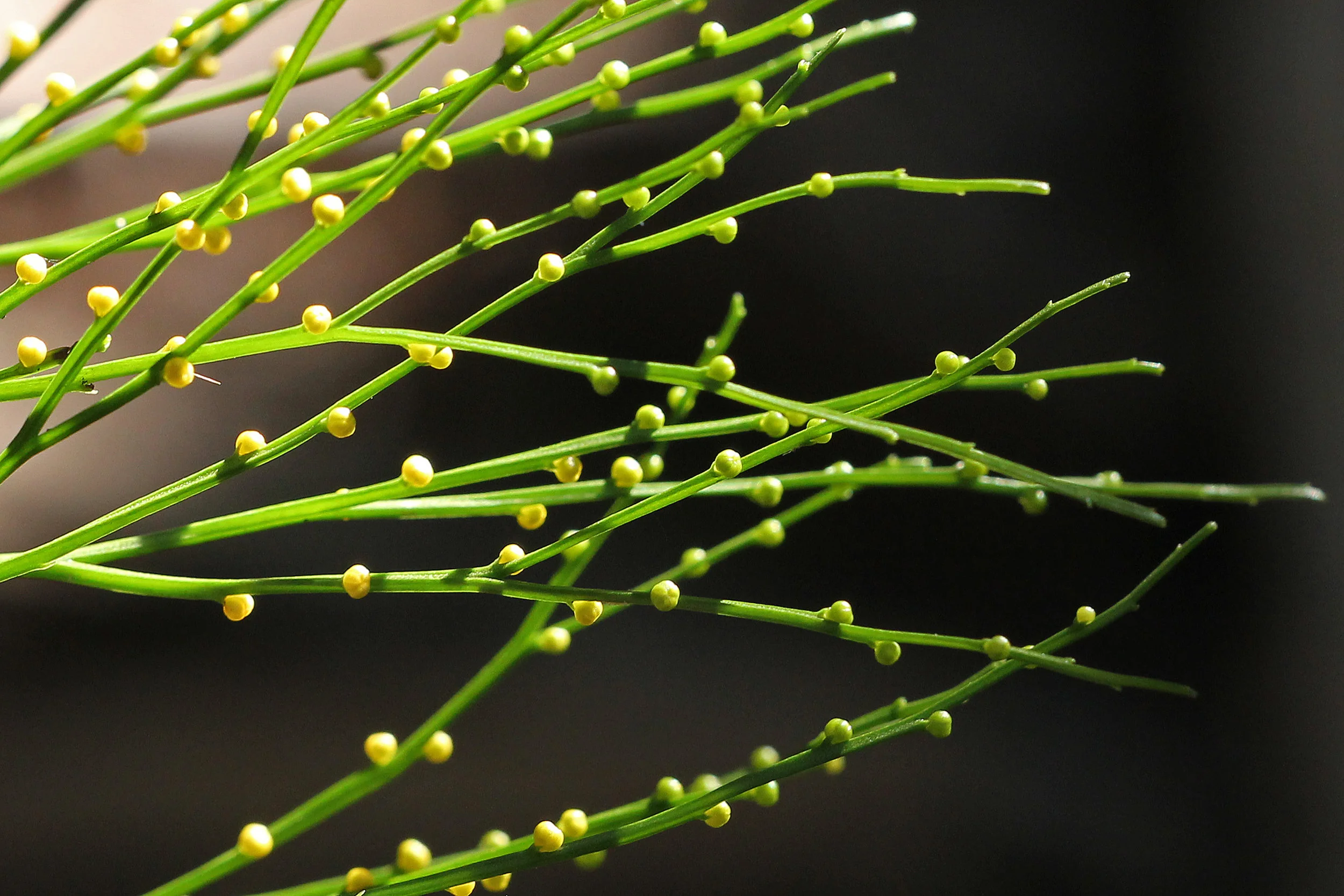
Psilotaceae
whisk fern; homosporous, eusporangiate, sporangia fused itno synagium sitting in axils of small scale-like leaves
Psilotum

Ophiglossaceae
Adders tongue; homosporous, eusporangiate, clustered on fertile spike
Ophioglossum
Marratiaceae
Giant fern; homosporous, eusporangiate, sporangia on underside of pinnules, fused in boat shaped synangia w/ longitudal dehiscence
Agiopteris
Leptosporangiate Families
Leptosporangiate
Osmundaceae
Royal fern; homosporous, eusporangiate (primitive), large naked sporangia heavily clustered over entire surface of leaflet or specialized part of frond, dimorphic, leathery frond with stipular wings
Osmunda
Hymenophyllaceae
Filmy fern; homosporous, leptosporangiate, clustered on hair-like receptacle projecting out of leaf margin enclosed by protective envelope, monomorphic, filmy extremely thin frond with free veins ending in marginal tube-shaped receptacle
Hymenophyllum
Glycheniaceae
Forking fern; homosporous, leptosporangiate, arranged in small naked sori clusters on underside of pinnules, monomorphic, leathery frond stiff stipuled free forked verins (pseudodichotomously forking —> grows like vines)
Dicramopteris
Salvinaceae
Floating fern; heterosporous, leptosporangiate (specialized floating aquatic ferns), specialized submerged nut-like structures sporocarps either contain mega or microsporangia, dimorphic, highly reduced aquatic fronds, 2 floating leaves and one submerged leaf, soft fleshy floating with no stipes
Salvinia
Pteridaceae
Maidenhair fern; homosporous, leptosporangiate, sori arranged in lines along leaf blade edge protected by rolled over leaf margin (FALSE INDUSIUM), monomorphic, firm dark and glossy frond with scales on rhizomes and hairy leaves
Adiantum
Aspleniaceae
Spleenwort; homosporous, leptosporangiate, linear sori along veins of abaxial frond each flap covered by true indusium, monomorphic, firm/fleshy frond, stipe with 2 vascular bundles in X or V shape, free parallel veins
Asplenium
Thelypteridaceae
Marsh fern; homosporous, leptosporangiate, clustered in small round sori on veins of abaxial blade, protected by a reniform true indusium (hairy kidney shaped), dimorphic, thin papery stipe with 2 vascular bundles in U shape, unicellular needle like hairs on leaf
Thelypteris
Dryopteridaceae
Wood fern; homosporous, leptosporiangiate, grouped into prominent round sori on abaxial frond covered by peltate (umbrella-like) or reniform (kidney shaped) true indusium, monomorphic/dimorphic, firm leathery 5+ vascular bundles in a ring covered in scales, free veins
Dryopteris
Polypodiaceae
Polypody fern; homosporous, leptosporangiate, clustered into large round oval or elongated naked sori on abaxial frond completely lacking in indusium, monomorphic, leathery frond, stipe articulate from rhizome, smooth scales on rhizome, net like veins, acrostichoid: sporangia are spread all over the surface (no indusium)
Polypodium