Ch. 12 UP
 Call Kai
 Learn
 Practice Test
 Spaced Repetition
 Match
 Flashcards
 Knowt Play
1/59

There's no tags or description
Looks like no tags are added yet.
60 Terms
What type of images do clinicians mainly use today?
Two-dimensional (2D) images that display slices of anatomy
What are the two characteristics of sound that make 2D imaging challenging?
Sound travels in a straight line.
Sound beams must be narrow to for good lateral resolution.
Why must ultrasound beams be narrow?
To optimize lateral resolution (separate side-by-side structures).
How does ultrasound overcome the challenges of creating 2D images?
By using multiple sound pulses in different directions.
What does a modern ultrasound system send into the body?
Sends a narrow sound pulse into the body, receives reflections, processes, and stores the data.
The system automatically directs a second sound beam into the body at a slightly different direction than the first. The data are processed. (everything is repeated)
How does the system build a 2D image?
By processing data from multiple beams sent in different directions.
How long does it take to create a 10 cm deep image using 90 individual ultrasound pulses?
Slightly more than 1/100th of a second.
What five characteristics are used to describe different types of 2D ultrasound transducers?
Shape & number of active elements in the transducer
Automatic redirection of the sound beams to create an image
Focusing of each sound beam
Shape of the two-dimensional image
Consequences of damaged or nonfunctional active element in the probe
What is a mechanical transducer?
transducer contains a single, circular, disc-shaped active element that is physically moved to create a scan plane
How many active elements does a mechanical transducer have?
Only one active element (element shape resembles a coin).

How do the sound pulses travel from the PZT crystal in a mechanical transducer?
They radiate outward like the spokes of a bicycle wheel.
What is the shape of the image produced by a mechanical transducer?
fan or sector-shaped
What happens to the gaps between scan lines as imaging depth increases?
The gaps become increasingly larger with greater depth.
How does beam steering occur in a mechanical transducer?
A motor physically rotates or moves the crystal to redirect the sound beam.
What type of steering does a mechanical transducer use?
The scan plane is created through mechanical steering. The active element is moved by a motor, oscillating crystal or mirror.
What type of focusing does a mechanical transducer use?
Mechanical transducers have a FIXED focal depth. This is called conventional, mechanical, or fixed focusing.
What are the two types of fixed focusing?
Internal focusing (curved PZT crystal).
External focusing (use of acoustic lens)
In which two planes does focusing occur?
in both the horizontal and vertical planes because of the hourglass shape of the sound beam.
What happens to the image if the single PZT crystal in a mechanical transducer is damaged?
Whenever the crystal in any single-crystal transducer breaks, the entire image is lost.
What are modern ultrasound transducers generally called?
Arrays. They contain multiple active elements.
Why have single-element transducers, such as mechanical probes, been replaced?
Because they are technically simple compared to more sophisticated array designs.
What is an array transducer?
A transducer made from a single slab of PZT cut into multiple separate pieces called elements.
What is an element and channel
Element: A single slab of PZT cut into separate pieces called elements.
Channel: Combination of active element, the wire and system electronics.
How is each active element connected to the ultrasound system?
Each element has its own wire connected to its own electrical circuitry.
What does acoustically isolated mean?
Each element is separated acoustically from its neighboring crystals. (separated to prevent sound vibrations from interfering with one another.)
Why does each element have its own electrical connection?
Since each element has its own electrical connection, the system can excite a single or multiple elements in various ways during transmission
What happens during reception in an array transducer?
Each individual crystal produces a small electrical signal that travels through its own electrical connection (wire) back to the system's receiver.

What is a linear phased array transducer?
A compact transducer with a small footprint and no moving parts that uses electrical phasing to steer and focus the sound beam.
How large is the footprint of a linear phased array?
a small square about 1cm on each side.
How does a linear phased array steer and focus its sound beam?
using an electrical technique called phasing.
How many active elements can a linear phased array contain?
Although the footprint is small, as many as 100-300 elements are arranged along the face of the probe. Placed compactly side by side, each element is rectangular and narrow. The width of each elements is ¼ - ½ of the sound’s wavelength
What is the image shape produced by a linear phased array?
The image is created by a phased array transducer is fan or sector-shaped, similar to that produced by a mechanical transducer.

How does a linear phased array build a 2D image?
is built up with an electronic steering process called phasing. The sound beams are electronically transmitted in different directions without the use of moving parts.
What is phasing?
An electronic process that sends sound beams in different directions without moving parts.
What happens if one PZT element in a phased array is damaged?
Results in inconsistent or erratic beam steering and focusing. Because there are so many elements it is hard to determine which one is damaged.
Beam focusing in linear phased arrays
sound beams are focused electronically. Unlike mechanical transducers, which have a single fixed focus, the phased array system has controls that allow the sonographer to modify the depth and amount of focusing of the sound beam.
What advantage does a phased array have over a mechanical transducer?
The sonographer can electronically adjust the focal depth and amount of focusing. It also allows the sonographer to match the beam's focus to the area being examined, whether it is shallow or deep.
What is multi-focusing capability
Sending multiple beams down the same scan line, each focused at a different depth.
How many elements in a linear phased array are used to create one sound pulse?
All the elements in a linear pulsed array probe are fired to create each sound pulse. For example, if a phased array transducer has 128 elements, all the elements are excited by electrical signals from each channel and 128 small sound wavelets are created.
How do the small wavelets create one sound beam?
They interact through constructive and destructive interference, combining to form one sound beam.
What determines the direction and focus of the sound beam?
The overall timing pattern of the electrical signals from the ultrasound system determines the beam’s direction and focus.
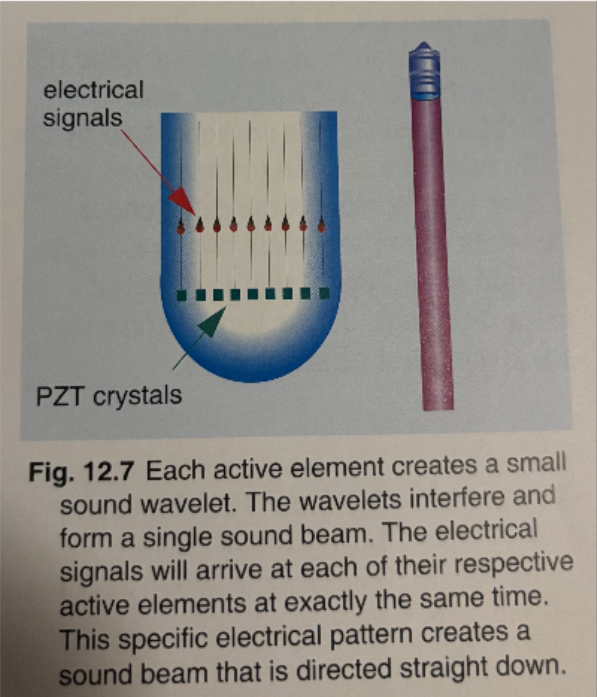
What do the green rectangles and red dots represent in the diagram?
Green rectangles: The PZT crystals (active elements).
Red dots: Electrical spikes created by the ultrasound system's transmit channels.
What happens to the electrical spikes after they are created?
They travel down the wires and excite the active elements. Then, each active element creates a small sound wavelet. The wavelets interfere, forming a single sound beam

Electrical spike pattern created by the US appears
This picture represents the slope going up toward the LEFT side with no curvature. We can say this beam is steered left with no transmit focusing.

How does a linear phased array steer its beam to the left?
This pattern of phasing starts with an electrical spike that excites the far right active element first, followed instantly by a second spike that strikes the next PZT crystal, and so on.
How far apart can the electrical signals be in the example from your notes?
10 nanoseconds (10 billionths of a second).
What are the two electronic controls used to shape a phased-array beam?
Electronic slope controls beam steering. (steers the beam in a particular direction)
Electronic curvature controls beam focusing.

A different electrical pattern
The teardrop shape structures are seen increasing (our slope going up) from left to right. We can say this beam is steered to the right.
Since there is no curvature within the slope, its just goes straight up from left to right there is no focusing.
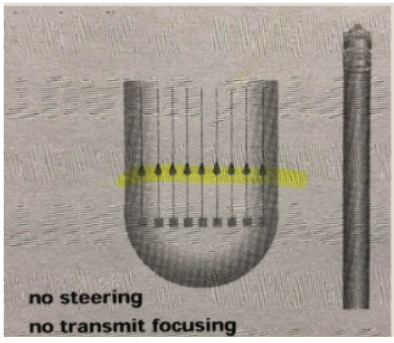
Another electrical spike pattern
We can see these tear drop structures going straight across the beam. There is no slope so we can say there is NO steering. The pulse is going DIRECTLY in the body. Since there is no curvature, there is also NO focusing.

Symmetrical teardrops
This picture demonstrates the tear drops are symmetrical. We can say that there is NO steering.
BUT since there is curvature, we can say this beam is focused! In this one, the outer crystals are excited earlier than the inner crystals. Since there is no predominant slope to this pattern, the beam will be directed straight down (as shown in the image).

More curvature
The curvature is more severe in this pattern. The sound beam created by this more curved electrical pattern will have a shallower focus. However, the sound beam will be directed straight down.
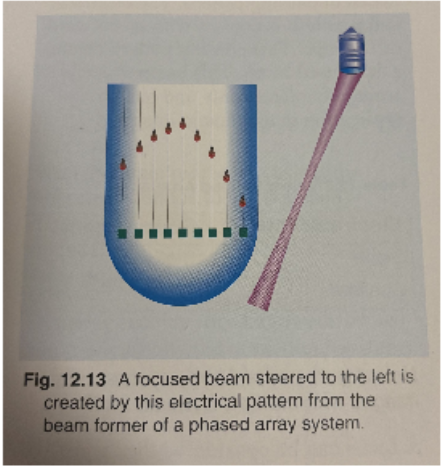
Describe this phasing pattern
phasing pattern steers the beam to the left and focuses it during transmission. The electrical spike pattern is curved creating a focusing sound beam. This pattern of phasing has an overall slope that steers the beam to the left.

Describe this phasing pattern
Demonstrates the tear drop structures closer together on the right side vs the left side after the curvature. Since we KNOW there is a curve we can say it is a focused beam.
Since the teardrop structures are seen closer together on the right side we say that the beam is steered right
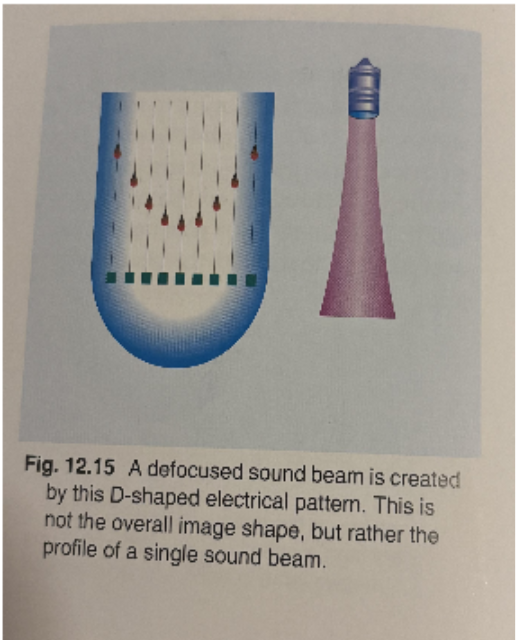
Describe this phasing pattern
The electrical spike pattern is convex with an outward or D-shape. This phasing pattern creates a defocused beam. This beam shape is of academic interest only and has no application in diagnostic imaging.
Why is each electrical pattern slightly different from the pattern before it?
To steer the sound beam in a slightly different direction each time. If the identical pattern was used, the ultrasound system would repeatedly transmit each sound pulse down the same line.
How does the ultrasound system create a sector-shaped image?
It slightly changes the slope of the electrical patterns, steering each sound beam in a different direction.
Beam steering
is achieved electronically without any moving parts in the transducer. These electronics within the ultrasound system that create these patterns are called the beam former.
What is the beam former?
the electronics responsible for controlling the timing of the individual crystals. (control the firing patterns and timing of crystals)
Can phase delays be used to focus a sound beam during reception?
Yes. This is called dynamic receive focusing, an automatic process where the ultrasound system adjusts the timing of returning electrical signals to focus echoes from different depths.
What is the difference between transmit focusing and receive focusing?
Transmit focusing: Focuses the outgoing sound beam.
Receive focusing: Focuses the returning echoes