Introduction to Marketing Midterm
 Call Kai
 Learn
Learn Practice Test
 Spaced Repetition
 Match
Match Flashcards
 Knowt Play
1/86

There's no tags or description
Looks like no tags are added yet.
Name | Mastery | Learn | Test | Matching | Spaced | Call with Kai | Chat |
|---|
No analytics yet
Send a link to your students to track their progress
87 Terms
Marketing
Activity, set of institutions, and processes for creating, communicating, distributing, delivering, and exchanging offerings that have value for customers, clients, partners, and society at large
For marketing to occur, at least four factors are required:
(1) two or more parties (individuals or organizations) with unsatisfied needs,
(2) a desire and ability on their part to have their needs satisfied,
(3) a way for the parties to communicate, and
(4) something to exchange
Exchange
The trade of things of value between a buyer and a seller so that each is better off after the trade
Marketing mix: 4 Ps
Product: A good, service, or idea to satisfy the consumer’s needs
Price: What is exchanged for the product
Promotion: A means of communication between the seller and buyer
Place: A means of getting the product to the consumer
Environmental forces
Social, economic, technological, competitive, and regulatory forces
These five forces may serve as accelerators or brakes on marketing, sometimes expanding an organization’s marketing opportunities and at other times restricting them
Customer value
Unique combination of benefits received by targeted buyers that includes quality, convenience, on-time delivery, and both before-sale and after-sale service at a specific price
Market segments
Relatively homogeneous groups of prospective buyers who
(1) have common needs and
(2) will respond similarly to a marketing action
Customer relationship management
The process of identifying prospective buyers, understanding them intimately, and developing favorable long-term perceptions of the organization and its offerings so that buyers will choose them in the marketplace and become advocates after their purchase
Strategy
An organization’s long-term course of action designed to deliver a unique customer experience while achieving its goals

Corporate level
Top management directs overall strategy for the entire organization. “Top management” usually means the board of directors and senior management officers with a variety of skills and experiences that are invaluable in establishing the organization’s overall strategy
Strategic business unit (SBU)
A subsidiary, division, or unit of an organization that markets a set of related offerings to a clearly defined target market
Strategic business unit level
Managers set a more specific strategic direction for their businesses to exploit value-creating opportunities
Functional level (Department)
Specialized functions such as marketing and finance
At the functional level, the organization’s strategic direction becomes its most specific and focused. Just as there is a hierarchy of levels within an organization
Organizational purpose
Describes why an organization exists, what problems it wishes to solve, and who it wants to be to every person it touches through its work. Consider the “top line” on organizational purpose expressed by the chief executive officers at Meta Platforms and Apple, two visionary organizations. According to Meta’s Mark Zuckerberg
Ex: The most important thing we at Facebook [Meta] can do is to develop the social infrastructure to give people the power to build a global community that works for all of us
Core values
Fundamental, passionate, and enduring principles that guide its conduct over time. A firm’s founders or senior management develop and nurture these core values, which are consistent with their essential beliefs and character
They capture the firm’s heart and soul and serve to inspire and motivate its stakeholders—employees, shareholders, board of directors, suppliers, distributors, creditors, unions, government, local communities, and customers
Mission
A statement of the organization’s function in society that often identifies its customers, markets, products, and technologies
Organizational culture
The values, ideas, attitudes, and norms of behavior that are learned and shared among the members of an organization. Southwest Airlines, for example, communicates the importance of a warm and friendly experience
Goals or objectives
Statements of an accomplishment of a task to be achieved, often by a specific time
Goals convert an organization’s mission and business into long- and short-term performance targets. Business firms can pursue several different types of goals
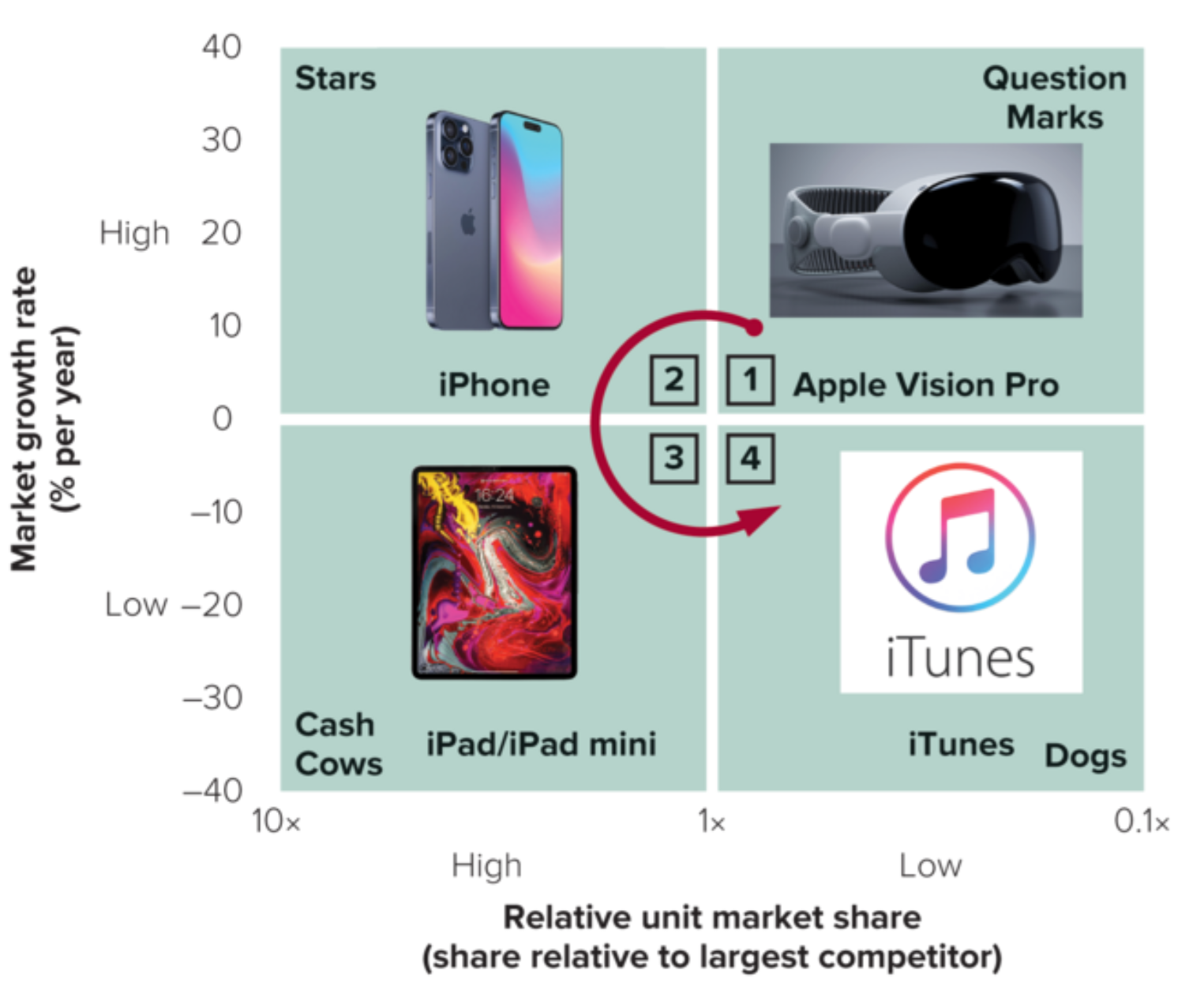
BCG
Question marks: are SBUs with a low share of high-growth markets. They require large injections of cash just to maintain their market share, much less increase it
Stars: are SBUs with a high share of high-growth markets that may need extra cash to finance their own rapid future growth. When their growth slows, they are likely to become cash cows
Cash cows: are SBUs that generate large amounts of cash, far more than they can use. They have dominant shares of slow-growth markets and provide cash to cover the organization’s overhead and to invest in other SBUs
Dogs: are SBUs with low shares of slow-growth markets. Although they may generate enough cash to sustain themselves, they may no longer be or may not become real winners for the organization

Four market-product strategies
Market penetration: a marketing strategy to increase sales of current products in current markets, such as selling more Ben & Jerry’s Chocolate Chip Cookie Dough ice cream to U.S. consumers
Market development: a marketing strategy to sell current products to new markets. For Ben & Jerry’s, Argentina is an attractive new market
Product development: a marketing strategy of selling new products to current markets. Ben & Jerry’s could leverage its brand by selling children’s clothing in the United States
Diversification: a marketing strategy of developing new products and selling them in new markets. This is a potentially high-risk strategy for Ben & Jerry’s if it decides to try to sell Ben & Jerry’s branded clothing in Argentina
SWOT Analysis
Acronym describing an organization’s appraisal of its internal Strengths and Weaknesses and its external Opportunities and Threats
The SWOT analysis is based on an exhaustive study of four areas that form the foundation upon which the firm builds its marketing program
Identify changes and trends in the organization’s industry
Analyze the organization’s current and potential competitors
Assess the organization itself, including available resources
Research the organization’s present and prospective customers
Marketing strategy
A marketing goal is to be achieved, usually characterized by a specified target market and a marketing program to reach it
Environmental scanning
The process of continually acquiring information on events occurring outside the organization to identify and interpret potential trends
Social forces: Environmental forces
Social forces: include the demographic characteristics of the population and its culture
Demographics: A type of social force, describing a population according to selected characteristics such as age, gender, ethnicity, income, and occupation
Silent Generation (1928–1945): Grew up during the Great Depression and World War II, valuing stability, hard work, and traditional social norms
Baby Boomers (1946–1964): Grew up during postwar economic growth and social change, often associated with ambition, career success, and traditional institutions
Generation X (1965–1980): Grew up during increasing divorce rates, economic shifts, and the rise of technology, often characterized by independence and adaptability
Millennials (1981–1996): Came of age with the internet and globalization, experiencing events like 9/11 and the Great Recession while embracing technology and new workplace norms
Generation Z (1997–2012): Grew up as digital natives with smartphones and social media, placing strong emphasis on technology, individuality, and social issues
Generation Alpha (2013–2024): Growing up surrounded by AI, smart devices, and highly digital environments, they are expected to have an even deeper integration of technology into everyday life
Culture: A type of social force, incorporates the set of values, ideas, and attitudes that are learned and shared among the members of a group
Economic forces: Environmental forces
Economy: pertains to the income, expenditures, and resources that affect the cost of running a business and household
Gross income: the total amount of money made in one year by a person, household, or family unit
Disposable income: the money a consumer has left after paying taxes to use for necessities such as food, housing, clothing, and transportation
Discretionary income: the money that remains after paying for taxes and necessities. Discretionary income is used for luxury items such as a Cunard cruise. An obvious problem in defining discretionary versus disposable income is determining what is a luxury and what is a necessity
Technological forces: Environmental forces
Technology: refers to methods, systems, and devices that are the result of scientific and engineering knowledge being used for practical purposes. Each new wave of technology can replace existing products, services, and companies, or create new ones.
Competition forces: Environmental forces
Competition: refers to the alternative firms that could provide a product to satisfy a specific market’s needs
Pure competition: there are many sellers and each has a similar product
Monopolistic competition: many sellers compete with substitutable products within a price range. For example, if the price of coffee rises too much, consumers may switch to tea. Coupons or sales are frequently used marketing tactics
Oligopoly: a common industry structure, occurs when a few companies control the majority of industry sales
Pure monopoly: occurs when only one firm sells the product
Barriers to entry: business practices or conditions that make it difficult for new firms to enter the market. Barriers to entry can be in the form of capital requirements, advertising expenditures, product identity, distribution access, or the cost to customers of switching suppliers
Regulatory forces: Environmental forces
Regulation: consists of restrictions state and federal laws place on business with regard to the conduct of its activities. Regulation exists to protect companies as well as consumers. Much of the regulation from the federal and state levels is the result of an active political process and has been passed to ensure competition and fair business practices
Sherman Antitrust Act (1890): (1) contracts, combinations, or conspiracies in restraint of trade and (2) actual monopolies or attempts to monopolize any part of trade or commerce
Clayton Act (1914): forbids certain actions that are likely to lessen competition, although no actual harm has yet occurred
Robinson-Patman Act (1936): makes it unlawful to discriminate in prices charged to different purchasers of the same product, where the effect may substantially lessen competition or help create a monopoly
Digital Millennium Copyright Act (1998): to improve protection of copyrighted digital products
The copyright law gives the author of a literary, dramatic, musical, or artistic work the exclusive right to print, perform, or otherwise copy that work. Copyright is secured automatically when the work is created
Trademark Law Revision Act: resulted in a major change to the Lanham Act, allowing a company to secure rights to a name before actual use by declaring an intent to use the name
Madrid Protocol: a treaty that facilitates the protection of U.S. trademark rights throughout the world
Ethics
Moral principles and values that govern the actions and decisions of an individual or group.2 They serve as guidelines on how to act rightly and justly when faced with moral dilemmas
Laws
Society’s values and standards that are enforceable in the courts

Four ways to classify marketing decisions according to ethical and legal relationships
Ethical but illegal:
Society used to see as acceptable or normal can become viewed as unethical or illegal over time
Ex: Drunk driving, smoking, LGBTQ+ rights

Consumer Bill of Rights
Codified the ethics of exchange between buyers and sellers. These were the right
Right to Safety: Consumers should be protected from dangerous or defective products
Right to Be Informed: Consumers should receive complete and accurate information about products and how their personal data is used
Right to Choose: Consumers should have access to a variety of products and services
Right to Be Heard: Consumers should be able to voice complaints and have their concerns addressed
Economic espionage
Clandestine collection of trade secrets or proprietary information about a company’s competitors
This practice is illegal and unethical and carries serious criminal penalties for the offending individual or business
Ex: illegal trespassing, theft, fraud, misrepresentation, electronic hacking, the search of a competitor’s trash, and violations of written and implicit employment agreements with noncompete clauses

Social responsibility, stakeholder responsibility, and profit responsibility
Social responsibility: organizations are part of a larger society and are accountable to that society for their actions. Like ethics, agreement on the nature and scope of social responsibility is often difficult to come by, given the diversity of values present in different societal, business, and corporate cultures
Stakeholder responsibility: focuses on the obligations an organization has to those who can affect achievement of its objectives. These constituencies include consumers, employees, suppliers, and distributors. Failure to consider a company’s broader constituencies when making decisions can have dire consequences
Profit responsibility: holds that companies have a simple duty: to maximize profits for their owners or stockholders.
Consumer behavior
The actions a person takes in purchasing and using products and services, including the mental and social processes that come before and after these actions

Purchase decision process
1) Problem recognition: initial step in the purchase decision process, is perceiving a difference between a person’s ideal and actual situations big enough to trigger a decision
Finding an empty milk carton in the refrigerator; noting, as a first-year college student, that your high school clothes are not in the style that other students are wearing; or realizing that your notebook computer may not be working properly
2) Information search: After recognizing a problem, a consumer begins to search for information, the next stage in the purchase decision process
Internal search: first, you may scan your memory for previous experiences with products or brands
External search: this is needed when past experience or knowledge are insufficient, the perceived risk of making a wrong purchase decision is high, and the cost of gathering information is low
Personal sources: such as relatives and friends, as well as social networking platforms that the consumer trusts
Public sources: including various product-rating organizations such as Consumer Reports, government agencies, and TV “consumer programs”
Marketer-dominated sources: such as information from sellers including digital and print advertising, company websites, salespeople, and point-of-purchase displays in stores
3) Alternative evaluation: clarifies the information gathered by
suggesting criteria to use for the purchase
yielding brand names that might meet the criteria
developing consumer value perceptions
4) Purchase decision: you are almost ready to make a purchase decision. Two choices remain: (1) from whom to buy and (2) when to buy
5) Post-purchase behavior: after buying a product, the consumer compares it with personal expectations and is either satisfied or dissatisfied
If the consumer is dissatisfied, marketers must determine whether the product was deficient or consumer expectations were too high. Product deficiency may require a design change
If expectations are too high, a company’s advertising or the salesperson may have oversold the product’s features and benefits

Involvement
The personal, social, and economic significance of the purchase to the consumer
High-involvement purchase occasions: typically have at least one of three characteristics: The item to be purchased
(1) is expensive, (2) can have serious personal consequences, or (3) could reflect on one’s social image
Ex: college, car
Low-involvement purchases: such as toothpaste and soap, barely involve most of us, but audio and video systems and automobiles are very involving
Cognitive dissonance
Feeling of post-purchase psychological tension or anxiety
Often a consumer is faced with two or more highly attractive alternatives, such as the choice between the Apple Watch Series 9 and the Samsung Galaxy Watch 6. If you choose the Samsung Galaxy 6, you might think, “Should I have purchased the Apple Watch Series 9?”
Situational influences
An impact on the purchase decision process:
(1) the nature of the purchase task
(2) social surroundings
(3) physical surroundings
(4) temporal effects
(5) antecedent states
Social surroundings, including the other people present when a purchase decision is made, may also affect what is purchased. Consumers accompanied by children buy about 40 percent more items than consumers shopping by themselves. Physical surroundings such as décor, music, and crowding in retail stores may alter how purchase decisions are made
Consumers with credit cards purchase more than those with cash or debit cards
Psychological influence
Motivation: energizing force that stimulates behavior to satisfy a need. Because consumer needs are the focus of the marketing concept, marketers try to arouse these needs
Personality
person’s consistent behaviors or responses to recurring situations
Research suggests that people who are generally compliant prefer known brand names and use more mouthwash and toilet soaps. People who tend toward more assertive behaviors use razors, not electric shavers, apply more cologne and aftershave lotions, and purchase signature goods such as Gucci and Yves St. Laurent as an indicator of status
Personality characteristics often reveal a person’s self-concept, which is the way people see themselves and the way they believe others see them
Perception
The process by which an individual selects, organizes, and interprets information to create a meaningful picture of the world
Selective perception: the human brain attempts to organize and interpret information, a filtering of exposure, comprehension, and retention
Your mind subconsciously chooses what you want to see
Selective exposure: occurs when people pay attention to messages that are consistent with their attitudes and beliefs and ignore messages that are inconsistent with them
Selective comprehension: involves interpreting information so that it is consistent with your attitudes and beliefs
Selective retention: means that consumers do not remember all the information they see, read, or hear, even minutes after exposure to it
Subliminal perception: means that you see or hear messages without being aware of them
Perceived risk
Represents the anxiety felt because the consumer cannot anticipate the outcomes of a purchase but believes there may be negative consequences
Ex: eliminate the risk by offering money-back guarantee, free-trial, Costco free samples
Learning
refers to those behaviors that result from (1) repeated experience and (2) reasoning
Values, Beliefs, and Attitudes
Attitude: a “learned predisposition to respond to an object or class of objects in a consistently favorable or unfavorable way”
Beliefs: a consumer’s subjective perception of how a product or brand performs on different attributes. Beliefs are based on personal experience, advertising, and discussions with other people
Associative group
One to which a person actually belongs, including fraternities and sororities and alumni associations. Such groups are easily identifiable and are targeted by firms selling insurance, insignia products (including tattoos), and charter vacations
Aspiration group
One that a person wishes to be a member of or wishes to be identified with, such as a professional society or sports team. Firms frequently rely on spokespeople or settings associated with their target market’s aspiration group in their advertising
Dissociative group
One that a person wishes to maintain a distance from because of differences in values or behaviors. Firms often avoid dissociative reference groups in their marketing
Ex: Apple does not permit villainous characters to use its products in movies
Social class
The relatively permanent, homogeneous divisions in a society into which people sharing similar values, interests, and behavior can be grouped. A person’s occupation, source of income (not level of income), and education determine social class
Business-to-business marketing
The relatively permanent, homogeneous divisions in a society into which people sharing similar values, interests, and behavior can be grouped. A person’s occupation, source of income (not level of income), and education determine social class
Organizational buyers
Manufacturers, wholesalers, retailers, service companies, nonprofit organizations, and government agencies that buy products and services for their own use or for resale
(1) industrial: Businesses that buy products/services and use or reprocess them to create something else
Ex: A construction company buying steel to build buildings.
(2) reseller: Businesses that buy products and resell them to customers without significantly changing them
Ex: Walmart buying products from manufacturers and selling them in stores
(3) government: federal, state, and local agencies that buy goods and services for the constituents they serve
North American Industry Classification System (NAICS)
A six-digit system used to classify businesses by industry in the U.S., Canada, and Mexico
Ex: A restaurant has a specific NAICS code that identifies it as part of the food-service industry
Derived demand
Demand for business products is based on the demand for the final consumer products they help produce
Ex: More people buying cars creates more demand for car parts
International standard organization ISO 9000
A set of international standards that help companies maintain consistent quality in their products and services
ISO 9000 certificate: Proof that a company’s quality management system meets international standards for consistently producing quality products or services
Buying center
The individuals in this group share common goals, risks, and knowledge important to a purchase decision
Users: The people who actually use the product
Ex: Employees using the new laptops
Influencers: People who help decide what the company needs and what features it should have
Ex: IT recommends laptops with certain storage and security features
Buyers: People who handle the actual purchase and negotiate with the seller
Ex: A purchasing manager gets quotes and places the order
Deciders: People who give the final approval or choose the supplier
Ex: An IT director approves which laptop company to buy from
Gatekeepers: People who control who gets information or access to the decision-makers
Ex: An assistant decides which salesperson's emails reach the purchasing manager
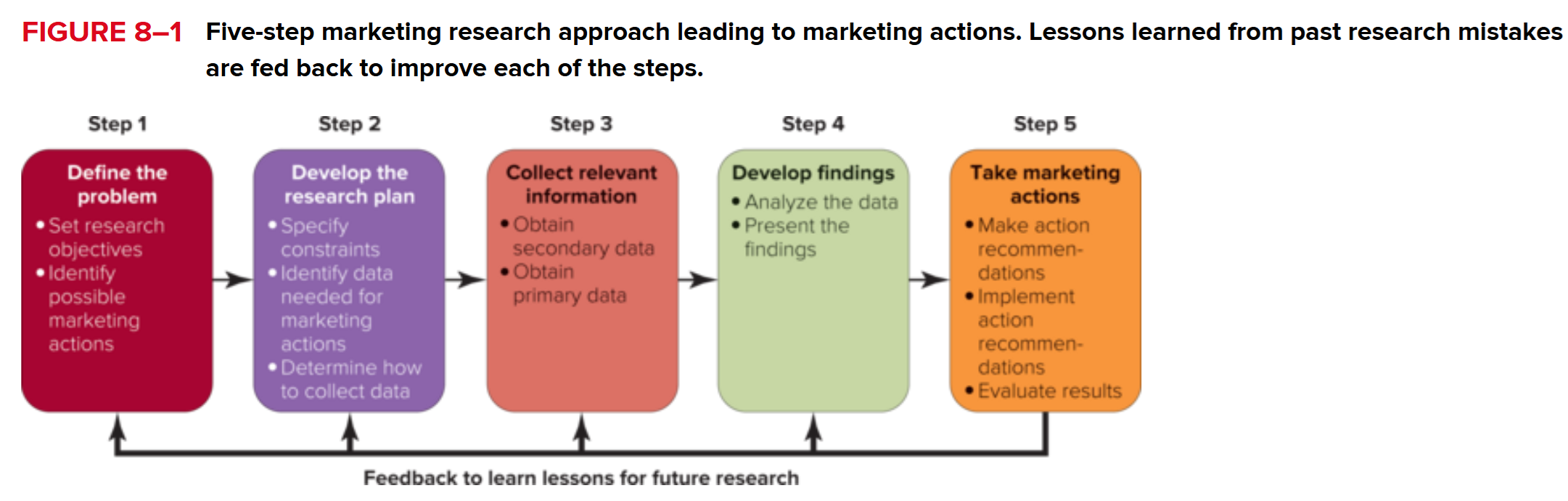
Marketing research
The process of defining a marketing problem and opportunity, systematically collecting and analyzing information, and recommending actions
1) Define problem
Define the problem: means clearly figuring out what the company needs to know or solve before doing research. The problem should be specific enough to research but not so narrow that the results aren't useful
Ex: LEGO is deciding between two new SPIKE® Prime designs, so the problem could be: Which design will middle and high school students prefer and use more?
Exploratory research: used when a company doesn't fully understand a problem yet and wants to get ideas or learn more about it. It usually involves things like interviews, focus groups, or open-ended questions
Ex: LEGO is worried that students might get bored because SPIKE® Prime has 500+ pieces. LEGO talks to students in focus groups and discovers that students want to be able to build and test something within about 20 minutes
Descriptive research: used to find out what is happening, how often something happens, or whether two things are related. It usually involves collecting more specific information through surveys or other data
Ex: LEGO surveys students to find out which SPIKE® Prime design middle school students prefer versus high school students. It can then compare school level with kit preference
Causal research: looks at whether changing one thing causes another thing to change. Researchers change one factor and see what effect it has
Ex: LEGO changes the number or type of pieces in a SPIKE® Prime kit and measures whether students can build the robot faster or are more likely to finish it
2) Developing plan
Developing the research plan means deciding exactly how the research will be done, including the limits of the study, what information is needed, and how that information will be collected
Sample: choosing a smaller group of people from the larger group you want to study and using their answers to learn about that larger group
Ex: LEGO surveys 100 students instead of every middle school student who might buy the product
Statistical inference: means using the results from a sample to make conclusions about the larger population
Ex: If most of the 100 students surveyed prefer Design A, LEGO may use that information to estimate that students overall would also prefer Design A
3) Collect Relevant Information
Primary data: new information collected specifically for the current research project
Watching / Observing: researchers watch how consumers actually behave
Mechanical observation: technology records behavior automatically
Example: Nielsen uses devices to track what people watch on TV and other devicesMystery shopping: researchers act like normal customers to evaluate things like customer service, prices, product availability, and store cleanliness
Neuromarketing: uses brain and body responses to understand how consumers react to things like ads, packaging, and products
Example: eye tracking or EEG measuring how someone reacts to an advertisements
Focus Groups: a small group of about 6–10 consumers who discuss a product or idea with a moderator
Example: A company asks 8 customers what they think about a new product and what they would change
Used mainly to generate ideas and understand consumer opinions
Surveys / Questionnaires
Survey: asking people questions to collect information about their opinions, behaviors, awareness, or intentions
Common types of questions:
Open-ended: people answer in their own words
Example: “What do you like most about this product?”Close-ended: people choose from given answers
Dichotomous: only two choices, usually yes/no
Example: “Would you buy this product? Yes / No”Likert scale: measures how strongly someone agrees or disagrees with a statement
Example: “I would recommend this product” → Strongly disagree → Strongly agreeDemographic questions: ask about characteristics such as age, income, gender, education, etc
In-depth interview: long, detailed interview where the researcher asks follow-up questions to understand deeper opinions and feelings
Email/online survey: survey sent through email or completed online; usually cheaper and faster than traditional interviews
Primary Data: Other Sources
Social media: companies collect consumer opinions and behavior from platforms like Instagram, Facebook, and X
Important social media metrics:
Conversation velocity: how quickly people are talking about a brand/topic
Share of voice: how much of the overall conversation is about one brand compared with competitors
Brand sentiment: whether comments about a brand are positive, negative, or neutral
Intelligent Enterprise / Internet
Intelligent enterprise: using large amounts of data, technology, and analytics to turn information into useful marketing decisions
The Internet and devices collect data from things like websites, phones, apps, and connected devices
Secondary data: information that was already collected before the current research project
Ex: A company uses a McKinsey report that already contains research instead of collecting the information itself
Internal Secondary Data: information that comes from inside the company
Examples:
Sales records
Customer emails
Social media comments
Marketing budgets
Customer purchases
External Secondary Data: information collected by organizations outside the company
Examples
U.S. Census Bureau
Nielsen
McKinsey reports
Trade associations
Universities
Business publications
Syndicated Panels
Syndicated panel: a sample of households, consumers, or businesses that provides information repeatedly over time
Ex: Nielsen tracks the TV viewing behavior of a panel of households and sells that information to many companies
Primary Data
Advantages:
More specific to the research problem
More flexible
Can collect exactly the information the company needs
Disadvantages:
More expensive
More time-consuming
Secondary Data
Advantages:
Quick and easy to access
Usually cheaper or free
A lot of information may already be available
Disadvantages:
May be outdated
May not perfectly match the researcher's needs
May not have enough detail or use the right categories
4) Develop findings
Develop findings: analyze the data and turn it into useful information that helps managers make marketing decisions
Analyze the Data: researchers look at the data to find patterns, problems, and opportunities
Ex: Tony’s Pizza had flat sales from 2021–2024. The research showed that each household was buying fewer Tony’s pizzas, but more households were buying pizza overall
Present findings: show the results clearly so managers can easily understand them and decide what to do
Marketing dashboards = visual displays of data using charts, graphs, and other information
Findings should be clear, easy to understand, and focused on information managers can actually use
Ex: Tony’s dashboard showed that sales were flat overall, but purchases were declining among households with children ages 6–12 → Tony’s could focus its marketing on this group
5) Take action
Take marketing actions: use the research findings to make a decision, put the decision into action, and check whether it worked
Make Action Recommendations: Turn the research findings into specific marketing actions
Ex: Tony’s found that sales were declining among households with children ages 6–12, so they recommend:
Advertising aimed at children 6–12 and their families
Monthly promotions targeting this group
Special events for this age group
Implement the Action Recommendations: Actually put the marketing recommendations into practice
Ex: Tony’s creates several ads, tests them with children, chooses the most appealing one, and uses it in its advertising campaign
Evaluate the Results: Check whether the marketing action worked and whether the research process itself could be improved
Ex: Tony’s checks whether sales increased among households with children ages 6–12 and whether the new ads were successful
Step 1 = Define the Problem → What problem are we trying to solve?
Step 5 = Take Marketing Actions → Did our actions solve the problem?
Sale forecasting
Refers to the total sales of a product that a firm expects to sell during a specified time period under specified environmental conditions and its own marketing efforts
Three main sales forecasting techniques are often used: (1) judgments of the decision maker (2) surveys of knowledgeable groups, and (3) statistical methods
Market segmentation
involves aggregating prospective buyers into groups, or segments, that
(1) have common needs and (2) will respond similarly to a marketing action
Product differentiation
The existence of different market segments has caused firms to use a marketing strategy
This strategy involves a firm using different marketing mix actions, such as product features and advertising, to help consumers perceive the product as being different and better than competing products. The perceived differences may involve physical features, such as size or color, or nonphysical ones, such as image or price
Cannibalization
When a company introduces a new product or service and it causes sales of its existing product/service to decrease because customers switch to the new one
Ex:
McDonald’s introduces a new burger
Customers who used to buy the Big Mac start buying the new burger instead
Big Mac sales decrease → that is cannibalization
Mass customization
Tailoring products or services to the tastes of individual customers on a high-volume scale
Is the next step beyond build-to-order (BTO), which involves manufacturing a product only when there is an order from a customer
A segment of one: tailoring a product or service to the specific preferences of each individual customer, instead of treating customers as part of a larger group
Four general bases of segmentation
Geographical Segmentation: Dividing a market based on where customers live or are located
Examples: region, state, city, climate
Scenario: Campbell Soup Company found that its canned nacho cheese sauce was too spicy for customers in the East but not spicy enough for customers in the West and Southwest
Campbell’s plants in Texas and California began producing a hotter version to better serve those regions
Easy way: Geographical = Where do they live?
Demographic Segmentation: Dividing a market based on measurable characteristics of customers or households
Examples: age, gender, income, household size, education
Scenario: More than half of U.S. households have only one or two people, so Campbell Soup Company packages some meals with only one or two servings
Easy way: Demographic = Who are they?
Psychographic Segmentation: Dividing a market based on lifestyles, interests, values, or personalities
Based on the idea that people with similar lifestyles tend to live near one another, have similar interests, and buy similar products
This is useful because marketers can target people with similar lifestyles and buying habits
Scenario: A company targets active, health-conscious people with fitness clothing, running shoes, and healthy food products
Claritas PRIZM classifies U.S. households into 68 different market segments based on characteristics and lifestyles
Easy way: Psychographic = How do they live?
Behavioral Segmentation, Product Features: Dividing customers based on which product features are important to them
Different customers may value different features in the same product
Understanding these differences can lead directly to marketing actions, such as creating a new product, advertising campaign, or distribution channel
Scenario: College dorm students often want to prepare and store their own food, but dorm rooms have very little space
MicroFridge targets these students with an appliance that combines a microwave, refrigerator, freezer, smoke sensor, and charging station
Important feature = saving space and combining multiple functions
Easy way: Product features = What features do they want?
Behavioral Segmentation, Usage Rate: Dividing customers based on how much they use a product/service or how often they visit a store during a specific period
Usage rate = the quantity consumed or number of visits/purchases during a specific period
Usage rate can vary significantly between different customer groups
Customers can be light, medium, or heavy users
Scenario: Airlines use frequent-flyer programs to encourage passengers who fly often to continue using the same airline
This is called frequency marketing
Goal = increase usage and create loyal customers
Easy way: Usage rate = How much/how often do they use it?
Criteria to Use in Selecting the Target Segments
1. Market Size
The estimated number of customers in a market segment helps determine whether the segment is worth targeting
Large market → more potential sales
Tiny/no market → not worth spending marketing effort on
Example: Dorm students with meal plans already have breakfast included, so there is basically no market for breakfast among them
In the market-product grid, this segment gets a “0” to show there is no market
2. Expected Growth
A segment may be small now but could grow significantly in the future
Small market today → could still be attractive if it is expected to grow
Example: Sales of fast-food meals eaten outside restaurants are expected to become greater than meals eaten inside restaurants
Wendy’s has been shown to have the fastest average drive-thru service time, faster than McDonald’s
This speed and convenience could be especially important to night commuters in adult education programs
3. Competitive Position
Look at how much competition exists in the segment now and how much is expected in the future
Less competition → more attractive segment
More competition → less attractive segment
Example: If college dorms announce “no meals on weekends,” students would need somewhere else to eat, making the restaurant market more promising
Companies may also add features to keep up with competitors
Example: Wendy’s introduced a mobile app for ordering and payment to compete with Burger King’s similar service
4. Cost of Reaching the Segment
A company should consider whether it can easily and affordably reach the customers in the segment through its marketing
Easy/cheap to reach → more attractive
Difficult/expensive to reach → less attractive
If a segment is basically inaccessible through the company's marketing methods, it should not be targeted
Example: If only a few nonstudents live in the area and they cannot be effectively reached through newspapers or other advertising, the restaurant shouldn't waste money advertising to them
5. Compatibility with Organization’s Objectives and Resources
The segment needs to fit the company's goals and available resources
The company needs to have the money, equipment, employees, and capabilities to serve the segment
Example: If Wendy’s doesn't have the cooking equipment needed to make breakfast and has a policy against spending more money on restaurant equipment, it should not target the breakfast segment
6. Capability
Does the company have the ability to successfully serve the segment?
Does the company have the right skills, technology, employees, equipment, and knowledge?
If the company doesn't have the capability to serve the segment well → don't target it
Example: A restaurant wants to target customers who want healthy meals, but it doesn't have the equipment, ingredients, or employees needed to prepare healthy meals → it may not have the capability
7. Complications
Are there any problems or difficulties that could make targeting the segment difficult?
A segment may look attractive but have complications that make it harder or riskier to target
Example: A restaurant targets college students, but students leave during summer and holidays → inconsistent demand could be a complication
Another example: A market may have complicated regulations or difficult distribution requirements
Product positioning
Refers to the place a product occupies in consumers’ minds based on important attributes relative to competitive products
Product repositioning
Changing the place a product occupies in a consumer’s mind relative to competitive products
Head-to-head positioning: involves competing directly with competitors on similar product attributes in the same target market. Using this strategy, Dollar Car Rental competes directly with Avis and Hertz
Differentiation positioning: involves seeking a less-competitive, smaller market niche in which to locate a brand. Whole Foods, for example, differentiates itself from large supermarket chains with its “wholesome” and organic selection of products, unique store design, local ambience, and promotion of a “greener” lifestyle
Perceptual map
A means of displaying in two dimensions the location of products or brands in the minds of consumers. This enables a manager to “see” how consumers perceive competing products or brands, as well as the firm’s own product or brand
Identify the important attributes (or scales) for adult drinks. Research reveals the key attributes adults use to judge various drinks are (a) low versus high nutrition and (b) children’s drinks versus adult drinks, as shown by the two axes
Discover how adults see various competing drinks. Locate various adult drinks on these axes
Discover how adults see chocolate milk. Figure 9–9 shows adults see chocolate milk as moderately nutritious (on the vertical axis) but as mainly a child’s drink (on the horizontal axis)
Reposition chocolate milk to make it more appealing to adults. What actions did U.S. dairies take to increase sales? They repositioned chocolate milk to the location of the red star shown in the perceptual map
Product
Good, service, or idea consisting of a bundle of tangible and intangible attributes that satisfies consumers’ needs and is received in exchange for money or something else of value
Good: has tangible attributes that a consumer’s five senses can perceive. For example, the Apple Watch can be touched and its features can be seen and heard. A good also may have intangible attributes consisting of its delivery or warranties and embody more abstract concepts, such as becoming healthier or wealthier
Nondurable good: an item consumed in one or a few uses, such as food products and fuel
Durable good: one that usually lasts over many uses, such as appliances, cars, and smartphones
Services: are intangible activities or benefits that an organization provides to satisfy consumers’ needs in exchange for money or something else of value. Services have become a significant part of the U.S. economy and often augment products
Ex: Apple’s iPhone is a product and Verizon is a wireless network service provider
Consumer products
Products purchased by the ultimate consumer
Business products
Also called B2B products or industrial products) are products organizations buy that assist in providing other products for resale
Some products can be considered both consumer and business items. For example, an Apple iMac computer can be sold to consumers for personal use or to business firms for office use
Convenience products
Items that the consumer purchases frequently, conveniently, and with a minimum of shopping effort
Shopping products
Items for which the consumer compares several alternatives on criteria such as price, quality, or style
Specialty products
Items that the consumer makes a special effort to search out and buy
Unsought products
Items that the consumer does not know about or knows about but does not initially want
Product item
A specific product that has a unique brand, size, or price
Ex: Ultra Downy softener for clothes comes in different forms (liquid for the washer and sheets for the dryer) and load sizes (40, 60, etc.)
Each of the different product items represents a separate stock keeping unit (SKU), which is a unique identification number that defines an item for ordering or inventory purposes
Ex: a pack of three has a different SKU and barcode than one pack
Product line
Group of product or service items that are closely related because they satisfy a class of needs, are used together, are sold to the same customer group, are distributed through the same outlets, or fall within a given price range
Nike’s product lines include shoes and clothing, whereas the Mayo Clinic’s service lines consist of inpatient hospital care and outpatient physician services. Each product line has its own marketing strategy
Product mix
Consists of all the product lines offered by an organization
Ex: Cray Inc. has a small product mix of three lines (supercomputers, storage systems, and a “data appliance”) that are mostly sold to governments and large businesses
Protocol
A statement that, before product development begins, identifies
(1) a well-defined target market
(2) specific customers’ needs, wants, and preferences; and
(3) what the product will be and do to satisfy consumers
CPG (Consumer Packaged Goods): Products that consumers buy frequently and use regularly, usually packaged and sold in stores
Ex:
Snacks
Cereal
Shampoo
FMCG (Fast-Moving Consumer Goods): Basically, very similar to CPG, but the emphasis is on products that sell quickly and are replaced frequently
Ex:
Chips
Soda
Milk
Marketing Reasons for New-Product Failures
1. Insignificant Point of Difference: The product does not offer a unique or important enough benefit compared with competing products
A successful new product needs a clear reason for customers to choose it over existing products
Example: General Mills launched Fingos, a sweetened cereal flake meant to be eaten like a snack
Consumers continued choosing snacks like popcorn and potato chips because Fingos did not offer a strong enough reason to switch
Easy way: No strong difference = no reason to buy
2. Incomplete Market and Product Protocol: The company does not clearly define who the product is for, what customers need, and how the product will satisfy those needs before developing it
Without a clear product protocol, companies may create a product for a vague market that doesn't really exist
Example: Kimberly-Clark created Avert Virucidal tissues, which were designed to kill cold and flu germs
Consumers did not believe the product's claims and disliked the word "cidal" because it sounded like "suicidal"
The company had not clearly determined what consumers wanted or how the product would satisfy them
Easy way: Don't build the product before knowing the customer and their needs
3. Failure to Satisfy Customer Needs on Critical Factors: The product may be good overall but fails on one or two things that customers consider extremely important
A product can have high quality but still fail if it gets critical factors wrong
Example: Keurig's Kold machine made good-tasting cold soda at home, but:
It was too large
It took too long to make a drink
It was too expensive ($370 for the machine and $1.25 per 8-ounce drink)
Easy way: Getting the important things wrong can kill an otherwise good product
4. Bad Timing: The product is introduced too early, too late, or when consumer preferences are changing
Timing can determine whether customers are ready for a product
Example: HP launched the TouchPad tablet after Apple's iPad was already successful
The TouchPad was also behind the iPad 2 in available apps
HP abandoned the product only two months after launch
Easy way: Right product + wrong time = failure
5. No Economical Access to Buyers: The company cannot reach enough customers at a reasonable cost, often because it cannot get access to important distribution channels
This is especially difficult for CPG products that need supermarket shelf space
Supermarkets may carry 60,000+ SKUs, so new products have to compete for limited shelf space
Example: Thirsty Dog! was bottled water for dogs, but it failed to generate enough sales to justify the shelf space it occupied
Easy way: If you can't affordably reach customers, the product can't sell
6. Poor Execution of the Marketing Mix: The company makes a mistake with one or more parts of the marketing mix: brand name, package, price, promotion, or distribution
Even a good product can fail because of poor marketing execution
Example: Garlic Cake was intended to be an hors d'oeuvre eaten with sweet breads, spreads, and meats
The company failed to explain what Garlic Cake was, when to eat it, and why customers would want it
Consumers were confused, so the product failed
Easy way: Good product + bad marketing = failure
7. Too Little Market Attractiveness: The target market is too small, too competitive, or doesn't have enough demand to justify the cost of entering it.
The ideal market is large, growing, and has a real customer need
Example: Artifact was an AI-powered news app created by the co-founders of Instagram
It offered personalized news recommendations and later added social-media features
However, it faced competition from apps like Flipboard, NewsBreak, and SmartNews
The market wasn't large enough to justify continued investment, so Artifact shut down about one year after launch
Easy way: If the market isn't attractive enough, don't invest heavily in it
Poor Product Quality: The product fails because its quality is poor or it was not tested thoroughly enough before being launched. Poor quality can cause major costs for the company, including:
Labor and materials needed to fix the problem
Lost sales and profits
Lost market share
Example: Hoverboards became popular with teens, but many models were later found to catch fire or explode
Because of these safety and quality problems, hoverboard sales suffered greatly
Easy way: Poor quality = product doesn't work safely or reliably
New-product development process
The seven stages an organization goes through to identify opportunities and convert them into salable products or services
1. New-Product Strategy Development: Defines the role of a new product in the company’s overall objectives and product portfolio
Uses SWOT analysis and environmental scanning to identify strengths, weaknesses, opportunities, and threats
Creates a “protocol” that guides what the new product should accomplish
Based on the company’s business model
Closed innovation → ideas come mainly from inside the company
Example: Apple
Open innovation → ideas/solutions also come from outside the company
Example: PepsiCo’s “The Hive”
Idea Generation: Creates a pool of possible new-product ideas
Goal is to move from “what is?” → “what if?”
Ideas can come from:
Employees → Flamin’ Hot Cheetos came from an employee’s idea
Customers and suppliers → companies ask them for ideas and problems that need solving
Crowdsourcing → getting ideas from large numbers of people
R&D → company laboratories
Competitors → studying competitors can inspire new products
Smaller firms, universities, and inventors → outside innovation
GenAI → generating new ideas with AI
Example: Dell received 13,464 ideas through crowdsourcing and implemented 402
Screening and Evaluation: Evaluates new-product ideas and eliminates ideas that aren't worth pursuing.
Internal approach → employees check whether the idea is technically feasible and fits the company's strategy
External approach → consumers evaluate the idea through a concept test
Concept test = consumers evaluate a product idea before the finished product is created
Companies may show consumers descriptions, sketches, or mockups
Important questions:
How do customers perceive it?
Who would use it?
How would they use it?
4. Business Analysis: Determines whether the product makes business and financial sense before major resources are invested
Sales and profit projections
Production costs
Marketing strategy
Equipment and technology needed
Fit with company objectives
Whether existing resources can be used
Whether the product will cannibalize existing products
Also considers:
MVP (Minimum Viable Product): the simplest version of a product that can be created and tested with customers
MVO (Minimum Viable Offering): the simplest version of the product/service that can actually be offered to customers and provide value
5. Development: Turns the idea into an actual prototype
Prototype = full-scale working model of the product
Product is tested to make sure it meets the standards in the product protocol
Can involve many prototypes and changes
Example: Apple tested and rejected more than 25 computer mouse prototypes before choosing one
6. Market Testing: Tests the actual product with potential customers under realistic buying conditions to see if they will buy it.
3 types:
Standard test market: product is sold through normal retailers in selected test cities
Controlled test market: outside company manages the test and tracks sales
Simulated test market: consumers see the product and ads, then choose whether to buy it in a simulated store
Why companies may avoid standard test markets:
Expensive
Time-consuming
Can reveal the company's plans to competitors
7. Commercialization: The product is launched into full-scale production and sales
Usually the most expensive stage
Company fully positions and launches the product
Company may still stop the launch if:
A competitor introduces a better product
The new product causes too much cannibalization of existing products
Newness Compared with Existing Products
A product is considered new if it is functionally different from products that already exist.
Newness can range from adding a few new features to creating a completely new industry
Ex: Apple’s smartphone was a major innovation that created a new industry
Feature bloat: Adding too many features to a product
Feature fatigue: Consumers become overwhelmed by too many features
Newness in Legal Terms
Looks at how long a product can legally be called “new.”
The FTC says “new” should generally be used for a product for up to 6 months after it enters regular distribution
The problem is that “regular distribution” can be difficult to define
Newness from the Consumer’s Perspective
Looks at how much the consumer has to change their behavior to use the product.
Continuous innovation: Consumers do not need to change their behavior
Ex: Colgate adds whitening or plaque-removing benefits, but people still brush their teeth the same way
Marketing mainly focuses on creating awareness
Dynamically continuous innovation: Consumers only need to make minor behavior changes
Ex: Swiffer WetJet changes how people mop but does not require a completely new behavior
Marketing focuses on explaining the benefits and proper use
Discontinuous innovation: Consumers must learn entirely new consumption behaviors
Ex: Smart-home technology requires consumers to learn how to install and operate new systems
Marketing must educate consumers about both the benefits and proper use
Newness from the Organization’s Perspective
Looks at the amount of innovation and risk for the company
Product line extension: Small improvement or addition to an existing product line
Lowest risk
Ex: Purina added Elegant Medleys to its Fancy Feast line
Can attract new customers but may increase costs or cause cannibalization
Significant innovation/technology or brand extension: A bigger change
Significant technology jump: Major technological improvement, such as new smartphones or digital cameras
Brand extension: Using an existing brand name for a product in an unfamiliar market
Ex: Colgate frozen dinners failed because consumers strongly associate Colgate with toothpaste
Radical invention: A truly revolutionary product that creates new value
Highest level of innovation and risk
Ex: 3D printer