Unit 2 4801 Exam
 Call Kai
 Learn
 Practice Test
 Spaced Repetition
 Match
 Flashcards
 Knowt Play
1/77

There's no tags or description
Looks like no tags are added yet.
78 Terms
where do you put the bone oscillator?
mastoid (most common)
Forehead is permissible (highlights that stimulating both cochleas)
Which cochlea responds during unmasked bone conduction
the better cochlea regardless were the bone oscillator is placed
Bilateral/identical hearing impairment
UM BC could represent both ears when…
AC thresholds are equal bilaterally
Both cochlea are impaired equally
If 2 cochlea are different
process more challenging because without doing anything the better cochlea will pick up sound
How to determine if you are testing the test cochlea?
determine if there could be cross hearing
if so, use a masker to isolate the test ear
Crossover of sound- Physical
phenomenon: soud energy presented to one mastoid physcially reaches both cochlea
both ears are embbeded in the skull, allowing viberations to transfer
this is why for BC testing, crossover occurs at all presentation levels
For AC testing, crossover occurs only at higher intensity levels when the sound is loud enough to set the skull into viberation
Cross-hearing can result from the crossover of sound
occurs if one cochlea can detect the amount of crossover
perceptual phenomenon the listener hears the signal in the NTE cochlea
sound presented to the TE crosses over (via BC) and is detected by the NTE
if the listener does not recognize this, responses could be incorrectly logged as a TE finding
if the L BC thresholds are worse than R what will happen
cross hearing will occur during UM BC
need to mask to isolate the L cochlea for testing
Cross over for BC sound
test any level by BC in one ear, the other cochlea recives it at the same level
20 dB HL presented to the L cochlea is also recived at 20 dB HL in the right cochlea
Cross over for AC supra-aural headphones
as AC signal becomes more intense, these cause the bones of the skull to viberate. Sound crosses the head to the other side
Cross over for AC insert phones
as AC signal becomes even more intense, these cause the bones of the skull to viberate, but you need to make sound even louder
this is bc different transducers have different interaural attenuations
interaural attenuations
amount of sound energy lost as it cross over from TE to the NTE
use this to calculate the expected amount of cross hearing
Descirbe the process of interaural attenuation
when sound is presented to the TE, some of it can cross over the head and reach the NTE
reduction in intensity during this transfer is the IA
Most problematic when the NTE has better hearing thresholds than the TE
Explain how IA works with supra-aural
tone presented to the TE 80 dB HL
with IA of 40 dB, the cochlea on the NTE receives a signal at 40 dB HL (80-40=40)
if the NTE’s threshold is < or equal to 40 dB HL, it will hear the tone
masking is needed in the NTE to ensure the response reflects the TE cochlea
How do you calculate IA?
difference between level of signal in TE (by AC or BC) and level of signal that reaches NTE cochlea (by BC)
IA= TE AC/BC - NTE BC
primarly reflection of how many dB HL it takes to get skull to viberate for each transducer
What is the IA for a supra-aural phones?
40 dB
What is the IA for insert earphones?
55 dB
What is the IA for bone oscillator?
0 dB
more physcial contact with head→ more BC crossover→ lower IA
lower IA means higher risk for cross hearing
how do you estimate the level reaching the NTE
presentation level at TE - IA
ex: present 70 dB HL to the RE through (IA about 55 dB)
sound reaching the LE about 25 dB
What might happen if you fail to mask when needed?
you risk testing the wrong ear- the better ear (NTE) responds even though it was presented to the poorer ear (TE)
can lead to…
false thresholds→ too good for the poorer ear, bc actually evaulting the better ear (NTE)
misdiagnosis of the type or degree of hearing loss→ can affect treatment
shadow curve audiogram
LE thresholds are parallel to the RE thresholds
could be the result of the right cochlea (NTE) picking up the sound presented to left (TE) = cross hearing
What is the real AC threshold in the left ear
we need to remove the RE from the equation in order to determine the true AC threshold of the LE
when should we mask?
we should be masking whenever there is a chance that the signal will crossover and be heard by the NTE (cross hearing)
BC thresholds- when ABG in TE > 10 dB, we need to mask the NTE
AC thresholds- when the difference between AC threshold of TE and Bc threshold of NTE > IA
the masker
always goes in the NTTE
presented through AC transducers
narrow band noise is effective masker for pure tones
What factors do you need to consider when masking
When the amount of crossover >= sensitivity in the NTE cochlea
level of the test signal→ presented to the test ear
IA→ value varies based on transducer
amount of crossover→ =(level presented to TE) - IA
sensitivity of the NTE→ BC threshold of the NTE (or UM BC threshold)
masking for bone conduction
the non test ear should be masked for BC thresholds whenver the test ear exhbits an air bone gap
masking is needed if ABG of TE >= 15 dB
What is contralateral masking?
eliminates stimulus detection in the better, non-test ear
When one sound interferes with the perception of another sound.
Narrowband noise is presented to the NTE as a masker for pure-tones
When should we mask?
cross hearing
whenever there is a chance that the signal will crossover and be heard by the NTE
should you mask when the amount of crossover exceeds sensitivity of NTE
yes when susupect cross hearing whne the amount of crossover meets or exceeds the sensitivity of the NTE
TE signal = 100 dB HL (in RE)
IA = 40 dB
crossover=100-40= 60 dB (to LE cochlea)
therefore cross hearing occurs if LE threhsold <= 60 dB
When should you mask during BC?
whenever the TE exhbits an ABG
ABG of TE >= 15 dB
initial masking level
the starting intensity of the masking noise you present to the NTE
to be an effective masker, the level needs to be above the thresold of the NTE (at that frequency)
then, we add a small cushion 10 dB above the threshold of the NTE and use that as the initial masking level
When do you know when masking is needed
when the patient’s AC responses shift compared to the unmasked condition
masking plateau
threshold in the TE stays constant over a range as masker level is increased
overmasking
after plateauing, if we increase masker in the NTE, the TE responses resume increasing
as the masker level is further increased, the thresold in the TE increases (the masker crosses over to TE)
undermasking
when you are evaluating the NTE (threhsold in the TE goes up as masking level increases)
when the masking noise presented to the non-test ear is too quiet to block that ear from detecting the test signal, leading to a falsely good hearing threshold for the test ear
What is immittance?
describes how easily energy flows through the ME system
How is immittance an objective measure
does not measure auditory perception (non-behavioral)
immittance is a physiological measure
what are the two related measures of immittance?
impedance + admittance
acoustic impedance (Z)
the resistance of the ME to sound energy flow
acoustic admittance (Y)
the ease with which sound energy passes through the system
Why is immittance important in audiology?
provides objective information about ME function- information we can’t get from pure-tone audiometry alone
what are two immittance tests:
tympanometry and acoustic reflexes
how does immittance work/flow through the ear
present an acoustic signal to the ear canal
measure sound energy remaining in the EAM to infer how much energy goes into the middle ear space
how is immittance an indirect measure?
we want to measure admittance at the tympanic membrane
make inferences about the middle ear based on what we measure at the probe-tip
why include immittance in audiologic test battery?
clinical importance
assesses ME integrity
Helps identify problems like fluid, negative pressure, tympanic membrane perforation, or ossicular chain issues
Distinguishes conductive vs. sensorineural components of HL
Evaluates reflex pathways
Provides objective cross-check to behavioral results
Tympanometry
measures changes in admittance as a function of applied air pressure
sound is transduced best through ME when air pressure is equal on both sides of the TM (atmospheric pressure)
Where is balance normally kept
Eustachian tube
what is the typanometer probe assembly?
probe tone loudspeaker→ 85 dB SPL @ 226 Hz
microphone→measures residual sound in the ear canal
Pressure pump and manometer→ changes and measures air pressure
Tympanometry procedure
Perform an otoscopic examation
instruct patient
select a probe tip and insert in the ear facing TM
Begin pressure sweep
results of a Tympanometry are plotted on a
typanogram
graph that shows how the admittance into the ME changes as a fucntion of air pressure in the ear canal
Process of a tympanomy but all about the pressure of it
start with positive pressure
pressure pump changes pressure through ambient pressure to negative pressure
Where is admittance best?
when the pressure of the ME space and the OE are equal
What does admittance in the healthy ear look like

What is a normative range of admittance:
.25-1.7 mmho
what is the normative range for ear canal volume
children .3 - .9 ml
adults: .3 - 1.4 ml
but not pahsed until 2.9
can find it as a number next to the tympanogram
unit is the ml or cc
negative middle ear pressure (admittance)

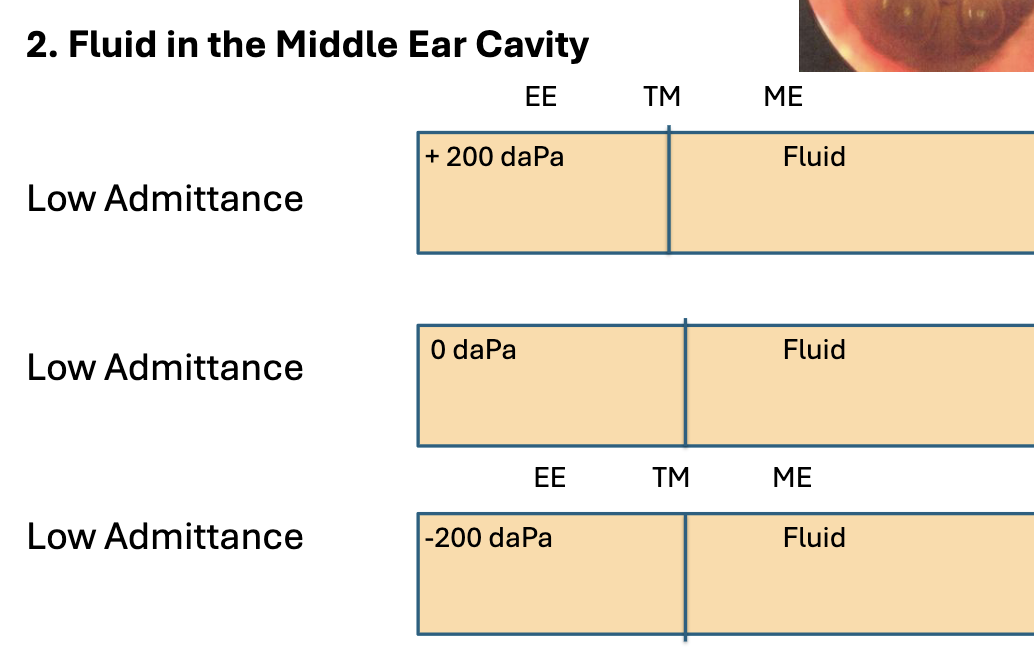
fluid in the middle ear cavity (admittance)
eardrum perforation (admittance)

Type A tympanogram
peak near ambient pressure (100 daPa)
normal static admittance
normal ear canal volume
consistent with normal outer and middle ear function

Tympanogram- Type A d
peak near ambient pressure
high static admittance
normal ear canal volume
consistent with abnormally increased middle ear mobility
what could cause increase mobility? → ossicular disruption/discontinuity and flaccid TM

Tympanogram- Type A s
peak near ambient pressure
low static admittance
normal ear canal volume
consistent with reduced middle ear mobility
Cause? ossicular fixation, inflammation or infection of ME, ear drum scaring
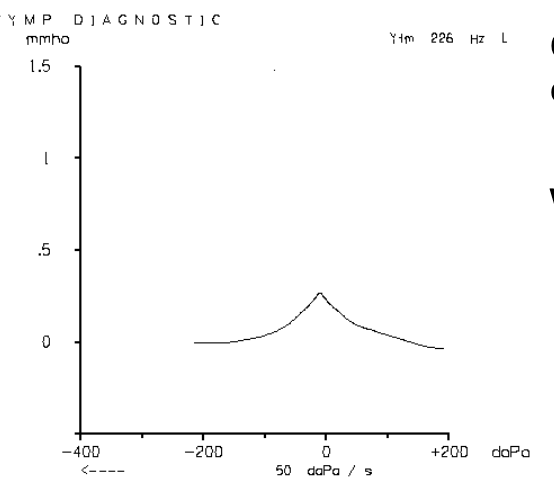
Tympanogram- Type B
no clear peak- no point at which the TM is mobile
consistent with reduced compliance of tympanic membrane
look to ECV (ear canal volumne)
high ECV (5.2)- perforation
low to regular ECV (1.3)- otitis media
really low ECV (.15) you’re hitting the wall or your probe tube is clogged

Tympanogram- Type C
peak at negative pressure (<150 daPa)
normal static admittance
normal ear canal volume
consistent with abnormally negative middle ear pressure
cause? emerging or resolving OME
tympanometry measures
measures how easily the ME moves in response to changes in air pressure
acoustic reflex measures
measures the involuntary ME muscle contraction in response to a loud sound
acoustic reflex how does the muscles contract
involuntary contraction of the stapedius muscle (primary) and tensor tympani muscle (minor role) in response to loud sounds
Bilateral reflex→ if you stimulate either ear, both R and L muscles will contract
when the muscle contracts, it pulls on the TM and causes stiffness in the ME system
when this happens, admittance into the ME decreases
SPL in the canal increases
how the reflex works
contraction of the muscle increases middle ear impedance for high intensity sounds
when a loud sound is presented…
each muscle exerts force of the ossicles perpendicular to their normal manner of movement
the force they exert stiffness the ME’s ability to transmit sounds
The stiffness results in an increase in ME impedance
if normal hearing, at sound levels of 85 dB SL, the reflect will start to contract muscles
contraction results in TM movement that can be measured as a change in impedance of the system
function of acoustic reflex
protection→ potential injury to hearing is avoided by attenuating hgh intensity sounds
perception→ reduced interferences from unimportant sounds like when eating and talking. Redcues masking of high frequency sounds by lmiting low frequency admittance
acoustic reflex arc
the reflex is reflective of the sensory and motor pathways working properly.
sensory (afferent neurons)→ affects the brain and signal travels up to the brain
motor (efferent neurons)→ has an effect in the body and signal travels back down to whenever it’s going
acoustic reflex arc pathway
sound enters the ear→ ME→ cochlea
auditory nerve carries the neural signal to the brainstem (cochlear nucleus)
the signal travels bilaterally to the superior olivary complex
impulse sent to the facial nerve on both sides of the brainstem
the facial nerve carries the motor signal to the ME muscle
stapedius muscle contracts, pulling on the stapes and stiffening the ossicular chain, which reduces sound transmission to the cochlea
these structures must be intact for the AR to be present
if the reflex is absent, it could be a sign of toruble in one of the following places:
middle ear
cochlea
AN
Brainstem structures
facial nerve
stapedius muscle
AR testing- similarities and differences with typanometry
similar- same probe tone of 226Hz and measures changes in the SPL in the external aud canal
differences- air pressure is not varied, measure is made at peak pressure of the tympanogram, stimulus is ALSO played in addition to the probe tone
acoustic reflexes- acoustic signals
probe tone (y, 226 Hz)→ to measure change in impedance or admittance
stimulus/elicitor tone (1000 Hz)→ to elcit the reflex, “I”= ipsilateral condition
ART- the reflex threshold
lowest intensity at which a change is detectable in the immittance of the middle ear system
ART may be elicited in response to pure-tones and noise
For normal listners, the acoustic reflex is observed at about 85-100 dB HL for tones
Reflex is absent if not observed at 110 dB HL or max output
How to determine a threshold
>_ 0.02 mmhos
shows “growth” 5-10 dB above threshold
Repeatable
No artifact (test at low level)

Ipsilateral presentation
stim ear and probe ear are the SAME
ex: probe tone is measuring response in right ear and stimulus tone is being presented to the right ear
contralateral ARs
the response is measured in the contralateral (probe) ear using a continusous probe tone
the probe is not another loud reflex-activating signal
low-level probe tone (usually 226 Hz) allows the instrument to continuously measure sound reflected back from the eardrum
when the stimulus/elicitor is presented…
middle ear system stiffens in both ears
in probe ear, this stiffening changes the amount of probe tone that is absorbed vs. reflected- i.e., a change in admittance
the tympanometer detects and records this small change as the reflex response