BIO 156 Module 6: Cell Components
 Call Kai
 Learn
 Practice Test
 Spaced Repetition
 Match
 Flashcards
 Knowt Play
1/86

There's no tags or description
Looks like no tags are added yet.
87 Terms
plasma or cell membrane
a semi-permeable membrane that defines a cell's borders and keeps it functional

what is dispersed across the plasma membrane?
proteins that allow the cell to import nutrients, export waste, and communicate with other cells
what contributes to the fluidity of a cell membrane?
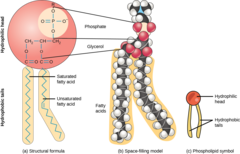
cholesterol and lipid tails within the phospholipid bilayer which consist of some saturated and unsaturated fatty acids
Amphipathic molecules
an amphipathic molecule contains both a hydrophilic and hydrophobic region. phospholipids are amphipathic
intracellular fluid
the fluid contained within cells- cytoplasm
what is the extracellular fluid in blood vessels called?
plasma
what are 2 different types of proteins that are commonly associated with the cell membrane?
integral proteins and peripheral proteins
integral protein
an integral protein is embedded in the membrane.
types of integral proteins?
channel protein, cell recognition proteins, receptor protein, glycoproteins
channel protein
selectively allows particular materials like ions to leave or enter the cell

cell recognition proteins
mark a cell's identity so it can be recognized by other cells. a white blood cell needs to know if another cell is a white blood cell so it can leave it alone, or attack if its not.
A receptor
a type of protein that can selectively bind a specific molecule outside the cell which induces a chemical reaction within the cell.
Ligand
A molecule that binds to and activates a receptor . some integral proteins serve as dual roles as both a receptor and an ion channel.
receptor-ligand interaction example
the receptors on nerve cells that bind neurotransmitters like dopamine. when a dopamine molecule binds to a dopamine receptor protein, a channel within the transmembrane protein opens to allow certain ions to flow into a cell.
glycoproteins
some integral membrane proteins are glycoproteins. which is a protein with carbohydrate molecules attached, which extend into the extracellular matrix.
what is the purpose of the attached carbohydrate tags on glycoproteins?
they aid in cell recognition
Glycocalyx
a fuzzy appearing coating around the cell from glycoproteins and other carbohydrates attached to the cell membrane
what are the various roles of the glycocalyx
it may have molecules that allow the cell to bind to another cell, it may contain receptors for hormones. may have enzymes to break down nutrients. they give each individual cell an identity. this identity is how a person's immune system knows not to attack its own cells.
peripheral proteins
typically found on the inner or outer surface of the lipid bilayer. they can also be attached to the internal or external surface of an integral protein
peripheral protein's purpose
these proteins typically form a specific function for the cell. like peripheral proteins on the surface of intestinal cells act as digestive enzymes to break down nutrients to sizes that can pass through the cells and into the bloodstream.
why is the nucleus the control center for a cell?
it stores all the genetic instructions for manufacturing proteins.
multinucleated
when cells have more than one nucleus. Muscles cells have more than one nucleus.
what cells do not contains a nuclues
mammalian red blood cells (RBCs) they eject their nuclei as they mature, making space for large amounts of hemoglobin molecules. their life span is short without one
hemoglobin molecules purpose?
carry oxygen through the body
what information is stored in the nucleus?
DNA the nucleus sends commands to the cells with molecular messengers that translate the information from DNA.
nuclear envelope
the nuclear envelope or nuclear membrane consists of two adjacent lipid bilayers with a thin fluid space between them.

nuclear pores
a nuclear pore is a tiny passageway for the passage of proteins, RNA, and solutes between the nucleus and cytoplasm.
nucleoplasm
inside the nuclear envelope is a gel like nucleoplasm with solutes that include the building blocks of nucleic acids.
Nucleolus
the nucleolus is a region of the nucleus that is responsible for manufacturing RNA necessary for construction of ribosomes.
how does the nucleus direct the synthesis of ribosomes?
the nucleolus (plural = nucleoli) aggregates the ribosomal RNA with associated proteins to assemble the ribosomal subunits that are then transported out through the pores in the nuclear envelope to the cytoplasm.
Chromatin
the term for all DNA and associated proteins within the nucleus
chromatin
along the chromatin threads, DNA is wrapped around a set of proteins called histones.

genes to chromosomes ratio
22,000 genes distributed on 46 chromosomes
what happens to chromatin when a cell is ready to divide
the proteins that are bundled and condensed into chromatin are packed tightly into chromosomes when the cell is ready to divide, so the DNA can be safely integrated into 2 daughter cells.
endomembrane system
a group of cellular components that are in charge of proteins and how they're modified, packaged and shipped
eukaryotic cells are distinguished by a nucleus and endomembrane system. what makes up the endomembrane system?
plasma membrane, nuclear envelope, lysosomes, vesicles, endoplasmic reticulum, and Golgi apparatus.
endoplasmic reticulum
a serious of interconnected sacs and tubules that modifies proteins and synthesizes lipids.
Rough Endoplasmic Reticulum (rough ER)
ribosomes give the rough ER its studded appearance. ribosomes undergo structural modifications in the rough ER like cleaving off portions of the protein, folding or the disquisitions of side chains.
smooth ER
its not part of protein production, its purpose is to synthesize lipids like phospholipids, cholesterol, and steroid hormones. it detoxifies substances like food, medications, alcohol and storage of ions.
golgi appararus
after proteins leave the ER they go to the Golgi apparatus to be sorted, packaged and tagged so they end up in the right place. the post office of the cell.
what type of modifications happen when a protein travels through the Golgi apparatus?
the most frequent modification is the addition of short chains of sugar molecules. then they're tagged with phosphate groups or other molecules.
what do the tagged proteins from the Golgi apparatus get packaged into
they get packaged into secretory vesicles that bud from the face of the Golgi.
what type of cells have an abundance of Golgi?
cells in the salvatory glands have a lot of Golgi because the secretory activity that secretes digestive enzymes. or cells of the immune system that secrete antibodies.
lysosomes
the "cell's stomach" because it contains enzymes that breaks down waste and destroys disease causing pathogens. the inside is acidic.
why is the lysosome considered part of the endomembrane systemn?
because they are end products comprised of protein filled vesicles
Phagocytosis
Phagocytosis is the cellular process where a cell uses its outer membrane to engulf and digest large solid particles, often described as "cell eating"

peroxisomes
similar to lysosomes, peroxisomes contain enzymes. they perform lipid metabolism and chemical detoxification.
what are the differences between the enzymes in lysosomes and in peroxisomes
the enzymes in peroxisomes serve to transfer hydrogen atoms from molecules to oxygen, producing hydrogen peroxide (H2O2) this is how they neutralize poisons like alcohol.
Reactive oxygen species (ROS)
reactive oxygen species such as peroxides and free radicals are unstable, oxygen-containing molecules that easily react with other cellular structures
why are free radicals bad?
free radicals are reactive because they contain free unpaired electrons, they can easily oxidize other molecules throughout the cell causing cell damage and even cell death.
why are peroxisomes important in relation to free radicals?
peroxisomes oversee reactions that neutralize free radicals. they neutralize harmful toxins so they don't wreak havoc in cells. the liver contains a lot of peroxisomes.
how do antioxidants work?
they work by being oxidized themselves, stopping the destructive reaction initiated by the free radicals.
Oxidative stress
the term used to describe damage to cellular components cause by ROS.
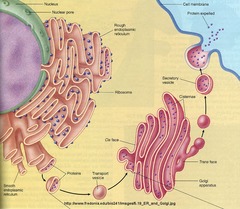
The nucleus holds DNA containing genetic instructions that dictate the synthesis of proteins. In the nucleus, a gene is transcribed into mRNA, which leaves through nuclear pores.

The strand of mRNA will code a protein that needs to be packaged and shipped out of the cell. A ribosome unites with the mRNA strand and associates with the rough ER. Here, the ribosomes performs translation and a protein is formed inside the rough ER lumen.

The rough ER modifies the protein by cutting, folding and adding sugars to it. The protein is packaged into a transport vesicle that bubbles off the ER and travels to the Golgi.

The Golgi apparatus sorts and repackages the protein into a secretory vesicle bound for the membrane.

The secretory vesicle bubbles off the Golgi and makes its way to the cell membrane. The vesicle nudges close to the membrane, fusing phospholipids with it, and exocytosis occurs. The protein can now fulfill its role outside of the cell.
Mitochondrion
a membranous, bean shaped organelle that is the "energy transformer" of the cell.

what is the mitochondria made of?
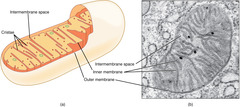
consists of a lipid bilayer outer membrane and an inner membrane of layered phospholipids. between the membranes is the intermembrane space.
what resides in the intermembrane?
there is a high concentration of hydrogen ions.
what does the inner membrane surround?
it surrounds the most internal mitochondrial space known as the MATRIX
Cristae
folds in the inner membrane of mitochondria
Aerobic cellular respiration
biochemical reactions preformed within the spaces and along the inner membrane, these reactions convert energy stored in nutrient molecules like glucose into adenosine triphosphate (ATP), which provides the cell with usable cellular energy.
mitochondria summary
Biochemical reactions within mitochondria transform energy-carrying molecules into the usable form of cellular energy known as ATP. Mitochondria are oval-shaped, double membrane organelles that have their own ribosomes and DNA. Each membrane is a phospholipid bilayer embedded with proteins. The inner layer has folds called cristae. We call the area surrounded by the folds the mitochondrial matrix. The cristae and the matrix have different roles in cellular respiration.
cytoskeleton
A network of protein fibers that holds the cell together, helps the cell to keep its shape, and aids in movement

what are the three types of protein fibers within the cytoskeleton?
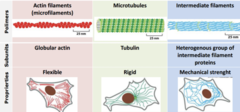
Microfilaments, intermediate filaments, and microtubules

Microfilaments
microfilaments are the narrowest of the cytoskeleton fibers, they function in cellular movement, have a diameter of ab 7nm and are made of 2 intertwined strands of globular protein called actin. so they are also known as actin filaments.

what are microfilaments primarily made of?
actin
What does actin use to assemble into filamentous form?
ATP
What motor protein works with actin?
myosin
How do actin and myosin cause muscle contraction?
Actin and myosin filaments slide past each other, causing the muscle to contract.
What are two cellular processes besides muscle contraction that involve actin?
Cell division and cytoplasmic streaming.
Why can microfilaments help cells move and change shape?
they can quickly assemble and disassemble
What is the main function of actin/microfilaments?
they help with cell shape, movement, division, and muscle contraction.
intermediate fimalments
they are made of several strands of fibrous proteins that are wound together. they are 8-10nm which is a size in between microfilaments and microtubules.

what is the role of intermediate filaments?
they have no role in cell movement, their role is structural
how do intermediate filaments contribute to structure?
they bear tension, maintaining the shade of the cell and anchor the nucleus and other organelles in place.
what are some common fibrous proteins found in the intermediate filaments?
keratin, the fibrous protein that strengthens hair, nails, and the epidermis of the skin.
Microtubules
microtubules are small hollow tubes, its walls are mad of polymerized dimers. it has a diameter of ab 25nm, which are the widest components of the cytoskeleton.

purpose of the microtubules
they help the cell resist compression, provide a track along which vesicles move through the cell, and pull replicated chromosomes to opposite ends of a dividing cell. like microfilaments, they assemble and disassemble quickly.
What structures are made of microtubules?
flagella, cilia and centrioles.
flagella
hair-like structures that extend from the plasma membrane and are used to move an entire cell ex: sperm

cilia
They are short, hair-like structures that are used to move entire cells (such as paramecia) or substances along the outer surface of the cell (for example, the cilia of cells lining the Fallopian tubes that move the ovum toward the uterus, or cilia lining the cells of the respiratory tract that trap particulate matter and move it toward your throat.)

tight junctions
Membranes of neighboring cells are pressed together, preventing leakage of extracellular fluid

gap junctions
provide cytoplasmic channels between adjacent animal cells that allow for the transport of ions, nutrients and other substances that enable cells to communicate.

desmosomes
Short proteins called cadherins in the plasma membrane connect to intermediate filaments to create desmosomes. The cadherins join two adjacent cells together and maintain the cells in a sheet-like formation in organs and tissues that stretch, like the skin, heart, and muscles. You can think of the desmosomes like rebar between two concrete blocks that stops them from being puled apart.
