Psychology: Freud’s Psychodynamic Theory and Motivation
 Call Kai
 Learn
 Practice Test
 Spaced Repetition
 Match
 Flashcards
 Knowt Play
1/123

There's no tags or description
Looks like no tags are added yet.
124 Terms
What is personality?
The enduring configuration of characteristics and behavior that comprises an individual's unique adjustment to life.
What is Personality Psychology?
The branch of psychology that investigates the nature, development, structure, and dynamics of personality.
What does 'psyche' refer to?
The mind in its totality, distinguished from the physical organism.
Who developed the concept of psychoanalysis?
Sigmund Freud.
What is the main assumption of psychoanalysis?
Much mental activity is unconscious, and understanding people requires interpreting the unconscious meaning underlying their behavior.
What are the three levels of the mind according to Freud?
Conscious, preconscious, and unconscious.

What is the conscious mind?
The region of the psyche containing thoughts, feelings, and perceptions currently present in awareness.
What is the preconscious mind?
The level of the psyche containing thoughts and feelings not currently in awareness but can be readily accessed.
What is the unconscious mind?
The region containing memories, emotional conflicts, and repressed impulses not directly accessible to awareness.
What are the components of Freud's structure of the mind?
Id, ego, and superego.
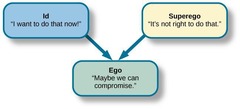
What is the Id?
The component of personality containing instinctual drives that seek immediate gratification.
What principle does the Id operate on?
The pleasure principle.
What is the Superego?
The moral component of personality that represents parental and societal standards.
What role does the Superego play in personality?
It acts as our conscience, striving for perfection and judging our behavior.
What is the Ego?
The component that deals with the external world and balances the demands of the Id and Superego.
What principle does the Ego operate on?
The reality principle.
What is the reality principle?
The regulatory mechanism that represents the demands of the external world and requires postponing instinctual gratification.
What is the psychosexual theory of development?
Freud's theory outlining five stages of development and the consequences of fixation at each stage.
What are defense mechanisms?
Psychological strategies used to cope with anxiety and maintain self-image.
What is the Oedipus complex?
A central concept in Freud's theory, referring to a child's feelings of desire for their opposite-sex parent and jealousy toward their same-sex parent.
Who are the neo-Freudians?
Psychologists who expanded on Freud's theories, including Carl Jung, Alfred Adler, and Karen Horney.
What is psychodynamic theory?
A constellation of theories based on the interplay of drives and forces within the person, originating from Freud's psychoanalytic theories.
What is the significance of anxiety in Freud's theory?
Anxiety is central to neurotic reactions and is managed through defense mechanisms.
What is the pleasure principle?
The view that human beings are motivated by the desire for immediate gratification of instinctual impulses.
What is the relationship between biological drives and personality?
Personality develops from the conflict between biological drives and socialized control over these drives.
What principle governs the ego according to Freud?
The reality principle
What does the id operate on?
The pleasure principle
What is the role of the superego in Freud's theory?
It focuses on ideal behavior and acts as a moral conscience.
What are the three systems of the mind according to Freud?
Id, Superego, and Ego

What is fixation in the context of Freud's psychosexual stages?
The persistence of an early stage of psychosexual development that limits the ability to negotiate later tasks.
What age range corresponds to the oral stage of psychosexual development?
0-1.5 years
What are the consequences of fixation at the oral stage?
Possible oral aggressiveness or passiveness, leading to a manipulative personality.
What age range corresponds to the anal stage of psychosexual development?
1.5-3 years
What are the two types of personalities resulting from anal fixation?
Anal retentive (organized) and anal expulsive (careless).
What age range corresponds to the phallic stage of psychosexual development?
3-6 years
What complex is associated with the phallic stage in boys?
Oedipus complex
What complex is associated with the phallic stage in girls?
Electra complex
What is the latency stage of psychosexual development?
6 years to puberty, characterized by dormant sexual feelings.
What is the genital stage of psychosexual development?
Puberty to death, where sexual interests mature.
What is a defense mechanism in Freud's theory?
An unconscious reaction pattern employed by the ego to protect itself from anxiety.
What is repression as a defense mechanism?
Not allowing painful experiences and unacceptable thoughts to become conscious.
What is the consequence of fixation during the latency stage?
Immaturity and inability to form fulfilling non-sexual relationships.
What is the primary focus of the id?
To satisfy basic drives to survive, reproduce, and aggress.
What does the ego do according to Freud?
It seeks to realistically gratify the id's impulses to bring long-term pleasure.
What is the function of the superego?
To strive for perfection and uphold moral standards.
What can result from unresolved Oedipus complex?
Neurosis due to fear of castration and identification with the father.
What can result from unresolved Electra complex?
Jealousy toward the mother and issues with self-esteem.
What is the role of the ego in managing anxiety?
It employs defense mechanisms to protect itself from overwhelming anxiety.
What is the consequence of fixation during the genital stage?
Difficulty in forming healthy sexual relationships.
What is the significance of the Oedipus complex in Freud's theory?
It represents a child's feelings of desire for the opposite-sex parent and rivalry with the same-sex parent.
What is the significance of the Electra complex in Freud's theory?
It represents a daughter's feelings of desire for the father and jealousy toward the mother.
What is regression in psychodynamic theory?
Retreating to an earlier (fixated) psychosexual stage.
Give an example of regression.
A boy sucks his thumb in the car on the way to his first day of school.
What does denial mean in the context of defense mechanisms?
Simply refusing to acknowledge the existence of threatening impulses.
Provide an example of denial.
A partner denies evidence of his loved one's affair.
What is rationalization?
Making excuses for one's unacceptable feelings or behavior.
Give an example of rationalization.
A habitual drinker says she drinks with her friends 'just to be sociable.'
What does projection involve?
Attributing one's threatening impulse to others.
Provide an example of projection.
The thief thinks everyone else is a thief.
What is displacement in defense mechanisms?
Satisfying one's sexual or aggressive impulses with a less threatening target.
Give an example of displacement.
A little girl kicks the family dog after her mom puts her in a time-out.
What is reaction formation?
Converting unacceptable impulses with exaggerated opposites.
Provide an example of reaction formation.
A gay man has a number of conspicuous heterosexual affairs.
What does sublimation mean?
Channeling unacceptable drives into socially acceptable or enhancing activities.
Give an example of sublimation.
A surgeon turns aggressive desires to cut people into life-saving acts.
Who is Alfred Adler?
A Neo-Freudian theorist who emphasized the importance of social relationships and overcoming feelings of inferiority.
What is the inferiority complex according to Adler?
A feeling of inadequacy stemming from childhood experiences.
Who is Karen Horney?
A Neo-Freudian theorist who founded feminist psychology and challenged Freud's views on women.
What did Karen Horney argue about women's psychology?
She traced psychological differences between men and women to social and cultural factors, not biology.
Who is Carl Jung?
A Neo-Freudian theorist known for his concepts of the collective unconscious and archetypes.
What is the collective unconscious according to Jung?
The part of the unconscious that contains ancestral images and archetypes common to all humankind.
What are archetypes in Jungian psychology?
Universal symbols and themes that derive from the collective unconscious.
What is the persona archetype?
The public face an individual presents to the outside world, contrasting with their true self.
What does the shadow archetype represent?
The darker side of the human psyche, including traits and desires that are hidden from the conscious ego.
What is a key criticism of Freud's psychoanalytic perspective?
Development is lifelong, not fixed in childhood.
What modern perspective exists on the unconscious mind?
It is viewed as information processing that occurs without awareness.
What did modern research find about Freud's defense mechanisms?
Research supports reaction formation and projection but contradicts many of Freud's other ideas.
What is the role of childhood social tensions according to Adler and Horney?
They are crucial for personality formation, rather than sexual tensions.
What is motivation?
The impetus that gives purpose or direction to behavior, operating at conscious or unconscious levels.
What are the two potential sources of motivation?
Intrinsic motivation (internal feelings) and extrinsic motivation (external factors or rewards).
What does drive-reduction theory suggest?
Physiological needs create an aroused tension state (a drive) that motivates an organism to satisfy the need.
What is homeostasis?
The tendency to maintain a balanced or constant internal state, regulating aspects of body chemistry.
What is an incentive in the context of motivation?
A positive or negative environmental stimulus that motivates behavior.
What does arousal theory state about human motivation?
Humans are motivated to engage in behaviors that either increase or decrease arousal levels.
What are the five levels of Maslow's Hierarchy of Needs?
1. Physiological needs 2. Safety needs 3. Love and belongingness needs 4. Esteem needs 5. Self-actualization.
What is the biopsychosocial model of motivation?
A systematic integration of biological, psychological, and social approaches to the study of motivation.
What are the three components of the biopsychosocial model?
Biological, psychological, and sociocultural factors.
What is the difference between sex and gender?
Sex refers to biological aspects, while gender refers to psychological, behavioral, and social aspects.
What is gender identity?
One's self-identification as male, female, or other classification.
Give an example of intrinsic motivation.
Engaging in a hobby for personal satisfaction.
Give an example of extrinsic motivation.
Studying to earn a good grade.
What motivates behaviors to lower high arousal levels?
High arousal motivates behaviors that decrease arousal.
What motivates activities to increase low arousal levels?
Low arousal motivates activities through curiosity or novelty seeking.
What is an example of a biological influence on sexual orientation?
Genetic predispositions.
What is an example of a prenatal influence on sexual orientation?
Hormonal exposure during pregnancy.
What is an example of a social motivation?
The desire for social acceptance.
What is one reason humans have sex for physical motivation?
Pleasure.
What is one reason humans have sex for emotional motivation?
Love and commitment.
What is one reason humans have sex for goal attainment?
Social status.
What does the term 'social facilitation' refer to in eating motivation?
The presence of others amplifies natural behavior tendencies related to eating.