Osmoregulation
 Call Kai
 Learn
 Practice Test
 Spaced Repetition
 Match
 Flashcards
 Knowt Play
1/136

There's no tags or description
Looks like no tags are added yet.
137 Terms
What is excretion?
Elimination of metabolic waste products e.g. CO2, H2O and nitrogenous compounds.
What is osmoregulation?
Regulation of water and ion balance in body fluids.
In many animals Osmoregulatory and excretory organs are the same. What is this organ?
Kidneys
What is the function of excretion?
Rid the body of toxic waste
What is the function of osmoregulation?
Maintain concentration and ion balance in body fluids
How are membranes involved in osmoregulation?
Membranes are permeable to solvent (water) and solutes (ions).
Describe diffusion
Diffusion is the passive movement of solutes from a high concentration to a low concentration.
Describe osmosis
Osmosis is the passive movement of the solvent from less to more concentrated solutions.
What is osmosis driven by?
Differences in osmotic pressure between solutions
Define isosmotic
an animal has the same osmotic concentration as the external environment.

Define hyperosmotic
Animal has a higher osmotic concentration than the external environment.

Define hyposmotic
Animal has a lower osmotic concentration than the external environment.

What does the movement of the solvent (water) and the solute (ions) across a semipermeable membrane depend on?
Gradient, permeability, surface area.
What happens when the concentrations of ions and water are different?
The water and ions will move down a concentration gradient until an equilibrium is reached
If a concentration difference is to be maintained for both water and Ions what is required?
Active transport
How is active transport possible
Pumps on the membrane use ATP to move ions against their concentration gradient
give examples of common ions that are used in osmosis/active transport
Na+/K+ ATPase
describe symport
The transport of two different molecules crossing the membrane at the same time in the same direction. it requires energy
Describe antiport
The transport of two different molecules crossing the membrane at the same time in the opposite direction. it requires energy
Can water be actively transported?
NOOO!!!!!!!!!!!!
Where is the elimination of nitrogenous waste products often coupled with water regulation therefore they are discussed together?
Kidneys
Name the three main forms of nitrogenous waste
Ammonia, Urea, Uric acid
What are the three methods of reducing the toxicity of nitrogenous waste?
eliminate it, dilute it, or convert into a less toxic alternative.
What form of nitrogenous waste do fish and marine and freshwater life deal with?
mmonia, Can be eliminated quickly, cheap to produce and highly soluble in water as ammonia is extremely toxic this is essential.
What form of nitrogenous waste does animals including mammals, amphibians, some reptiles and cartilaginous fish produce?
Urea Less toxic than ammonia but also less soluble. It requires some water.
What form of nitrogenous waste do terrestrial arthropods and snails, snakes,
birds, many reptiles produce?
Uric acid, least toxic but is insoluble
What is the order of how expensive each form of nitrogenous waste costs?
Ammonia is the easiest to make, then urea then uric acid.
Describe osmoconformers
animal conforms (wrt theblood/haemolymph etc.) to the osmotic concentration of its environment
Describe osmoregulator
an animal is able to regulate its body fluids and keeps teh same osmotic concentration no matter its environment.
Describe how marine Invertebrates conform/regulate water concentration
Marine invertebrates are osmoconformers, as their environment is very salty.
They conform their extracellular fluid. (BLOOD)
They regulate their intracellular fluid. (CYTOPLASM). K+, Na+ and Cl- are regulated by active transport – requires energy.
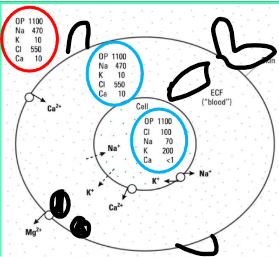
Describe how Brackish/Intertidal Invertebrates conform/regulate water concentration
They conform their extracellular fluid.
They regulate their intracellular fluid.

How do Brackish/Intertidal Invertebrates Use amino acids to help prevent changes in their intracellular fluid.
Because their blood becomes more salty when this happens compared to the freshwater, the sodium ions exit their extracellular fluid and enter the the ocean, which regulates the concentration of ECT
Describe how freshwater invertabrates are conform/regulating to its environments concentration.
freshwater invertebrates are osmoregulators as
their body fluids are hypertonic to their
environment.
✓ They regulate their extracellular fluid.
✓ They regulate their intracellular fluid.
What challenges do invertebrates face when in comes to water
There must be equal exchange of water between all three environments. (Environmental water, extracellular fluid and intracellular fluid)
Are freshwater invertebrates osmoregulators or osmoconformers?
Osmo regulator (their body fluids are hypertonic to their environment.) (because they live in freshwater they would explode and fill with fresh water if they didnt regulate)
How do freshwater invertebrates regulate the volume and concentration of water?
Excretory system.
What are hyper-hyposmotic invertebrates
an organism that in fresh water salts going out and water going in of blood, saltwater salt going in water going out of blood.
Give examples of Hyper-hyposmotic invertebrates
Palaemonetes (salt marsh shrimp) is hyperosmotic in freshwater and
hyposmotic in seawater.
Artemia (brine shrimp) hyposmotic in seawater. Can tolerate concentrations x3 greater than seawater!
How do hyper-hyposmotic invertebrates keep their osmotic pressure of blood constant?
They have to take up water (drink) and eliminate salts using salt glands; work by active transport.
Give example of terrestrial invertebrates
Slugs and snails
What needs to be considered when discussing terrestrial invertebrates regarding osmoregulation?
They have limited access to water so they must conserve water.
What behavioural strategies have terrestrial invertebrates developed to conserve water?
Impermeable integument: insects have a waxy epicuticle.
Live within moist environments: hygrophiles. (e.g only come out at night)
Water from food/drinking: fluid feeders.
Water from soil or air: spiders and mites.
What are the 4 main types of regulatory organs found in invertebrates?
Contractile vacuoles: protozoans and sponges.
Nephridial glands: platyhelminths
Antennal or green glands: crustaceans.
Malpighian tubules: insects.
Where are contractile vacuoles found?
protozoans and sponges cells attatched to vacuoles.
Describe the relationship between the cytoplasm and the environment in contractile vacuoles
Hyperosmotic
Describe the relationship between the vacuole and the cytoplasm
Hyposmotic
Why must protozoans and sponges use the contractile vacuole?
in an environment full of water molecules so they start swelling up as water enters. Therefore they make their vacuole walls as impermeable as possible. Which means they need a method of allowing water inside their cells.
Describe the mechanism of contractile vacuoles
It is a vacuole surrounded by canals. Water flows via osmosis into these radial canals surrounding the vacuoles and ions will follow. They then flow towards the central vacuole. The protist wants to retain some ions and use ATP made by mitochondria for active transport for pumps along the walls of canal to remove the ions and leave only water within the vacuole, the membrane that lines the vacuole is highly impermeable to water so it stops water from flowing out of the vacuole. This leaves us with a vacuole filled with pure water and very little anything else. Finally the vacuole fuses and contracts with the cell membrane and expels the pure water from the cell.
Where are Protonephridia found?
flatworms, rotifers
Describe the mechanism of nephridia
The proto evolved first and the meta after.
A series of channels, interconnected tubules that are blind ending, meaning they are not continuous. They terminate at the nephridia pore. The flagellum of the cell beats at the blind end, creating negative pressure at the blind end. This negative pressure draws fluid from within the animal into the central cavity into the duct and passes between cells and into a central lumen.
It's all driven by pressure changes which are driven by the flagellum.
What is the main function of nephridia?
Excretion of metabolic waste and regulation of water and ion balance (osmoregulation)
What are protonephridia?
Excretory tubules with closed internal ends, often containing specialised flame cells or solenocytes
How does the flagellum in protonephridia help move fluid?
Its beating creates fluid movement and helps generate a pressure gradient that draws fluid through the tubules
What is the role of ion pumps in protonephridia?
They actively transport ions, helping regulate the composition of body fluids and drive water movement by osmosis
Is the fluid excreted by protonephridia always pure water?
No. Its composition varies, but it can be very dilute and contain water, ions and nitrogenous wastes.
What are metanephridia?
Tubular excretory organs that open internally into the coelomic cavity and externally through a nephridiopore.
What is a nephrostome?
A ciliated funnel that opens into the coelomic cavity and collects coelomic fluid.
What is a nephridiopore?
The external opening through which waste fluid leaves the animal.
How does fluid enter a metanephridium?
Coelomic fluid enters through the ciliated nephrostome and passes into the collecting tubule.
What is ultrafiltration?
The movement of water and small dissolved substances across a filtration barrier, while larger components are retained
What is haemolymph?
The circulating fluid in most arthropods, functioning as their main extracellular fluid. It combines functions of blood and interstitial fluid.
Why is the circulatory system of most arthropods called open?
Haemolymph leaves the vessels and bathes organs directly in body cavities called haemocoels.
What are the antennal or green glands?
Excretory and osmoregulatory organs in many crustaceans
What is the pathway through a crustacean antennal gland?
End sac → labyrinth → nephridial canal → bladder → nephropore.
What is the function of the end sac?
It helps filter fluid from the haemolymph into the excretory system
What is the function of the bladder in an antennal gland?
It temporarily stores urine before it leaves through the nephropore
Why must marine arthropods regulate particular ion concentrations even if they are isosmotic with seawater?
Their internal fluids may have different concentrations of individual ions, such as Mg²⁺ and SO₄²⁻, from seawater.
Which structure is important for ammonia excretion in many aquatic crustaceans?
Which structure is important for ammonia excretion in many aquatic crustaceans?
What happens to the osmoregulatory challenge when a marine crustacean enters freshwater?
Water tends to enter the body, while ions tend to diffuse out. It must excrete excess water and actively take up salts.
Why must a freshwater crustacean actively acquire salts?
Freshwater has a much lower ion concentration than its body fluids, so ions are lost by diffusion unless replaced.
What are the three main gut regions associated with insect digestion and excretion?
Midgut, hindgut and the Malpighian tubules, which connect near the midgut–hindgut junction.
What are Malpighian tubules?
Blind-ended excretory tubules extending from the digestive tract near the junction of the midgut and hindgut.
Do Malpighian tubules primarily use filtration or active secretion?
Active secretion.
How is primary urine formed in Malpighian tubules?
K⁺ and other solutes are actively transported into the tubule lumen; water follows by osmosis.
Where does the fluid from Malpighian tubules pass?
Into the hindgut, where its composition is modified.
What happens to water in the insect hindgut?
Water is reabsorbed into the body along with useful solutes.
In what form do insects commonly excrete nitrogenous waste?
Mainly uric acid, which can precipitate as poorly soluble urate crystals or other solid material.
Why is uric acid useful for terrestrial insects?
It can be excreted with very little water, helping conserve water.
How does uric acid precipitation help insects conserve water?
It keeps much of the nitrogenous waste in a solid form, allowing water to be reabsorbed without retaining large amounts of dissolved waste.
Why are Malpighian tubules effective at conserving water?
They secrete wastes into the tubules and allow extensive reabsorption of water and solutes in the hindgut.
How permeable is the integument of amphibians?
Generally highly permeable to water and many dissolved substances.
How permeable is the integument of fish?
The body surface is generally much less permeable than the gills, which are highly permeable and important for ion and water exchange
Why are fish gills important in osmoregulation?
They provide a large, thin exchange surface for gas exchange, ion transport and, in many species, ammonia excretion.
Which vertebrate groups generally have relatively impermeable integuments?
Reptiles, birds and most mammals; some desert-adapted amphibians also have reduced water permeability
What is meant by a secondary aquatic mammal?
A mammal whose ancestors lived on land but which later evolved to live in aquatic environments.
How permeable is the integument of secondary aquatic mammals?
Generally relatively impermeable to water, helping maintain internal fluid balance
What is osmoregulation?
The regulation of water and dissolved ion concentrations in body fluids.
What is an osmoconformer?
An animal whose overall internal osmotic concentration is similar to that of its environment.
What is an ionoconformer?
An animal whose concentrations of particular ions broadly reflect those of its environment. This describes ionic regulation, not necessarily total osmotic concentration.
What is an ion regulator?
An animal that maintains the concentrations of particular ions in its body fluids within a controlled range.
What is an osmoregulator?
An animal that maintains its internal osmotic concentration substantially independently of the external environment.
What are the three broad categories of marine vertebrates in these notes?
Osmoconformers, ion regulators that may be osmoconformers, and osmoregulators.
What is the approximate osmotic concentration of a marine teleost's blood compared with seawater?
About one-third that of seawater; marine teleosts are hypo-osmotic to seawater
Why do marine teleosts tend to lose water to seawater?
Their body fluids are less concentrated than seawater, so water leaves their bodies by osmosis.
How do marine teleosts compensate for water loss?
They drink seawater, absorb water through the gut and excrete excess salts, particularly through the gills and kidneys.
Can an animal be an osmoconformer but still regulate ions?
Yes. It can maintain a similar total osmotic concentration to seawater while keeping individual ion concentrations different.
Where do hagfish live?
Marine environments, including deep-sea habitats; their exact depth and lifestyle vary by species.
Why are hagfish classified as osmoconformers?
Their body fluids have an overall osmotic concentration close to that of seawater.
Are hagfish completely unable to regulate their internal environment?
No. They regulate certain ions and their intracellular environment despite being osmoconformers overall.
How do hagfish blood Na⁺ and Cl⁻ levels compare with seawater?
They are slightly elevated relative to seawater, according to the notes.