ECOLOGY - Test 1
 Call Kai
 Learn
Learn Practice Test
 Spaced Repetition
 Match
Match Flashcards
 Knowt Play
1/77

There's no tags or description
Looks like no tags are added yet.
Name | Mastery | Learn | Test | Matching | Spaced | Call with Kai | Chat |
|---|
No analytics yet
Send a link to your students to track their progress
78 Terms
What is Ecology?
The study of relationship of living organisms and the natural environment
What does Community mean to ecologists?
Associations of species living in a particular area.
What does Ecosystem mean to ecologists?
The entire biological community plus all the abiotic factors influence one another.
What is the definition of Population?
a group of interbreeding individuals of a single species inhabiting a defined area.
What is the definition of Biotic/Abiotic ?
Biotic = living
Abiotic = nonliving
What are the two types of Methods of Logic/Reasonings used in Science?
Deductive Logic/Approach and Inductive Logic/Approach
What is Deductive Reasoning?
Also known as Top-down approach: General idea or theory (hypothesis) is used to predict specific observations. IF a general hypothesis is true, THEN we predict.

What is Inductive Reasoning?
Also known as Bottom-Up approach: take a large body of small specific observations, pool them together, and create a general idea. Needs testing to prove point however.

Differentiate between a Question and Hypothesis
Question: based on the information, form an idea of what’s unanswered and may be correlated between the informations
Hypothesis: a possible answer to a question
what are the Steps in the Scientific Method?
Observe ecosystems
Ask Questions
Convert questions into testable hypotheses
Determine what data are required to test hypotheses
Predict potential interactions
Collect the data (through observation/experimentation)
Test hypotheses (statistical tools)
What makes a GOOD hypothesis?
Convert questions into a statements about cause and effect that can be tested experimentally.
What is Climate?
Long term AVERAGE pattern of weather. It places the greatest constraint on living organisms
What causes variation in Temperature?
Latitudinal, seasonal, and diurnal variations
Explain the latitudinal variation in temperature
Based on latitudinal location and shape of the earth, the equator gets more sun compared to the poles of the earth.
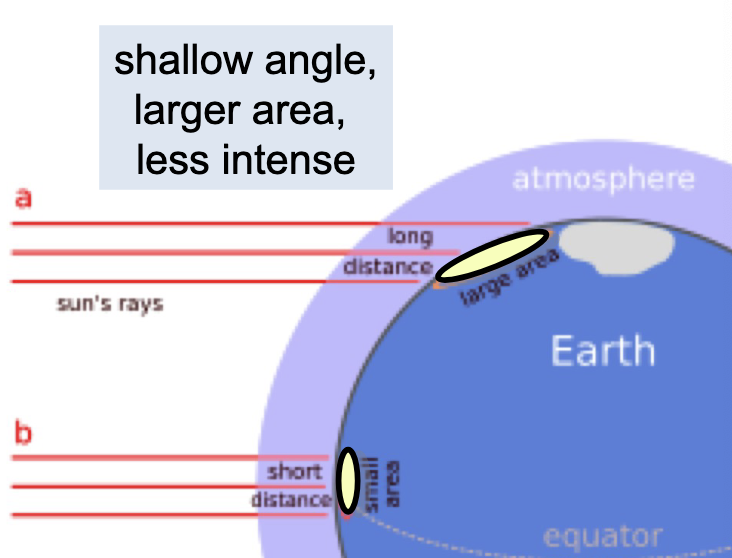
Explain the Seasonal Variation in temperature
Explained through Earth’s tilt and rotation around the sun. During summer solstice, the north pole is pointed towards the sun, while during winter its pointed away so we get less sun.
Explain the Diurnal Variation in temperature
Driven by Earth’s rotation, the amount and angle of sunlight hitting the surfaces changes daily.
What are the consequences of Air Circulation cells and what are they?
The cells are patterns in air circulation. The consequence is that over the equator, warm air rise and absorb moisture which condenses and create rain thus creating the tropics. While the air that decends at 30* latitude is dry and absorbs moisture which creates dry deserts.

What is Macroclimate
the prevailing weather conditions of a region over a long period of time (the climate of a region). It can be overridden by things like elevation.
What is Microclimate?
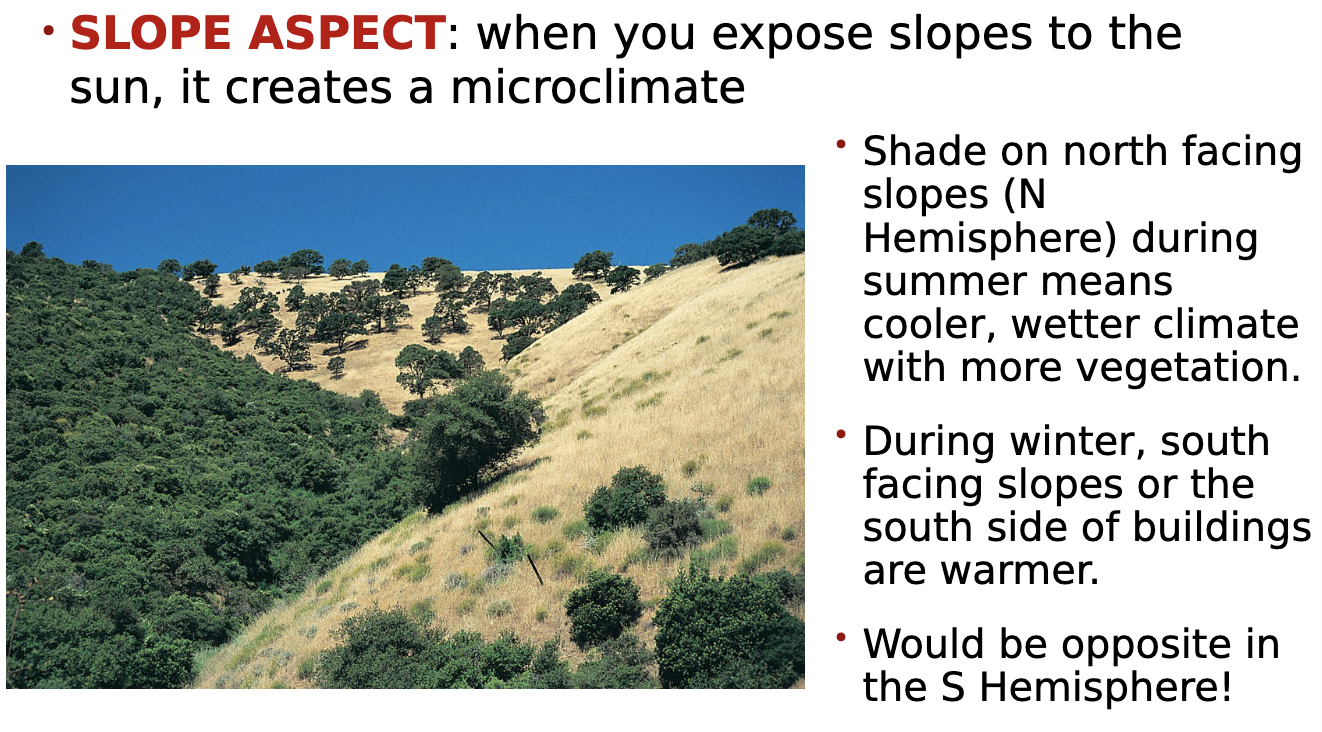
smaller areas that differ in temperature and/or moisture than the prevailing climate; caused by factors such as distinctive substrate, location or aspect.
Give one example of Microclimate
What is a Biome?
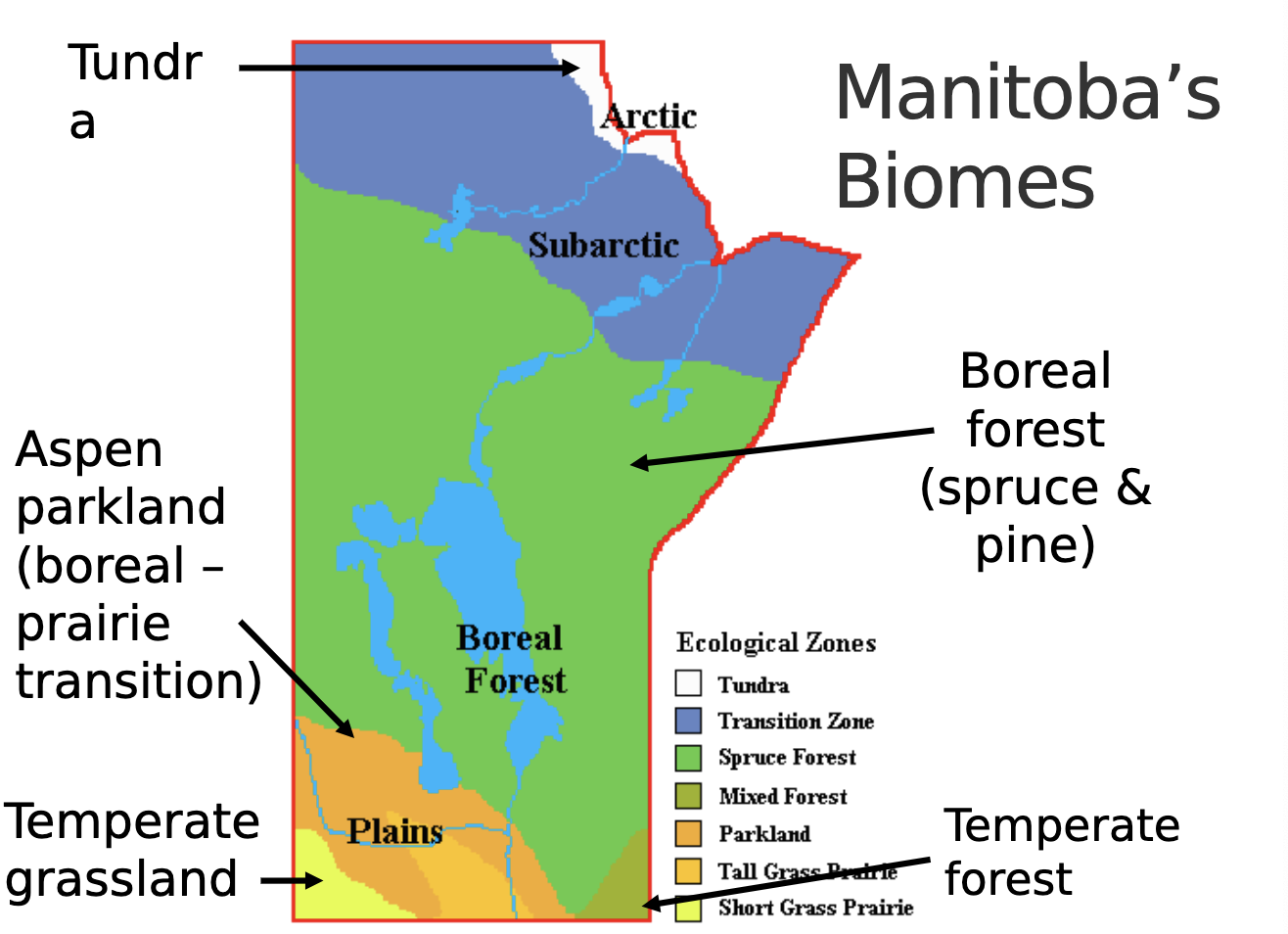
Biological communities that are similar in form and are associated with geographic variation in temperature and precipitation.
What are some world biomes represented in Manitoba?
Tundra
Boreal Forest (taiga)
Temperate Grassland
Temperate Forest
Compare two biomes of Manitoba based on their climate, soils, and species composition
Examples: Tundra and Boreal
Tundra: Covers land north of arctic circle, that has a cool and dry climate. It’s soil consist of permafrost (frozen soil) and their surface soil is soggy in summer. Contains many herbaceous vegetation
Boreal: Covers the northern hemisphere, with long cold winters for climate. It has thin acidic soils and dominated by frost-tolerant conifers.
How can biomes can be used to set conservation goals?
Understanding and identifying biomes in a region. Knowing the biome can show what are threatened and set protection goals.
What are some benefits with Nature connecting with our well-being?

Connect research done that connects Nature and Well-being
Phytoncides released by trees increases Natural Killer cell functions in humans
Nature experience reduces rumination
Spending at least 120 minutes a week in nature is associated with Good Health and Well-being
Where can you find water?
Air, water bodies, Ice, underground, Organisms
Illustrate how Earth’s water is distributed

What are the three properties of water and how they facilitate life?

What is Specific heat capacity?
Water has a high specific heat capacity meaning that it requires 4x the heat energy required by air per unit mass to increase in temperature by 1. Outcome is that water bodies resist changes in temperature
Contrast the variation in average monthly temperatures between coastal and continental climates
In Coastal Cities: Air near water bodies is humid. Transfer of heat between water and air (cools air during summer, vice versa for winter)
In Continental cities: More temperature variation yearly for continental than oceanic cities.
Describe variables that contribute to stratification in aquatic environments
Light (available light)
Temperature (warm water rises)
Oxygen (levels differ per level)
Salinity and other nutrients (affects water density)
Water movement (mixing of water/current)
What is Thermocline?
Zone through which temperature changes rapidly resulting in thermal stratification
Explain Seasonal Turnover in freshwater lakes
Summer: lakes become stratified, warm water at top, cold water at bottom.
Fall/Spring: temp and wind-driven mixing of water distributes nutrients and oxygen
Winter: lake become stratified again, but this time warm water at bottom and cold water at top
What is Nutrient cycling?
the USE, TRANSFORMATION, MOVEMENT and REUSE of nutrients in ecosystems. Particularly CARBON, NITROGEN, and Phosphorus
What are the main function of Nitrogen?
core components of proteins (amino acids) and DNA (nitrogenous bases)
Explain the Nitrogen Cycle:
Step 1: Nitrogen Fixation: Atmospheric nitrogen (N2) is converted by nitrogen-fixing bacteria in the soil or in root nodules of legumes.
Step 2: Ammonification occurs: converts organic nitrogen in the soil into inorganic ammonia (NH3)
Step 3: Nitrification occurs: converts ammonium (NH4+) intro nitrate (NO3-)
Step 4: Fates of nitrate (NO3): Either nitrates plant uptake or leaching: nitrates are not held in soil and is lost in water
What are the main biological function of Phosphorus?
Makes up fundamental components of: ATP, DNA, RNA, cell membranes
What are some NON-symbiotic N2 fixing organisms?
Free-living soil bacteria like Clostridium (anaerobic)
Other soil bacteria like Cyanobacteria
What are some Symbiotic N2 fixing organisms?
Require plant/animal hosts:
Rhizobium (bacteria) in leguminous plants
Frankia (actinobacteria) in non-leguminous plants
Contrast the main sources of Nitrogen and Phosphorus
Nitrogen: mostly in the atmosphere and soil through bacterial fixation
Phosphorus: 11th most abundant in the Earth’s crust, slowly released through weathering of sedimentary rocks
What is Eutrophication? Describe the link with Phosphorus using ELA examples
Enrichment of a water body with excess nutrients. An ELA example would be Lake 226 where phosphorus, among with carbon and nitrogen, were the cause for algae blooms

What were Darwin’s FOUR Postulates? Give examples
Four postulates for Natural Selection to occur:
Variation in phenotypic traits (ex. different beak sizes in Finches or diff colours of flower petals)
Some of the variation in traits is inherited (parental genes are inherited, half from both parents)
Differential survival (ex. different size of beaks in finches determine what seeds they’ll eat)
Survival and reproduction is not random (based on available resources and favourable conditions like seeds and weather)
What is Natural selection?
the mechanism which acts on a range of phenotypic traits of individuals
What is Adaptation?
one potential outcome of evolution, provides increased ability of an individual to survive or reproduce (increased fitness)
What is Evolution?
Defined as a change in the frequency of genes in the population
Genotype vs. Phenotype

What is Phenotypic Plasticity?

What are the mechanisms of Temperature regulation?
Ectotherm: relies primarily on external sources to regulate their temperature
Endotherm: relies heavily on metabolic production of heat to warm tissues
Relate temperature regulation with Poikilotherm and Homeotherm
Poikilotherm: variable body temperature
Homeotherm: stable body temperature
How do Ectotherms vs. Endotherms respond to temperature?
Ectotherms: Avoid freezing by moving under ground or under water. They contain Freeze Tolerance
Endotherms: relies on metabolism for heat, and insulation such as fur, feathers, or fat
what is Homeostatic Mechanism?
maintains temperature at “-set-point” through negative feedback
What is Heat budget and the elements for it?
Heat budget: balancing heat gain and loss
Heat (total) = Hm (metabolic heat) ± Hcd (conduction) ± Hcv (Convection) ± Hr (radiation) - He (evaporation)
Hm= is only for Endotherms
What is the Thermoneutral Zone?
TNZ = The range of external temp. over which the metabolic rate of an endothermic animal does not change (while maintaining its “set-point”)
How do endotherms react to Highs and Lows of TNZ
They react to thermoneutral zone by:
Hot: sweat, pant, evaporative heat loss
Cold: shiver, metabolize energy stores
What are THREE adaptations to COLD?
Larger body size are better at conserving heat
Physical (insulation: fur, far, or feathers) and behavioural adaptions (huddle)
Hibernation/Torpor location: nest under snow or ground.
What is Torpor?
animal allows body temp (and metabolic rate) to drop to a lower set point (response to cold and saves energy)
What is Acclimation?
Physiological adjustment to environment that occurs within lifespan of an individual (usually reversible)
What is VPD?
Vapour Pressure Deficit: difference (deficit) between the amount of moisture in the air and how much moisture the air can hold when it is saturated
What is osmotic pressure?
the tendency of water to flow from an area with a higher concentration of water to an area with a lower concentration of water
What does evaporation depend on?
depends on temperature and water content of air
Describe the take in and take out of water in Plants
Lose: secretions (like nectar), gain: by drinking (roots), transpiration: (evaporation)

Describe the take in and take out of water in Animals
Lose: evaporation (skin permeability, respiration)
Gain: water from drinking or food
Lose: secretions

What are some Plant adaptations to conserve water in Arid climates?
Fewer stomata (they open stomatas at nigh to reduce water lose)
C4 and CAM photosynthesis
Thick leaves : lowers water loss and less SA
What are some Animal adaptations in Arid climates?
Arabian camels have efficient kidneys to allow high concentration of urine. They also allow the body temperature to cycle (day/night)
90% of water used by kangaroo rat is metabolic water (product of oxidation of food molecules).
Define Primary Production
Also known as NPP (Net primary production), it is the use of energy to create organic material. Such as photosynthesis using solar energy to make sugar

What are some variables that regulate primary production?
Light intensity
Temperature
Water
Nutrients
What are the forms of Photosynthesis?
C3 Pathway
C4 Pathway
CAM Pathway (CAM= Crassulacean acid metabolism)
What is C3 pathway?
The most common and simplest, but wasteful of water. Stomata opens during the day and uses carbon assimilation and light one cell at a time.
What is C4 pathway
Stomata doesn’t remain open for too long, and carbon assimilation is quicker. Carbon fixation in separate cell than light-dependent reaction
What is CAM pathway?
Stomata opens at night, closed during the day. It has a temporal separation: carbon assimilation at night and light-dependent reaction during the day (in the same cell)
Which is the most effective form of photosynthesis based on the use of water?

What are some challenges that Herbivores face?
Limited Nitrogen: needed for amino acids and nucleic acids (DNA) and plants are low in Nitrogen.
Cell walls made of cellulose: animals cannot digest cellulose.
Chemical defence from plants
Physical defence from plants
What are some solutions to the challenges that Herbivores face?
Limited Nitrogen: needed for amino acids and nucleic acids (DNA) and plants are low in Nitrogen.
Picky eating (like eating different parts of a plant that contains more nitrogen)
Cell walls made of cellulose: animals cannot digest cellulose.
Symbiotic microorganisms in gut that digest cellulose
Chemical defence from plants
More picky eating like eating a variety of plants to reduce buildup of toxins
What are some challenges and solutions that Carnivores face?
Some prey are too large for Carnivores
Solution: eat smaller preys
Prey behaviours affect predator success
Carnivores evolve to accomodate their defense
What are Detritivores?
organisms who consume dead plant or animal matter (detritus) or waste. “scavengers”
What are Decomposers?
Organisms who break complex organic matter through enzymatic action (they do not consume the waste)