Marketing Key Concepts
 Call Kai
 Learn
 Practice Test
 Spaced Repetition
 Match
 Flashcards
 Knowt Play
1/13

There's no tags or description
Looks like no tags are added yet.
14 Terms
Consumer Decision Process
Need recognition - functional & psychological
Information search - internal & external
Alternative evaluation - attribute sets, evaluative criteria, consumer decision rules
Purchase - up conversion rate
Post purchase - customer satisfaction, post-purchase dissonance, customer loyalty
Difference between functional & psychological needs
Draw a diagram of attribute sets - defining each part

Evaluative criteria consists of:
a set of important attributes (determinant attributes) for a particular solution
Determinant attributes are
Product features that are important to the buyer. Features on which competing brands or stores are perceived to differ.
Internal vs External search for information:
Internal - Consumer refers to their own memories and knowledge
External - Consumer refers to friends, family, salespeople and commercial exposure
Factors affecting consumer search processes:
Perceived value - perceived benefits vs perceived costs
Locus of control - Internal and External
Internal - more search activities
External - fate, external factors
Actual or perceived risk - Performance, Financial, Social, Physiological and Psychological
Post-purchase outcomes
Customer satisfaction - state that indicates products and services supplied by a company meet or surpass customer expectation
Post-purchase dissonance - customer questions appropriateness of their purchase
Customer loyalty - combination of purchasing behaviour and attitude (liking the brand)
Reasons for post-purchase dissonance & how minimise
Expensive
Infrequently purchased
Does not work as intended
Associated with high levels of risk
Warranties & guarantee help minimise
Consumer decision rules
Criteria that consumers use to quickly select between from among several alternatives
Compensatory decision rule - trade one product characteristic against another
(comparing weight of the important attributes - choose best overall score from multi-attribute model)
Non-compensatory rule - make a choice on the basis of one characteristic, regardless of the others
(one single determinant attribute - choose best of one specific category [e.g. price] from multi-attribute model)
Table based on elaboration likelihood model (high vs low involvement)
| High involvement | Low Involvement |
Attention | Greater | Less |
Processing | Deeper | Peripheral |
Result | Develops strong attitudes and purchasing intentions | Generates weak attitudes and increased use of cues |
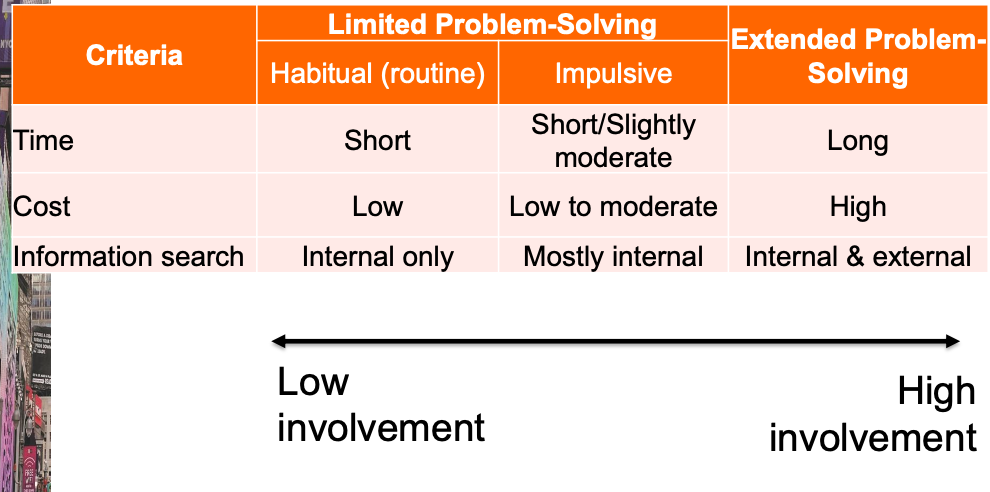
Types of buying decisions
Extended Problem-solving (consumer use when more interested)
Limited problem solving - habitual decision-making and impulse buying
(use when less involved)
Types of buying decisions ranked on low to high involvement
factors that affect consumer decision process
