Module 3 Conditioning and Learning
 Call Kai
 Learn
 Practice Test
 Spaced Repetition
 Match
 Flashcards
 Knowt Play
1/20

There's no tags or description
Looks like no tags are added yet.
21 Terms
Cerebellum: classical conditioing/ motor learning—stages
Acquisition: learning of conditioned response
—Cerebellum
Extinction: gradual weakening and disappearance of conditioned response, if the association between CS and US no longer occurs , NOT FORGETTING,
—Dentate Gryrus
Spontaneous Recovery, response can relapse w passage of time
—ex relapse in addiction
—Dentate Gyrus
Extinction and extinguished association + what makes CS effective again
A conditioned association can be extinguished
by breaking the association between stimuli:
CSCR conditioned reflex:
– Present the CS alone repeatedly.
– With repetition CS becomes less effective,
similar to the beginning of training
Stress, new context, or passage of time can make the CS effective again!
– This suggests that the classically conditioned memory persists even after extinction
Garcia Koelling study
BRIGHT NOISY WATER EXPERIMENT 1966
—Study of the effects of radiation
Licking a spout not only delivered a saccharin solution but also activated a flashing light and a loud clicker. During exposure to this “tasty/bright- noisy water,” the rats were irradiated.
—Rats were getting sick and learned to drink less, which indicated classical conditioning… which of the stimuli were they conditioned to? (the light?, the sound?, the flavor?
GK Pairings
When tone + light + taste paired with x-ray, only taste provokes CR
When tone + light + taste paired with shock, only tone+light provoke CR
In nature, tastes go with getting sick, sounds with getting hurt
Rescorla-Wagner Model of CC
Model proposes:
CC Is about learning the predictive value of different stimuli. (prediction/anticipation model)
• It also proposes that errors of prediction drive learning
—organisms try to anticipate events from stimuli around them
RW values
Each stimulus has a weight (V) for predicting a US.
– Weights can go from 0 (no expectation) to 100 (certain).
– A neutral stimulus has no expectations (Vs = 0).
• The sum of the stimulus weights is the animal’s prediction.
Cerebellum: Anatomy—DCN
DCN= deep cerebellar nuclei, primary output of the cerebellum
DCN neurons project to
—spinal cord, via relays in brainstem
—cerebral cortex, via relays in the thalamus
Cerebellar Peduncles
nerve tracts that connect the cerebellum to the brainstem and the rest of the brain
How many layers does cerebellar cortex have?
3 LAYERS
2 main cell types: Granule cells and Purkinje cells, and 4 sets of axons
-also contains a parallel fiber, mossy fiber
Function of granule cells and purkinje cells
granule: small, densely packed, are most numerous cell type in the brain
—axons called parallel fibers branch in the form of a T in the molecular layer
Purkinje cells: characterized by wo-dimensional flattened dendritic trees
Cerebellum: US and CS pathways
US: input pathway is in the climbing fiber, which originates from the inferior olivary nucleus in the medulla from brainstem
CS: input pathway is from the neocortex, spinal cord, vestibular nuclei
—sensory info processed from various brain regions
Cerebellum: US and CS pathways pt 2
US input path: climbing fiber → purkinje → deep nuclei
—responsible for innate reflexes unconditioned)
CS input pathway: mossy f. → granule cell → parallel f. → purkinje → deep nuclei
—responsible for learned reflexes (conditioned)
Cerebellum: Error Correction Mechs/LTD
Climbing fiber activity can induce LTD in
parallel fiber to Purkinje synapses
• This mechanism is thought to help sort out
predictive and non-predictive stimuli,
disregarding non-predictive ones when
errors are made
Cerebellum role for motor learning
Most active for fine adjustments to the way action is performed ie fine hand movements and balance
—in this type of motor tasks, “error signals” used in cerebellar circuits to eliminate unwanted/excess movement
damage to cerebellum leads to..
1) Deficits in motor learning: hard to acquire/refine/adapt motor skills via practice
2) Ataxia: cannot perform rapid alternating movements, movement tremors (intention tremor), staggering, wide based walking (ataxic gait), slurred speech, abnormal eye movements
Ataxia: term for group of disorders which affect motor coordination, balance, and speech
Basal ganglia: Learning/Operant Cond.
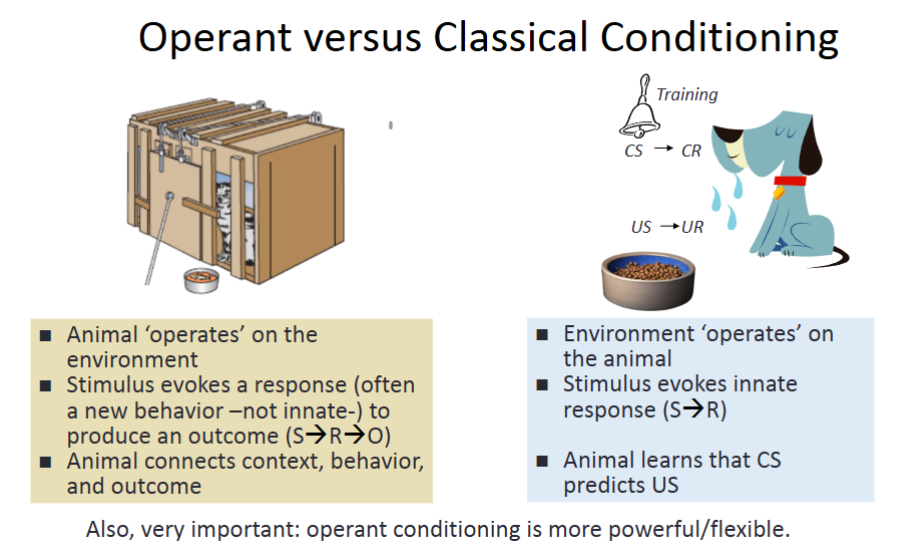
Classical Cond.= association between environmental stimulus and innate responses
Operant Cond.= association between a behavior and its consequences (instrumental)
—process where organisms learn new behaviors to obtain/avoid certain outcomes
—1st studied by Thorndike, studied how cats learned to escape from puzzle boxes
—OC mmore powerful/flexible
CC vs OC cont (visual)
Types of OC
Reinforcement: increases likelihood response will occur
Punishment: decreases likelihood response will occur
Positive: something is given to animal
Negative: something is taken from animal
Positive Reinforcement= press lever, get food
negative Reinforcement= press lever, end shock
positive punishment= press lever, get shocked
negative punishment= press lever, food stops
Schedules of Reinforcement + resposne rates: FI and VI
Fixed Interval: reinforcement after fixed amt of time. responses can increase as the time for reinforcement approaches, leading to scalloped pattern
—Ex, paychecks every 2 weeks
—lower overall response rates, individuals may engage in behavior right before reinforcement
Variable interval: reinforcements after varying amounts of time, schedule produces more consistent responses as the time for reinforcement is unpredictable
—Ex, checking emails, random pop quizzes for regular study habits
—Moderate response rates, indivis are aware since checking doesn’t increase likelihood of rewards
Schedules of Reinforcement + response rates: FR and VR
Fixed Ratio: reinforcement after a specific number of responses, goal oriented rather than based on passage of time, produces high/consistent response rates
—Ex, getting prize after every 3 books read, encourages to read mor frequently
—good to establish behaviors but should transition to variable schedules over time to maintain behavior and prevent dependency on rewards
Variable ratio: reinforcement after unpredictable # of responses, leads to high/resilient response rates due to uncertainty of reward.
—Ex. slot machines
—can lead to overuse/ persistance/compulsive behaviors
Shaping Strats for Reinforcement
shaping: gradual process of reinforcement in which behaviors that are progressively closer to the target behavior are reinforced, enabling the learner to acquire complex behaviors through incremental steps
-involves reinforcing small steps toward desried behavior
-trainer needs to accurately identify/reinforce each successive approximation to avoid reinforcing wrong behaviors