Conversions and Constants
 Call Kai
 Learn
 Practice Test
 Spaced Repetition
 Match
 Flashcards
 Knowt Play
1/84

Earn XP
Description and Tags
85 Terms
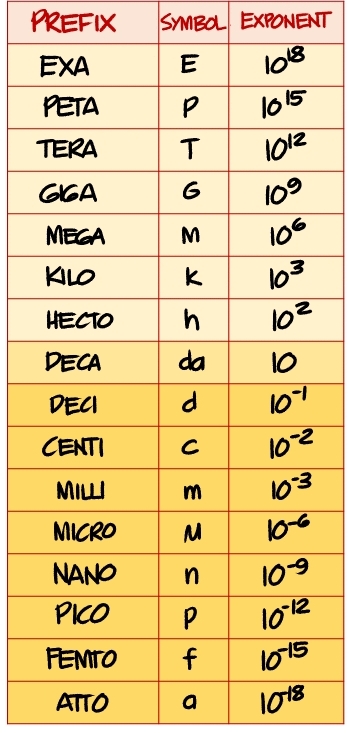
Numerical Prefixes, Symbols, and Exponents:
Volume: Quart = Pints
1 Quart = 2 Pints
Volume: US Gallon = Liters = Quarts
1 US Gallon = 3.785 Liters = 4 Quarts
Volume: Brit. Gallon = in³
1 Brit. Gallon = 277.42 in³
Volume: ft³ = US Gallon
1 ft³ = 7.48 US Gallons
Volume: Barrel (bbl) = Gallons
1 Barrel (bbl) = 42 Gallons
Volume: Ganta = Liters = Chupas
1 Ganta = 3 Liters = 8 Chupas
Volume: Cavan = Gantas
1 Cavan = 25 Gantas
Mass: Tonne = Metric Ton = kg
1 Tonne = 1 Metric Ton = 1000 kg
Mass: Short Ton = lbsm
1 Short Ton = 2000 lbsm
Mass: Long Ton = lbsm
1 Long Ton = 2240 lbsm
Mass: kg = lbs
1 kg = 2.2 lbs
Mass: lbs = oz
1 lbs = 16 oz
Mass: slug = lbsm
1 slug = 32.2 lbsm
Temperature: °C to °F
°F = 1.8C + 32
Temperature: °F to °C
°C = (F - 32)/1.8
Temperature: °F to R
R = °F + 460
Temperature: °C + K
K = °C + 273
Temperature: ∆Tc = ∆Tf
∆Tf = 1.8∆Tc
Temperature: Tk, Tc, Tr, Tf
∆Tk = ∆Tc
∆Tr = ∆Tf
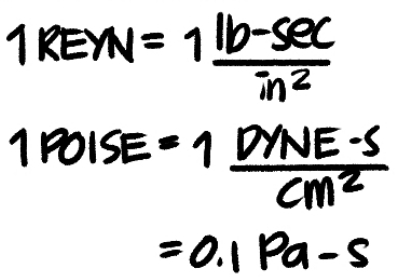
Viscosity: Absolute
1 reyn = 1 lb-sec/in²
1 poise = 1 dyne-s/cm² = 0.1 Pa-s
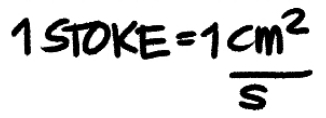
Viscosity: Kinematic
1 Stoke = 1 cm²/s
Density/Concentration: kg/L, lb/ft3, ppm, mg/L, mg/kg
1 kg/L = 62.4 lb/ft3
1 ppm = 1 mg/L = 1 mg/kg
Force: N = dynes, kgf = N, lbf = N
1 N = 100,000 dynes
1 kgf = 9.81 N
1 lbf = 4.448 N
Pressure:
1 atm = 101.325 kPa = 14.7 psi = 760 mmHg = 29.92 inHg = 1.032 kg/cm2 = 760 torr
1 bar = 100 kPa
Energy: BTU, ft-lb, cal, J
1 BTU = 778 ft-lb = 252 cal = 1055 J
Energy: kcal = J
1 kcal = 4.187 J
Energy: J = erg
1 J = 107 erg
Energy: erg = dyne-cm
1 erg = 1 dyne-cm
Energy: Centrigrade heat unit = BTU
1 CHU = 1.8 BTU
Energy: ev = J
1 ev = 1.602×10⁻¹⁹ J
Power: HP = kW = lb-ft/s = lb-ft/min = BTU/hr = BTU/min = MHP
1 HP = 0.746 kW = 550 lb-ft/s = 33,000 lb-ft/min = 2545 BTU/hr = 42.4 BTU/min = 1.014 MHP
Power: Boiler HP = kJ/hr
1 Boiler HP = 35,322 kJ/hr
Power: TOR = kW = BTU/hr
1 TOR = 3.516 kW = 12,000 BTU/hr
Power: Metric HP = kW
1 MHP = 0.736 kW
Area: acre = furlong x chain = ft x ft
1 acre = 1 furlong x 1 chain = 660 ft x 66 ft
Area: are = m2
1 are = 100 m2
Area: hectare = m2
1 hectare = 10,000 m2
Angles: rev = rad = ° = grad = gons = mils
1 rev = 2π rad = 360° = 400 grad = 400 gons = 6400 mils
Distance, Speed, Acceleration: statute mile = ft
1 statute mile = 5280 ft
Distance, Speed, Acceleration: nautical mile = ft
1 nautical mile = 6080 ft
Distance, Speed, Acceleration: league = nautical miles
1 league = 3 nautical miles
Distance, Speed, Acceleration: yard = ft
1 yard = 3 ft
Distance, Speed, Acceleration: m = ft
1 m = 3.281 ft
Distance, Speed, Acceleration: ft = in
1 ft = 12 in
Distance, Speed, Acceleration: in = cm
1 in = 2.54 cm
Distance, Speed, Acceleration: rod = yards
1 rod = 5.5 yards
Distance, Speed, Acceleration: furlong = yards
1 furlong = 220 yards
Distance, Speed, Acceleration: cable length = ft
1 cable length = 720 ft
Distance, Speed, Acceleration: fathom = ft
1 fathom = 6 ft
Distance, Speed, Acceleration: chain = ft
1 chain = 66 ft
Distance, Speed, Acceleration: furlong = ft
1 furlong = 660 ft
Distance, Speed, Acceleration: span = in
1 span = 9 in
Distance, Speed, Acceleration: light year = m
1 light year = 9.46×10¹² m
Distance, Speed, Acceleration: knot = nautical mile/hr
1 knot = 1 nautical mile/hr
Distance, Speed, Acceleration: m/s = kph
1 m/s = 3.6 kph
Distance, Speed, Acceleration: m/s2 = ft/s2
9.81 m/s2 = 32.2 ft/s2
Gas Laws: R̄
R̄ = 8.3143 J/mol.K = 1545 lbf-ft/lbm.mol.R = 0.0821 L-atm/mol-K
Gas Laws: R
R = 0.287 kJ/kmol.K = 53.35 lb-ft/lbm.R
Acceleration due to Gravity (g). This is the standard acceleration of an object falling freely near the Earth's surface.
g = 9.81 m/s2
Avogadro’s Constant (NA). The number of atoms or molecules in one mole of a substance. It bridges the gap between the micro-world (atoms) and the macro-world (grams).
NA = 6.022×10²³ mol-1
Stefan-Boltzmann Constant (σ). Used in thermodynamics to calculate the power radiated by a black body (an ideal object that absorbs all radiation).
σ = 5.67×10⁻⁸ W/m2k4
Speed of Light in a vacuum (c). It is the universal speed limit for matter and energy.
c = 3×10⁸ m/s
Planck’s Constant (h). A fundamental value in quantum mechanics that relates the energy of a photon to its frequency.
h = 6.626×10⁻³⁴ J.s
Universal Gravitational Constant (G). It governs the gravitational force between any two masses in the universe.
G = 6.664×10⁻¹¹ Nm2/kg2
Solar Constant. The average amount of solar electromagnetic radiation (power) per unit area that reaches the outer atmosphere of Earth. This is crucial for solar energy calculations.
Solar Constant = 1353 W/m2
Radius of Earth
RE = 6.38×10⁶ m
Escape Velocity. The speed an object (like a rocket) needs to travel to break free from Earth's gravitational field without further propulsion.
Vel. to escape Earth = 11.2 km/s
Sensible Heat Load. This is an engineering estimate often used in HVAC design. It represents the amount of heat a sedentary person adds to a room, which engineers must account for when designing air conditioning systems to keep a building cool.
Human Heat = 225 BTU/hr
Properties of Air/Gases: Cp
Cp = 1 kJ/kg.K = 0.24 BTU/lb.R
Properties of Air/Gases: Cv
Cv = 0.7186 kJ/kg.K = 0.1714 BTU/lb.R
Properties of Air/Gases: k
k = 1.4 = 1.3 (hot)
Properties of Air/Gases: k of Gases
He, noble gases = 1.667
Carbon Dioxide (CO2) = 1.287
Nitrogen (N2) = 1.399
Properties of Air/Gases: molecular weight
H = 1
He = 4
C = 12
N = 14
O = 16
S = 32
Air = 28.97
Properties of H2O/Liquids: Cpw
Cpw = 4.187 kJ/kg.K = 1 BTU/lb.R
Properties of H2O/Liquids: Cpice
Cpice = ½ of Cpw
Properties of H2O/Liquids: latent heat of fusion of ice
Lf = 334 kJ/kg = 144 BTU/lb = 80 kcal/kg
Properties of H2O/Liquids: latent heat of vaporization
Lv = 2257 kJ/kg = 970 BTU/lb = 540 kcal/kg
Properties of H2O/Liquids: surface tension
@ 0°C = 0.076 N/m
@ 100°C = 0.59 N/m
Properties of H2O/Liquids: SG
SGhg = 13.6
SGsea = 1.03
Young's Modulus/Modulus of Elasticity. This measures the stiffness of the steel. It tells you how much the material will stretch or compress under a given load. A higher E means the material is stiffer and deforms less.
E = 30×106 psi = 210 GPa
Shear Modulus/Modulus of Rigidity. This measures the steel's resistance to shearing or twisting (torsion). It is related to Young's Modulus E via Poisson's ratio.
G = 12×106 = 83 GPa
Coefficient of Thermal Expansion. This tells you how much the steel will expand or contract with temperature changes. For every degree of temperature increase, the steel expands by this fraction of its length.
𝛼 = 11.7×10⁻⁶/°C = 6.5×10⁻⁶/°F
Density. The mass per unit volume. This is used to calculate the dead weight of steel structures.
ρ = 7850 kg/m3 = 490 lb/ft3