R2-M1 and M2
 Call Kai
 Learn
 Practice Test
 Spaced Repetition
 Match
 Flashcards
 Knowt Play
1/23

There's no tags or description
Looks like no tags are added yet.
24 Terms






Choice "B" is correct. The taxpayer has a $4,500 long-term capital gain. The basis of property acquired as a gift is the same as the basis in the hands of the donor, which is $4,500 in this situation. The donor's holding period of one year also rolls over. The total holding period is more than one year, so the gain recognized is long-term.
Sales price | $9,000 |
Rollover cost basis | (4,500) |
Long-term capital gain | $4,500 |
Choice "A" is incorrect. $1,000 would be the amount of the gain if the $8,000 fair market value at the date of gift is used as the donor's basis. The taxpayer's basis in the gifted property is the donor's rollover cost basis of $4,500, not the fair market value at the date of gift. The donor's holding period of one year also rolls over. The total holding period is more than one year, so the gain recognized is long-term.
Choice "C" is incorrect. The amount of the gain is $4,500, but the gain is long-term, not short-term. The taxpayer's basis in the gifted property is the donor's rollover cost basis, so the donor's holding period of one year also rolls over. The total holding period is more than one year, so the gain recognized is long-term.
Choice "D" is incorrect. $1,000 would be the amount of the gain if the $8,000 fair market value at the date of gift is used as the donor's basis. The taxpayer's basis in the gifted property is the donor's rollover cost basis of $4,500, not the fair market value at the date of gift. Although the holding period would be short-term if the fair market value at the date of gift is used as the basis, in this case the taxpayer's basis in the gifted property is the donor's rollover cost basis so the donor's holding period also rolls over so the gain recognized is long-term.

Choice "A" is correct. The fair market value (FMV) of the stock at the time of the gift was greater than the donor's basis, so the donee-child's tax basis in the gifted property is the rollover cost basis of $120,000.
The stock is held for investment, so it is a capital asset, and the gain or loss on the disposition of the stock is a capital gain or loss. Since the donee's tax basis is the donor's rollover cost basis, the donor's holding period also rolls over. The donee's holding period for the stock is two and a half years (2 years + 6 months), so the capital gain or loss is long term.
Sales price | $110,000 |
Tax basis | (120,000) |
Long-term capital loss | ($10,000) |
Choice "B" is incorrect. The capital loss would be $15,000 if the $125,000 FMV of the stock at the date of gift was incorrectly used as the donee's basis ($110,000 sales price – $125,000 tax basis = $15,000 loss). Since the FMV of the stock at the date of gift is greater than the donor's basis, the donee's tax basis in the gifted property is the rollover cost basis of $120,000. The donee's holding period for the gifted property is long term because the donor's holding period rolls over along with the donor's cost basis.
Choice "C" is incorrect. The capital loss would be $15,000 if the $125,000 FMV of the stock at the date of gift was incorrectly used as the donee's basis ($110,000 sales price – $125,000 tax basis = $15,000 loss). Since the FMV of the stock at the date of the gift is greater than the donor's basis, the donee's tax basis in the gifted property is the rollover cost basis of $120,000. The donee's holding period for the gifted property is long term, not short term, because the donor's holding period rolls over along with the donor's cost basis.
Choice "D" is incorrect. The amount of the loss is $10,000, but it is a long-term capital loss, not a short-term capital loss, because the donee-seller's holding period includes the two years that the stock was held by the donor.


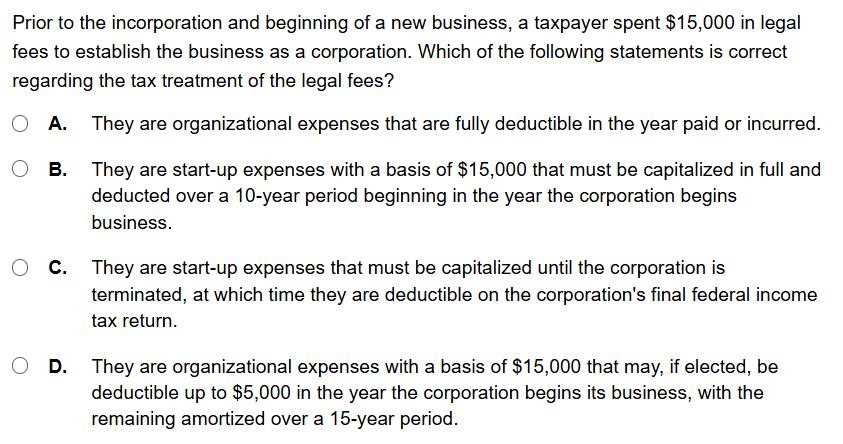

Choice "C" is correct. The amortizable start-up expenditures total $23,000:
Advertising for business opening | $7,000 |
Cost of analysis of potential markets | 4,000 |
Training of employees | 12,000 |
Total start-up costs | $23,000 |
The costs of issuing stock and interest on corporate loans are not included in start-up expenses. The costs of issuing stock are not deductible. The interest on corporate loans is separately deductible as a regular business expense.
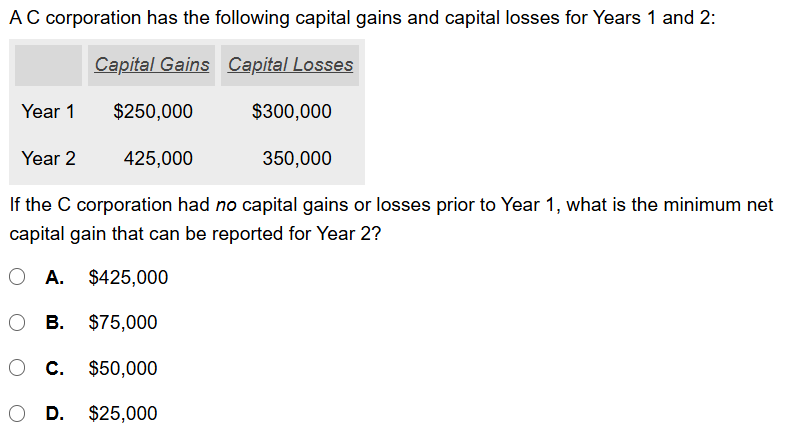
Choice "D" is correct. The minimum net capital gain reported for Year 2 is $25,000.
For C corporations, capital gains can only offset capital losses. A net capital loss can be carried back three years and forward five years to offset net capital gains in other years.
Year 1 capital gains | $250,000 |
Year 1 capital losses | (300,000) |
Year 1 net capital loss | (50,000) |
The facts provide that the C corporation had no capital gains or losses prior to Year 1, so the Year 1 net capital loss is carried forward to Year 2.
Year 2 capital gains | $425,000 |
Year 2 capital losses | (350,000) |
Year 2 net capital gain | 75,000 |
Year 1 capital loss carryforward | (50,000) |
Year 2 taxable net capital gain | 25,000 |
Choice "A" is incorrect. $425,000 is the amount of the Year 2 capital gains before deduction of Year 2 capital losses and the Year 1 net capital loss carryforward.
Choice "B" is incorrect. $75,000 is the Year 2 net capital gain before deduction of the Year 1 net capital loss carryforward.
Choice "C" is incorrect. $50,000 is the amount of the net capital loss carryforward from Year 1.
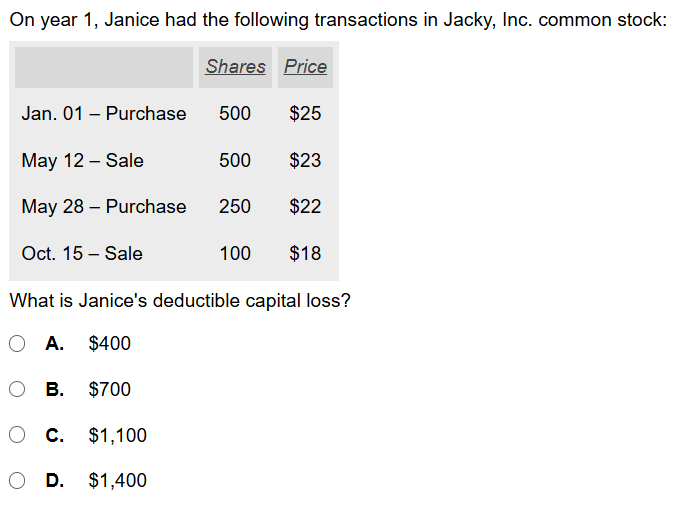
Choice "C" is correct. The wash sale rules apply to 250 shares that were sold on May 12, because they were repurchased within 30 days of the sale. The computation of Janice's total deductible capital loss is as follows:
May 12 sale of 250 shares that were not repurchased within 30 days: | |||||
250 shares × sale price of $23/share | 5,750 | ||||
250 shares × purchase price of $25/share | (6,250) | ||||
Loss on May 12 sale | 500 | ||||
October 15 sale of 100 shares: | |||||
100 shares × sale price of $18/share | 1,800 | ||||
100 shares × basis of $24/share* | (2,400) | ||||
Loss on October 15 sale | 600 | ||||
Total deductible capital loss | 1,100 | ||||
* The basis of these shares includes the purchase price of $22/share plus the loss of $2/share (sale price of $23/share less purchase price of $25/share) that was disallowed because of application of the loss disallowance rules.
Choices "A", "B", and "D" are incorrect per the explanation abov

Choice "B" is correct. The sale of Alpha Corp. stock on June 10 is a wash sale. The stock was sold at a loss ($10 sales price – $18 purchase price on May 15) and identical stock was purchased within 30 days before or after the June 10 sale date (June 1). Deduction of the $8,000 loss on the wash sale is disallowed [($10 sales price − $18 purchase price) × 1,000 shares]. The disallowed loss is added to the cost basis of the repurchased stock: $12 purchase price × 1,000 shares = $12,000 + $8,000 disallowed loss = $20,000 basis of repurchased stock.
Choice "A" is incorrect. $8,000 is the amount of the June 10 wash sale loss. Deduction of the wash sale loss is disallowed because identical stock was purchased within 30 days before or after the June 10 sale date (June 1).
Choice "C" is incorrect. $2,000 is the difference between the June 10 sales proceeds ($10 × 1,000 shares) and the June 1 stock purchase ($12 × 1,000 shares). The facts state that the 1,000 shares sold June 10 were purchased May 15, not June 1.
Choice "D" is incorrect. The taxpayer cannot deduct any loss for the sale of the stock because it is a disallowed wash sale loss.