Module 1 - experiments and diagrams
 Call Kai
 Learn
 Practice Test
 Spaced Repetition
 Match
 Flashcards
 Knowt Play
1/28

There's no tags or description
Looks like no tags are added yet.
29 Terms
Owls - computational level desc
sound waves reaching each ear need to be convented in representation that indicates where sound is coming from
goal: calculate difference in timing and loudness of sound detected at each ear
Owls - algorithmic level desc
Owls need to convert sound → location
Delay lines: Parallel Pathways - one starting at right ear be one at left
|
⬇
Coincidence detectors: circuits light up iff both inputs receiving signal at same time
|
Ex: sound from right side of Owl: reaches right ear Ist and travels down right delay line
Bc came from right ear travels further down the right delay line → coincidence detector lights up and senses this → spatiality mapped in the brain.
Owls - implementational level desc
Parts in brain used to convert sound → location
combines pair of delay lines w coinidence detector right ear Ist
- Activation passes @ fixed rate
- Coincidence detectors identify when signals cross
- Location encoded where cd activated
all parts need to be combined for entire thing to make sense

Karen Stromsworld
PET study
using functional microimaging to show how ppl process lang
Brain activation at different levels of complexity
2 sentences tested
1- The juice that the child spilled__stained the rug
2 - the child spilled juice that__stained the rug
Can be broken down to 2 sentences
The child spilled juice. The juice stained the rug.
Kaan & Swaab (2002)
Lesions in Broca’s area are not sufficient or necessary to induce syntactic deficits
Just because you have lesions in Broca’s area does not mean there will be syntactic deficits
Hard to localize & not perfect relationship
People get damage there & are fine, ppl have damage in other areas with effect
Kaan & Swaab (2002) study
Syntactic constructions that Broca’s aphasics
Comprehension not perfect
Have trouble understanding | Understand OK |
Passives - The boy was chased ____ by the girl … Object relatives - The boy who the girl chased ____ … Object clefts - It was the boy who the girl chased ____. | Actives - The girl chased the boy Subject relatives - The girl who___ chased the boy Subject clefts - It was the girl who____chased the boy |
Comparing simple and complex sentences
Underlying assumption: complex sentences require additional operations (reconstructing the canonical word order)
Karen Stromsworld results
Results:
On average ppl find sentence 1 harder to process than sentence 2
Longer reaction time
Center-embedded sentence shows greater activation in pars opercularis than right branching sentences
What does this tell us?
The part of brain
Understands hierarchy in brain
More time
More discrete operations

brain hemispheres

classical model
Spoken word:
1. Primary auditory cortex
where sound is processed
2. Wernicke’s Area
Comprehension of words
3. Arcuate fasciculus
Other type of aphasia - conduction aphasia - perfectly comprehend and produce sentences clearly - can say gist of sentence but not repeat it verbatim
4. Broca’s Area
Formulate response
5. Primary motor cortex
Send to BA6 - motor gestures of speech
criticisms of classical model
Criticisms of the classic model
Over-simplified model for language.
Areas in model not associated only with given functions.
Have other functions besides language
Broca’s area - not inherently motor related - musics and math too
Other areas are involved in language processing as well.
Sequence of words
Production of words
↓ ↑
Convert to representation
Comprehension of words
need some knowledge to do both
brain lobes
frontal
parietal
temporal
occipital

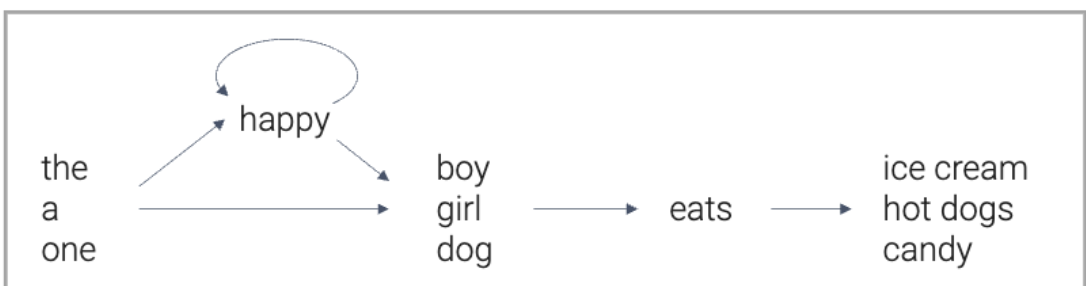
Markov model
linguistic knowledge is the probability that each word follows each other word.
Model seems like it could describe language, produces sequences
Add up probabilities involved 0 sum gives probability of entire sentence
Score
|
linking theories

Hierarchy levels of analysis

Operations as computational descriptions - Ex: Wh questions
In wh- questions, the wh- word appears in a fronted position, but is interpreted in a different position
This is described as a movement process
Does this mean that the mind executes a “move” operation?
Less diversity in language as it seems - Wh question continued
|
classical model
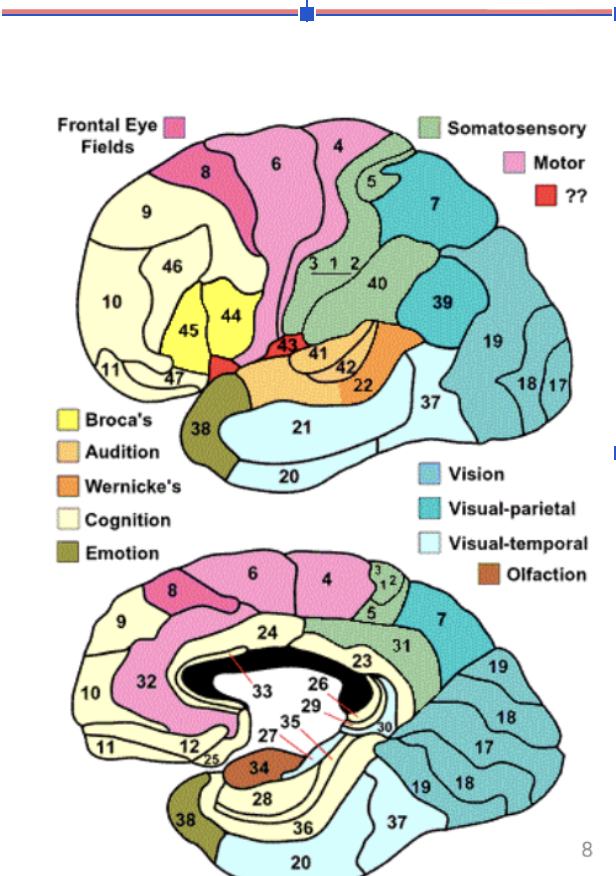
Broadmanns areas
44, 45, 47
6
21, 22
Posterior
areas toward the front
Inferior
areas toward the back
superior/dorsal
- higher areas
inferior/ventral
lower areas
Inferior frontal gyrus - Brocas area
towards the front bottom
the most inferior of the three gyri on the frontal lobe
areas of brain further
left and right sides of brain - lateral areas
areas toward middle of brain - medial areas
2 sides of central sulcus
anterior side - primary motor cortex
Front
sends signals controlling muscles
posterior side - primary somatosensory contex
Back
recieres signals related to touch
Superior temporal gyrus - Wernickes area
towards the side of brain on top
the most superior gyrus on the temporal lobe of the cortex
Deficit Lesion
links brain damage patterns with language
Ex: aphasias and autoposy
Used to only be based on identifiable behavior
Now we have technology - MRI can take image of damaged tissue in vivo
Pros: Earliest brain mapping technique function
Double Dissociations allows causal inferences
researches can infer part of brain carries out certain function
methods
MRI - magnetic resonanse imaging used to create 3D images with high spatial resolution
uses magnets to align water atoms and knock out of alignment
fMRI- measures blood oxygenation changes correlating with neuronal activity
TMS - uses a magnetic field to incite or inhibit activity - see which parts of brain do what buy basically turning it on or off
Simulating and inhibiting brain function
Virtual lesion kinda
DCS-uses electrical current to directly stimulate neuronal activity
Can be used to monitor patients undergoing brain surgery
Very powerful
Methods pt 2
Simulation techniques allow inferences about whether one region is casually related to a particular outcome
fNIR- Measures blood oxygenation using scattered light
PET - measures changes in blood glucose
EEG - scalp electrodes measure electrical currents from cortical neurons
MEG - Mensures megnetic fields generated by cortical regions
ECoG-Measures revronal activity with electrodes implanted in the cortex